Federal climatologists today declared an end to Orange County’s long and damaging drought, reclassifying the region as abnormally dry, the lowest level of concern in a comparatively dry year.
Orange County thus becomes the last area of coastal Southern California to be removed from any of the drought categories that climatologists list on the U.S. Drought Monitor, which is updated weekly.
Friday, February 29, 2008
OC Drought over
From Science Dude:

Wednesday, February 27, 2008
Columbia display

Here at the Flame Trench is the Columbia display that will go on tour.
"The fact that NASA is using, for the very first time, recovered Columbia pieces -- that obviously has real impact when people see it," KSC spokesman Allard Beutel said. "People have had an emotional response."
A cockpit switch panel is displayed behind the glass.
The Columbia crew would have used it to control the fuel drain and purge system on the shuttle's lefthand orbital maneuvering engine, which propelled the spaceship onto its final trajectory.
The Crew Module Side Hatch Pyro-Initiator T-Handle also is displayed. It would have been used to jettison the orbiter's side hatch had the astronauts been able to bail out of the shuttle.
Here is the Florida Today article about the display.
Monday, February 25, 2008
Snow cover biggest since 1966
From National Post here:
AGW fanatics will hate this story. Snow cover is highest since 1966.
Ice melting is also non-existent.
I know that one winter isn't telling us much about the future seasons and AGW. It just proves to me predictions are just that and precipitation is not 100% accurate.
AGW fanatics will hate this story. Snow cover is highest since 1966.
Snow cover over North America and much of Siberia, Mongolia and China is greater than at any time since 1966.
The U.S. National Climatic Data Center (NCDC) reported that many American cities and towns suffered record cold temperatures in January and early February. According to the NCDC, the average temperature in January "was -0.3 F cooler than the 1901-2000 (20th century) average."
China is surviving its most brutal winter in a century. Temperatures in the normally balmy south were so low for so long that some middle-sized cities went days and even weeks without electricity because once power lines had toppled it was too cold or too icy to repair them.
Ice melting is also non-existent.
And remember the Arctic Sea ice? The ice we were told so hysterically last fall had melted to its "lowest levels on record? Never mind that those records only date back as far as 1972 and that there is anthropological and geological evidence of much greater melts in the past.
The ice is back.
Gilles Langis, a senior forecaster with the Canadian Ice Service in Ottawa, says the Arctic winter has been so severe the ice has not only recovered, it is actually 10 to 20 cm thicker in many places than at this time last year.
I know that one winter isn't telling us much about the future seasons and AGW. It just proves to me predictions are just that and precipitation is not 100% accurate.
Friday, February 22, 2008
The Pentagon is tracking the space debris
From My Way News here:
"We have a fireball, and given that there's no fuel (on the tip of the missile), that would indicate that that's a hydrazine fire," he said.
The video showed the three-stage SM-3 missile launching from the USS Lake Erie at 10:26 p.m. EST Wednesday northwest of Hawaii, and of the missile's small "kill vehicle" - a non-explosive device at the tip - maneuvering into the path of the satellite and colliding spectacularly.
Cartwright said the satellite and the kill vehicle collided at a combined speed of 22,000 mph about 130 miles above Earth's surface, and that the collision was confirmed at a space operations center at 10:50 p.m. EST.
The satellite was described as the size of a school bus and weighing about 5,000 pounds.
Thursday, February 21, 2008
Debris from destroyed satellite sighted
 From Bob Christy here.
 by Rob Ratkowski
From Space.com here:
"I'm still having a hard time believing I actually caught the debris, but two others with us also saw a bright dot move fast from what was to be the intercept position," Hawaii-based skywatcher Rob Ratkowski told SPACE.com.
He observed a meteor shower of sorts when, apparently, bits of debris from the broken-up satellite burned up as they fell through Earth's atmosphere. Ratkowski, a professional photographer and astronomy enthusiast, took photos of what he saw from Maui, near where the U.S. Navy ship fired the missile that intercepted the satellite.
It's a hit!
A missile launched from a Navy ship successfully struck a dying U.S. spy satellite passing 130 miles over the Pacific on Wednesday, a defense official said. Full details were not immediately available.
It happened just after 10:30 p.m. EST.
Two officials said the missile was launched successfully. One official, who is close to the process, said it hit the target. He said details on the results were not immediately known.
The goal in this first-of-its-kind mission for the Navy was not just to hit the satellite but to obliterate a tank aboard the spacecraft carrying 1,000 pounds of a toxic fuel called hydrazine.
U.S. officials have said the fuel would pose a potential health hazard to humans if it landed in a populated area. Although the odds of that were small even if the Pentagon had chosen not to try to shoot down the satellite, it was determined that it was worth trying to eliminate even that small chance.
Officials said it might take a day or longer to know for sure if the toxic fuel was blown up.
Friday, February 15, 2008
Satellite will be destroyed on re-entry
 From Reuters
The Greyhound bus-sized intelligence satellite failed shortly after launch in 2006. Intended to conduct both electronic eavesdropping and photographic intelligence-gathering, the satellite contains a large tank of unused toxic fuel called hydrazine. The fuel would pose a health risk if the tank survived re-entry and landed in a populated area. The satellite has been gradually moving closer to the atmosphere and could come down some time in the next several weeks.
Since the satellite cannot be maneuvered to fall into the ocean, the plan calls for firing a modified Navy SM-3 anti-missile interceptor from an Aegis battle management system equipped warship in the northern Pacific, as the satellite nears the atmosphere.
It will be the first time a missile defense interceptor will be used against a satellite, something that has not been attempted since the 1980s, when the Pentagon tested an anti-satellite missile from a jet fighter.
From WaPo here.
Monday, February 11, 2008
Iran's into the mix
Iran plans to launch two more rockets into space
Feb 11 06:46 AM US/Eastern
Iran is to launch two more rockets into space in the next few months, President Mahmoud Ahmadinejad announced on Monday, after a firing of a rocket earlier this month sparked international concern.
"Two other rockets will be launched so that we can then send a satellite into space," Ahmadinejad said at a rally in Tehran broadcast live on state television.
"We home that Iran's first home-produced satellite will be launched in the summer," he added, reiterating a prediction made by other Iranian officials who said the satellite would be launched in May.
On February 4, Iran fired a rocket into space to mark the opening of its first space centre, triggering swift condemnation from the United States amid continued tensions over the Iranian nuclear drive.
Ahmadinejad hailed the launch of the rocket, named Kavoshgar-1, as a success and for the first time gave some technical details about its launch.
Monday, February 04, 2008


Thursday, January 31, 2008
Happy 50th!

My birth happened two weeks after Explorer I was launched. I have been an advocate for space exploration and loved space since my earliest memories.
Fifty years ago today, missile pioneers here thrust the United States into a space race with the Soviet Union, launching America's first "man-made moon."
Ike Rigell and Terry Greenfield peered through tinted green bulletproof glass in a blockhouse at Launch Complex 26 as an Army rocket lit up night skies over the Atlantic coast.
Kelly Fiorentino stood in a Quonset hut on an island in the Bahamas, ready to transmit a second-stage ignition signal — a precisely-timed switch-flip critical to propelling the Explorer 1 satellite into orbit.
And on that frigid Friday night in Huntsville, Ala., Norm Perry and dozens of Army Ballistic Missile Agency workers shivered beneath loudspeakers in a downtown square.
A telltale beep-beep finally blared out about an hour and 45 minutes after launch, signaling mission success. The crowd erupted in cheers.
"We had no idea it was in orbit until it had completely gone around Earth," said Perry, 74, of Titusville. "As soon as it came across, the whole square heard (the beep). We heard it, and we went wild."
With good reason, too.
Four months earlier, on Oct. 4, 1957, the Soviet Union launched Sputnik, the world's first artificial satellite, a 184-pound sphere the size of a medicine ball.
Then less than a month later, on Nov. 3, the Soviets sent up a half-ton orbiter with a living, breathing creature, a dog named Laika.
The American public panicked. The back-to-back Sputniks created hysteria. Fearful people realized Soviet rockets were powerful enough to rain nuclear bombs on U.S. soil. Anytime. Anywhere.
The Spider

From SpaceWeather.COM
Researchers once thought Mercury to be much like Earth's moon, but MESSENGER has found many differences. For instance, unlike the moon, Mercury has huge cliffs with structures snaking hundreds of miles across the planet's face. The spacecraft also revealed impact craters that appear very different from lunar craters. One particularly curious crater has been dubbed "The Spider."
This formation never has been seen on Mercury before and nothing like it has been observed on the moon. It lies in the middle of a huge impact crater called the Caloris basin and consists of more than 100 narrow, flat-floored troughs radiating from a complex central region.
"The Spider has a crater near its center, but whether that crater is related to the original formation or came later is not clear at this time," said James Head, science team co-investigator at Brown University, Providence, R.I.
Wednesday, January 16, 2008
Mercury Rising

Messenger probe has sent its latest here from Flame Trench here:
In yet another NASA first, the robotic Messenger probe beamed back pictures this week of parts of the planet Mercury that never have been seen by spacecraft before.
Soon after sweeping within 124 miles of the planet's surface on Monday, Messenger snapped this photo of half of a hemisphere that was missed by the only other spacecraft to visit Mercury -- Mariner 10, which made three flybys in 1974 and 1975.
Reality Deniers
From Roy Spencer, Climate Scientist over at NRO:
Like we are up s*** creek anyway!
I am astounded by the naiveté of those folks who seem to think there is some magic, non-polluting energy source out there that “Big Oil” has been hiding from us until all of the petroleum runs out. As these reality deniers continue to drive cars and fly in airplanes, they deny the fact that mankind’s dependence on oil is not out of choice, but necessity.
It makes me cringe when I see bloggers and pundits say things like, “What’s the downside of reducing greenhouse-gas emissions? Even if we’re wrong about man-made global warming, we’ll end up with better energy technologies and cleaner air. And if we’re right, we’ll save the planet!”
The only problem is, no matter how serious you think global warming will be, our current renewable-energy technologies and conservation will make virtually no difference to future global temperatures.
Like we are up s*** creek anyway!
Sunday, January 13, 2008
Skeptics are frowned upon
From BBC news last Novemeber 13, 2007here:
As I said above - and this may come as a surprise - scientists are mere mortals.
The tendency to succumb to group-think and the herd-instinct (now formally called the "informational cascade") is perhaps as tempting among scientists as any group because we, by definition, must be the "ones who know" (from the Latin sciere, to know).
You dare not be thought of as "one who does not know"; hence we may succumb to the pressure to be perceived as "one who knows".
This leads, in my opinion, to an overstatement of confidence in the published findings and to a ready acceptance of the views of anointed authorities.
Scepticism, a hallmark of science, is frowned upon. (I suspect the IPCC bureaucracy cringes whenever I'm identified as an IPCC Lead Author.)
The signature statement of the 2007 IPCC report may be paraphrased as this: "We are 90% confident that most of the warming in the past 50 years is due to humans."
We are not told here that this assertion is based on computer model output, not direct observation. The simple fact is we don't have thermometers marked with "this much is human-caused" and "this much is natural".
So, I would have written this conclusion as "Our climate models are incapable of reproducing the last 50 years of surface temperatures without a push from how we think greenhouse gases influence the climate. Other processes may also account for much of this change."
Thursday, January 10, 2008
The asteroid will miss Mars
From Space.com here:
New observations of the Mars-bound Asteroid 2007 WD5 have allowed astronomers to refine their predictions for the space rock's position during its red planet rendezvous on Jan. 30, according an update by NASA's Near-Earth Object (NEO) program office.
"As a result, the impact probability has dropped dramatically, to approximately 0.01 percent or 1-in-10,000 odds, effectively ruling out the possible collision with Mars," researchers said in the Jan. 9 report.
The new odds were released one day after astronomers with NASA's NEO office at the Jet Propulsion Laboratory (JPL) in Pasadena, Calif., lowered 2007 WD5's chances of striking Mars from 3.6 percent to 2.5 percent, or about a 1-in-40 chance, on Tuesday. After analyzing results from a new round of observations between Jan. 5 and Jan. 8, scientists now estimate the asteroid will make its closest pass by Mars at a maximum distance of about 16,155 miles (26,000 km).
Sunday, January 06, 2008
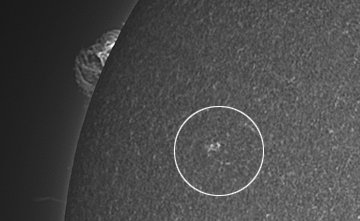
Solar Cycle 24 begins
From NASA.gov here:
Many forecasters believe Solar Cycle 24 will be big and intense. Peaking in 2011 or 2012, the cycle to come could have significant impacts on telecommunications, air traffic, power grids and GPS systems. (And don't forget the Northern Lights!) In this age of satellites and cell phones, the next solar cycle could make itself felt as never before.
The furious storms won't start right away, however. Solar cycles usually take a few years to build to a frenzy and Cycle 24 will be no exception. "We still have some quiet times ahead," says Hathaway.
From SpaceWeather.com here:
Solar physicists have been waiting for the appearance of a reversed-polarity sunspot to signal the start of the next solar cycle. The wait is over. On Jan. 4th, a magnetically reversed sunspot emerged at solar latitude 30 N, shown in this photo taken by Greg Piepol of Rockville, Maryland.
And here's a link to SOLARCYCLE24.COM for all Solar and Auruoa needs! This cycle looks like the peak will be around 2011 to 2012. Funny thing did the Mayan's have any foreknowledge when they ended their calender in 2012? Heh!
Well here is the news release from the Space and Science Research Center here.
Today, the Space and Science Research Center, (SSRC) in Orlando, Florida announces that it has confirmed the recent web announcement of NASA solar physicists that there are substantial changes occurring in the sun’s surface. The SSRC has further researched these changes and has concluded they will bring about the next climate change to one of a long lasting cold era.
Today, Director of the SSRC, John Casey has reaffirmed earlier research he led that independently discovered the sun’s changes are the result of a family of cycles that bring about climate shifts from cold climate to warm and back again.
“We today confirm the recent announcement by NASA that there are historic and important changes taking place on the sun’s surface. This will have only one outcome - a new climate change is coming that will bring an extended period of deep cold to the planet. This is not however a unique event for the planet although it is critically important news to this and the next generations. It is but the normal sequence of alternating climate changes that has been going on for thousands of years.
That about debunks Global Warming huh? Global Warming and Cooling occur in cycles and have "been going on for thousands of years." And the Solar Cycles are part of Climate Change.
UPDATE: I have been informed that SSRC's John Casey could be a fake. After going though the Climate Change blogs the consensus is this is an ad-hoc web site here. I stand corrected. However I still do not agree that global warming is caused by C02 or human made. I don't think the label "denier" is correct either for those who do not agree that the theory of AGW is happening. I still think Solar Cycles do play a part in Global cooling and warming.
Friday, January 04, 2008
One in 28 chance to hit Mars

Now Asteroid 2007WD5 has a one in twenty eight chance to hit Mars. Wow! From Space.com here.
Observations of the asteroid between Dec. 29 and Jan. 2 allowed astronomers to slightly lower the space rock's odds of striking Mars to about 3.6 percent (down from 3.9), giving the object a 1 in 28 chance of hitting the planet, according to Tuesday report from NASA's Near Earth-Object program office at the Jet Propulsion Laboratory in Pasadena, Calif.
More observations may further reduce the asteroid's impact chances to nil, NEO officials said. The space rock's refined course stems from observations by astronomers at New Mexico Tech's Magdalena Ridge Observatory.
But if WD5 does smack into Mars, some astronomers have a fair idea of what havoc it may spawn. The likely strike zone would be near the equator, but to the north of the current position of NASA's Opportunity rover at Victoria Crater, NASA officials have said.
Mark Boslough, a collision dynamics expert at New Mexico's Sandia National Laboratory, said the atmosphere at Mars' surface is similar to that of Earth at an altitude of 12 miles (20 km). Some space rocks that target Earth explode under the pressure created as they stream into our atmosphere. But they tend not to explode until much below the 12-mile mark.
Opportunity will be a in a great place to view the impact on January 30th. More updates as the NEO team updates its observations.
Monday, December 31, 2007
Candidates space policies
From Space.com here.
My concern is NASA should go beyond the low orbit and explore space and the planets. And private enterprise be more involved in the launching of rockets and satellites. Senator Clinton wants NASA to be the Global Warming Climate Change agency. Governor Romney wants to stay with President Bush's Moon-Mars policy. I'll have to do my reading this New Year's on each candidate's Space Policy.
Update: Space Review article is here:
However, Senator Clinton is more short term thinking than the Vision Bush proposed in 2004:
My concern is NASA should go beyond the low orbit and explore space and the planets. And private enterprise be more involved in the launching of rockets and satellites. Senator Clinton wants NASA to be the Global Warming Climate Change agency. Governor Romney wants to stay with President Bush's Moon-Mars policy. I'll have to do my reading this New Year's on each candidate's Space Policy.
Update: Space Review article is here:
The one candidate whose positions on space have received the most attention—and scrutiny—has been Sen. Hillary Clinton. That attention is based in part on her standing as one of the front runners in the Democratic race, but also because she is the one candidate, Democratic or Republican, who has provided any sort of detailed position on what she would do in space policy if elected. Even Dave Weldon, a Republican Congressman from Florida, said earlier this month, “The best person with a space policy—actually, the only candidate with any kind of substantial space policy on their Web site—is Hillary.”
However, Senator Clinton is more short term thinking than the Vision Bush proposed in 2004:
Another question about Clinton’s policy is her support for the Vision for Space Exploration. Her policy does mention support for “later human missions” beyond the completion of the International Space Station, but does not explicitly endorse the goals laid out nearly four years ago by President Bush to return humans to the Moon by 2020 and, later, send humans to Mars. In a New York Times article the day after her speech, Clinton indicated that such goals would be set aside in favor of restoring funding for aeronautics and space policy. Such exploration, she told the Times, “excites people,” but “I am more focused on nearer-term goals I think are achievable.”
Sunday, December 30, 2007
Star Trails
 From SpaceWeather.com
These are star trails--slow, graceful arcs traced by the stars as Earth spins on its axis. "A full 180° rotation of the circumpolar stars can be obtained only at this time of year when the astronomical night lasts more than 12 hours," says photographer Lorenzo Comolli. "I took this all-night picture on Dec. 28-29 using my Canon 350D on a tripod in light polluted Tradate, Italy."
The stubby arc near the center of the swirl is Polaris, also known as "the North Star" because Earth's north pole points almost directly at it. Polaris may be the most famous star in the heavens--but fame is fleeting! Earth's spin axis is precessing and in 10,000 years or so white-hot Vega (six times brighter than Polaris) will take over as North Star. Star trail photos will look even prettier then, with an intense bright dot illuminating the core of the starry whirlpool.
Subscribe to:
Posts (Atom)