Thursday, January 31, 2008

Happy 50th!


My birth happened two weeks after Explorer I was launched. I have been an advocate for space exploration and loved space since my earliest memories.
Fifty years ago today, missile pioneers here thrust the United States into a space race with the Soviet Union, launching America's first "man-made moon."

Ike Rigell and Terry Greenfield peered through tinted green bulletproof glass in a blockhouse at Launch Complex 26 as an Army rocket lit up night skies over the Atlantic coast.


Kelly Fiorentino stood in a Quonset hut on an island in the Bahamas, ready to transmit a second-stage ignition signal — a precisely-timed switch-flip critical to propelling the Explorer 1 satellite into orbit.

And on that frigid Friday night in Huntsville, Ala., Norm Perry and dozens of Army Ballistic Missile Agency workers shivered beneath loudspeakers in a downtown square.

A telltale beep-beep finally blared out about an hour and 45 minutes after launch, signaling mission success. The crowd erupted in cheers.


"We had no idea it was in orbit until it had completely gone around Earth," said Perry, 74, of Titusville. "As soon as it came across, the whole square heard (the beep). We heard it, and we went wild."

With good reason, too.


Four months earlier, on Oct. 4, 1957, the Soviet Union launched Sputnik, the world's first artificial satellite, a 184-pound sphere the size of a medicine ball.

Then less than a month later, on Nov. 3, the Soviets sent up a half-ton orbiter with a living, breathing creature, a dog named Laika.


The American public panicked. The back-to-back Sputniks created hysteria. Fearful people realized Soviet rockets were powerful enough to rain nuclear bombs on U.S. soil. Anytime. Anywhere.

The Spider


From SpaceWeather.COM

Researchers once thought Mercury to be much like Earth's moon, but MESSENGER has found many differences. For instance, unlike the moon, Mercury has huge cliffs with structures snaking hundreds of miles across the planet's face. The spacecraft also revealed impact craters that appear very different from lunar craters. One particularly curious crater has been dubbed "The Spider."


This formation never has been seen on Mercury before and nothing like it has been observed on the moon. It lies in the middle of a huge impact crater called the Caloris basin and consists of more than 100 narrow, flat-floored troughs radiating from a complex central region.

"The Spider has a crater near its center, but whether that crater is related to the original formation or came later is not clear at this time," said James Head, science team co-investigator at Brown University, Providence, R.I.

Wednesday, January 16, 2008

Mercury Rising


Messenger probe has sent its latest here from Flame Trench here:

In yet another NASA first, the robotic Messenger probe beamed back pictures this week of parts of the planet Mercury that never have been seen by spacecraft before.

Soon after sweeping within 124 miles of the planet's surface on Monday, Messenger snapped this photo of half of a hemisphere that was missed by the only other spacecraft to visit Mercury -- Mariner 10, which made three flybys in 1974 and 1975.

Reality Deniers

From Roy Spencer, Climate Scientist over at NRO:
I am astounded by the naiveté of those folks who seem to think there is some magic, non-polluting energy source out there that “Big Oil” has been hiding from us until all of the petroleum runs out. As these reality deniers continue to drive cars and fly in airplanes, they deny the fact that mankind’s dependence on oil is not out of choice, but necessity.

It makes me cringe when I see bloggers and pundits say things like, “What’s the downside of reducing greenhouse-gas emissions? Even if we’re wrong about man-made global warming, we’ll end up with better energy technologies and cleaner air. And if we’re right, we’ll save the planet!”

The only problem is, no matter how serious you think global warming will be, our current renewable-energy technologies and conservation will make virtually no difference to future global temperatures.

Like we are up s*** creek anyway!

Sunday, January 13, 2008

Skeptics are frowned upon

From BBC news last Novemeber 13, 2007here:
As I said above - and this may come as a surprise - scientists are mere mortals.

The tendency to succumb to group-think and the herd-instinct (now formally called the "informational cascade") is perhaps as tempting among scientists as any group because we, by definition, must be the "ones who know" (from the Latin sciere, to know).

You dare not be thought of as "one who does not know"; hence we may succumb to the pressure to be perceived as "one who knows".

This leads, in my opinion, to an overstatement of confidence in the published findings and to a ready acceptance of the views of anointed authorities.

Scepticism, a hallmark of science, is frowned upon. (I suspect the IPCC bureaucracy cringes whenever I'm identified as an IPCC Lead Author.)

The signature statement of the 2007 IPCC report may be paraphrased as this: "We are 90% confident that most of the warming in the past 50 years is due to humans."

We are not told here that this assertion is based on computer model output, not direct observation. The simple fact is we don't have thermometers marked with "this much is human-caused" and "this much is natural".

So, I would have written this conclusion as "Our climate models are incapable of reproducing the last 50 years of surface temperatures without a push from how we think greenhouse gases influence the climate. Other processes may also account for much of this change."

Thursday, January 10, 2008

The asteroid will miss Mars

From Space.com here:
New observations of the Mars-bound Asteroid 2007 WD5 have allowed astronomers to refine their predictions for the space rock's position during its red planet rendezvous on Jan. 30, according an update by NASA's Near-Earth Object (NEO) program office.

"As a result, the impact probability has dropped dramatically, to approximately 0.01 percent or 1-in-10,000 odds, effectively ruling out the possible collision with Mars," researchers said in the Jan. 9 report.

The new odds were released one day after astronomers with NASA's NEO office at the Jet Propulsion Laboratory (JPL) in Pasadena, Calif., lowered 2007 WD5's chances of striking Mars from 3.6 percent to 2.5 percent, or about a 1-in-40 chance, on Tuesday. After analyzing results from a new round of observations between Jan. 5 and Jan. 8, scientists now estimate the asteroid will make its closest pass by Mars at a maximum distance of about 16,155 miles (26,000 km).

Sunday, January 06, 2008

Solar Cycle 24 begins


From NASA.gov here:
Many forecasters believe Solar Cycle 24 will be big and intense. Peaking in 2011 or 2012, the cycle to come could have significant impacts on telecommunications, air traffic, power grids and GPS systems. (And don't forget the Northern Lights!) In this age of satellites and cell phones, the next solar cycle could make itself felt as never before.

The furious storms won't start right away, however. Solar cycles usually take a few years to build to a frenzy and Cycle 24 will be no exception. "We still have some quiet times ahead," says Hathaway.


From SpaceWeather.com here:
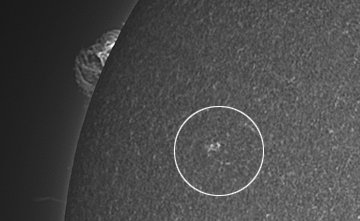
Solar physicists have been waiting for the appearance of a reversed-polarity sunspot to signal the start of the next solar cycle. The wait is over. On Jan. 4th, a magnetically reversed sunspot emerged at solar latitude 30 N, shown in this photo taken by Greg Piepol of Rockville, Maryland.

And here's a link to SOLARCYCLE24.COM for all Solar and Auruoa needs! This cycle looks like the peak will be around 2011 to 2012. Funny thing did the Mayan's have any foreknowledge when they ended their calender in 2012? Heh!


Well here is the news release from the Space and Science Research Center here.

Today, the Space and Science Research Center, (SSRC) in Orlando, Florida announces that it has confirmed the recent web announcement of NASA solar physicists that there are substantial changes occurring in the sun’s surface. The SSRC has further researched these changes and has concluded they will bring about the next climate change to one of a long lasting cold era.

Today, Director of the SSRC, John Casey has reaffirmed earlier research he led that independently discovered the sun’s changes are the result of a family of cycles that bring about climate shifts from cold climate to warm and back again.

“We today confirm the recent announcement by NASA that there are historic and important changes taking place on the sun’s surface. This will have only one outcome - a new climate change is coming that will bring an extended period of deep cold to the planet. This is not however a unique event for the planet although it is critically important news to this and the next generations. It is but the normal sequence of alternating climate changes that has been going on for thousands of years.

That about debunks Global Warming huh? Global Warming and Cooling occur in cycles and have "been going on for thousands of years." And the Solar Cycles are part of Climate Change.


UPDATE: I have been informed that SSRC's John Casey could be a fake. After going though the Climate Change blogs the consensus is this is an ad-hoc web site here. I stand corrected. However I still do not agree that global warming is caused by C02 or human made. I don't think the label "denier" is correct either for those who do not agree that the theory of AGW is happening. I still think Solar Cycles do play a part in Global cooling and warming.

Friday, January 04, 2008

One in 28 chance to hit Mars


Now Asteroid 2007WD5 has a one in twenty eight chance to hit Mars. Wow! From Space.com here.
Observations of the asteroid between Dec. 29 and Jan. 2 allowed astronomers to slightly lower the space rock's odds of striking Mars to about 3.6 percent (down from 3.9), giving the object a 1 in 28 chance of hitting the planet, according to Tuesday report from NASA's Near Earth-Object program office at the Jet Propulsion Laboratory in Pasadena, Calif.

More observations may further reduce the asteroid's impact chances to nil, NEO officials said. The space rock's refined course stems from observations by astronomers at New Mexico Tech's Magdalena Ridge Observatory.

But if WD5 does smack into Mars, some astronomers have a fair idea of what havoc it may spawn. The likely strike zone would be near the equator, but to the north of the current position of NASA's Opportunity rover at Victoria Crater, NASA officials have said.

Mark Boslough, a collision dynamics expert at New Mexico's Sandia National Laboratory, said the atmosphere at Mars' surface is similar to that of Earth at an altitude of 12 miles (20 km). Some space rocks that target Earth explode under the pressure created as they stream into our atmosphere. But they tend not to explode until much below the 12-mile mark.

Opportunity will be a in a great place to view the impact on January 30th. More updates as the NEO team updates its observations.

Monday, December 31, 2007

Candidates space policies

From Space.com here.

My concern is NASA should go beyond the low orbit and explore space and the planets. And private enterprise be more involved in the launching of rockets and satellites. Senator Clinton wants NASA to be the Global Warming Climate Change agency. Governor Romney wants to stay with President Bush's Moon-Mars policy. I'll have to do my reading this New Year's on each candidate's Space Policy.
Update: Space Review article is here:
The one candidate whose positions on space have received the most attention—and scrutiny—has been Sen. Hillary Clinton. That attention is based in part on her standing as one of the front runners in the Democratic race, but also because she is the one candidate, Democratic or Republican, who has provided any sort of detailed position on what she would do in space policy if elected. Even Dave Weldon, a Republican Congressman from Florida, said earlier this month, “The best person with a space policy—actually, the only candidate with any kind of substantial space policy on their Web site—is Hillary.”

However, Senator Clinton is more short term thinking than the Vision Bush proposed in 2004:
Another question about Clinton’s policy is her support for the Vision for Space Exploration. Her policy does mention support for “later human missions” beyond the completion of the International Space Station, but does not explicitly endorse the goals laid out nearly four years ago by President Bush to return humans to the Moon by 2020 and, later, send humans to Mars. In a New York Times article the day after her speech, Clinton indicated that such goals would be set aside in favor of restoring funding for aeronautics and space policy. Such exploration, she told the Times, “excites people,” but “I am more focused on nearer-term goals I think are achievable.”

Sunday, December 30, 2007

Star Trails

From SpaceWeather.com
These are star trails--slow, graceful arcs traced by the stars as Earth spins on its axis. "A full 180° rotation of the circumpolar stars can be obtained only at this time of year when the astronomical night lasts more than 12 hours," says photographer Lorenzo Comolli. "I took this all-night picture on Dec. 28-29 using my Canon 350D on a tripod in light polluted Tradate, Italy."

The stubby arc near the center of the swirl is Polaris, also known as "the North Star" because Earth's north pole points almost directly at it. Polaris may be the most famous star in the heavens--but fame is fleeting! Earth's spin axis is precessing and in 10,000 years or so white-hot Vega (six times brighter than Polaris) will take over as North Star. Star trail photos will look even prettier then, with an intense bright dot illuminating the core of the starry whirlpool.

New Year's Comet

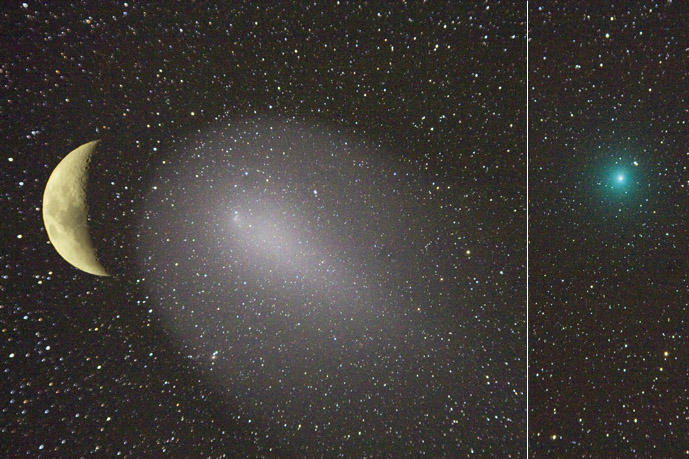
Comet Tuttle From the Photo archive at Comet Tuttle @ SpaceWeather here.

Saturday, December 29, 2007

Shuttle launch will be delayed again

Flame Trench has full converge of the fuel sensors problem with Atlantis's external fuel tank.
After removing foam protection on Friday, technicians were scheduled to remove a suspect connector from Atlantis' external tank today.

The failed connector, which scrubbed launches on Dec. 6 and 9, will be sent away for testing. It provides readings from redundant low-fuel sensors in the bottom of the external tank and instruments that would shut down the shuttle's main engines before the turbopumps ran dry and flew apart.

The Connector has been removed and sent in to be tested. NASA has not announced another launch date yet.

Spirit's Winter Position


Crossing the Winter Finish Line ... for Now

Human explorers would be hard pressed to show more persistence than NASA's Mars rover Spirit. After weeks of careful driving with a broken front wheel, Spirit finally made it to a north-facing slope of "Home Plate."

The rover gradually descended over the north edge to get into position, as shown here, tilting its solar panels 13 degrees toward the sinking winter Sun to maximize power. Rover drivers plan to continue nudging Spirit forward, increasing the tilt, to track the Sun as it moves lower in the northern sky.

Image credit: NASA/JPL-Caltech/Hazard avoidance camera

JPL's float in Rose Parade


JPL will celebrate the 50 years in space with a float in the Rose Parade, January 1, 2008.
"In January 2008 we celebrate the 50th Anniversary of Explorer 1, the first American satellite, which was built at JPL.? This is a historic milestone not only for the Jet Propulsion?Laboratory, Caltech and Pasadena, but for the country," said Charles Elachi, director of?JPL. "I can think of nothing better than kicking off the celebration?with a float in the ultimate New Year's pageant, the Rose Parade." JPL is managed for NASA by the California Institute of Technology in Pasadena.

More at NASA.gov here.


UPDATE 1/6/08: An article about the JPL float here at About Space.com.

Opportunities mission at Victoria Crater

Asteroid to hit Mars?


On January 30, 2008 an asteroid will pass Mars very close. Will it effect the Mars rovers if it hits the planet?
The chance that a rogue mini-world — asteroid 2007 WD5 — will smack into Mars on January 30th has increased from 1.3 percent to 3.9 percent.

That’s the new estimation from officials at the Near Earth Object Program at the Jet Propulsion Laboratory (JPL), stemming from several sky watching teams in Alaska, New Mexico, and in Arizona.
Read more at Live Science here.
The pre-discovery observations were located by Andy Puckett, a recent Ph.D. from the University of Chicago who has since moved to the University of Alaska Anchorage. Dr. Puckett located the observations in the archive of the Sloan Digital Sky Survey II, which contains extensive repeat coverage of 300 square degrees along the sky's celestial equator. The observations were taken using a 2.5 meter aperture telescope at the Apache Point Observatory near Cloudcroft, New Mexico. For the recent orbit refinement, these pre-discovery observations on November 8 were added to the existing observations provided by the Catalina Sky Survey and Spacewatch observatories (both near Tucson AZ) as well as New Mexico Tech's Magdalena Ridge Observatory.

More from NEO JPL page here.

Wednesday, December 26, 2007

Apollo 8 Christmas eve broadcast


From NASA here.
William Anders:

"For all the people on Earth the crew of Apollo 8 has a message we would like to send you".

"In the beginning God created the heaven and the earth.
And the earth was without form, and void; and darkness was upon the face of the deep.
And the Spirit of God moved upon the face of the waters. And God said, Let there be light: and there was light.
And God saw the light, that it was good: and God divided the light from the darkness."

Jim Lovell:

"And God called the light Day, and the darkness he called Night. And the evening and the morning were the first day.
And God said, Let there be a firmament in the midst of the waters, and let it divide the waters from the waters.
And God made the firmament, and divided the waters which were under the firmament from the waters which were above the firmament: and it was so.
And God called the firmament Heaven. And the evening and the morning were the second day."

Frank Borman:

"And God said, Let the waters under the heavens be gathered together unto one place, and let the dry land appear: and it was so.
And God called the dry land Earth; and the gathering together of the waters called he Seas: and God saw that it was good."

Borman then added, "And from the crew of Apollo 8, we close with good night, good luck, a Merry Christmas, and God bless all of you - all of you on the good Earth."

Saturday, December 15, 2007

Mars will be a Christmas Star!


HT from Mars Blog.
Mars is retrograding (moving westward) through the stars of Gemini and will cross over into Taurus on Dec. 30. It will come closest to the Earth on the night of Dec. 18 (around 6:46 p.m. EST). The planet is then 54,783,381 miles (88,165,305 kilometers) from Earth. It is at opposition – exactly opposite from the sun, with Earth in the middle – six days later, on Christmas Eve, Dec. 24.

It will then gleam at magnitude -1.6, and through Jan. 2, 2008, will outshine Sirius, the brightest star.

......
The night that Mars will probably attract the most attention, from even those who don't normally look up at the sky, will be on the night before Christmas Eve: Sunday, Dec. 23. That will be the night of a full moon, and Mars will serve as a companion to it all through that night. In fact, it will result in an exceptionally close approach between the two across much of the United States, while for parts of the Pacific Northwest, southern and western Canada and Europe, the moon will actually occult (hide) Mars.

From Space.com here.

January 10 launch

The shuttle Atlantis launch will be rescheduled for January 10. It will not delay the next flight of Endeavour on February 14Th.
From Flame Trench here:
NASA could still pick up its original 2008 schedule after launching Atlantis on Jan. 10. A five-week turnaround between the launches of Atlantis and Endeavour would make that possible.

"If we launched on the 10th (of January), it does not affect the ability to launch on Feb. 14," said NASA spokesman Kyle Herring.

A Valentine's Day launch of Endeavour will return NASA to the schedule the agency proposed to complete the space station before the shuttle program ends in 2010.

However, if Atlantis' launch is delayed until Jan. 13 or 14, that would force a day for day slip in Endeavour's Valentine's Day mission. Laboratory modules will be delivered on both missions to the International Space Station.

"All of that still fits," said Herring.