Monday, December 31, 2007

Candidates space policies

From Space.com here.

My concern is NASA should go beyond the low orbit and explore space and the planets. And private enterprise be more involved in the launching of rockets and satellites. Senator Clinton wants NASA to be the Global Warming Climate Change agency. Governor Romney wants to stay with President Bush's Moon-Mars policy. I'll have to do my reading this New Year's on each candidate's Space Policy.
Update: Space Review article is here:
The one candidate whose positions on space have received the most attention—and scrutiny—has been Sen. Hillary Clinton. That attention is based in part on her standing as one of the front runners in the Democratic race, but also because she is the one candidate, Democratic or Republican, who has provided any sort of detailed position on what she would do in space policy if elected. Even Dave Weldon, a Republican Congressman from Florida, said earlier this month, “The best person with a space policy—actually, the only candidate with any kind of substantial space policy on their Web site—is Hillary.”

However, Senator Clinton is more short term thinking than the Vision Bush proposed in 2004:
Another question about Clinton’s policy is her support for the Vision for Space Exploration. Her policy does mention support for “later human missions” beyond the completion of the International Space Station, but does not explicitly endorse the goals laid out nearly four years ago by President Bush to return humans to the Moon by 2020 and, later, send humans to Mars. In a New York Times article the day after her speech, Clinton indicated that such goals would be set aside in favor of restoring funding for aeronautics and space policy. Such exploration, she told the Times, “excites people,” but “I am more focused on nearer-term goals I think are achievable.”

Sunday, December 30, 2007

Star Trails

From SpaceWeather.com
These are star trails--slow, graceful arcs traced by the stars as Earth spins on its axis. "A full 180° rotation of the circumpolar stars can be obtained only at this time of year when the astronomical night lasts more than 12 hours," says photographer Lorenzo Comolli. "I took this all-night picture on Dec. 28-29 using my Canon 350D on a tripod in light polluted Tradate, Italy."

The stubby arc near the center of the swirl is Polaris, also known as "the North Star" because Earth's north pole points almost directly at it. Polaris may be the most famous star in the heavens--but fame is fleeting! Earth's spin axis is precessing and in 10,000 years or so white-hot Vega (six times brighter than Polaris) will take over as North Star. Star trail photos will look even prettier then, with an intense bright dot illuminating the core of the starry whirlpool.

New Year's Comet

Comet Tuttle From the Photo archive at Comet Tuttle @ SpaceWeather here.

Saturday, December 29, 2007

Shuttle launch will be delayed again

Flame Trench has full converge of the fuel sensors problem with Atlantis's external fuel tank.
After removing foam protection on Friday, technicians were scheduled to remove a suspect connector from Atlantis' external tank today.

The failed connector, which scrubbed launches on Dec. 6 and 9, will be sent away for testing. It provides readings from redundant low-fuel sensors in the bottom of the external tank and instruments that would shut down the shuttle's main engines before the turbopumps ran dry and flew apart.

The Connector has been removed and sent in to be tested. NASA has not announced another launch date yet.

Spirit's Winter Position


Crossing the Winter Finish Line ... for Now

Human explorers would be hard pressed to show more persistence than NASA's Mars rover Spirit. After weeks of careful driving with a broken front wheel, Spirit finally made it to a north-facing slope of "Home Plate."

The rover gradually descended over the north edge to get into position, as shown here, tilting its solar panels 13 degrees toward the sinking winter Sun to maximize power. Rover drivers plan to continue nudging Spirit forward, increasing the tilt, to track the Sun as it moves lower in the northern sky.

Image credit: NASA/JPL-Caltech/Hazard avoidance camera

JPL's float in Rose Parade


JPL will celebrate the 50 years in space with a float in the Rose Parade, January 1, 2008.
"In January 2008 we celebrate the 50th Anniversary of Explorer 1, the first American satellite, which was built at JPL.? This is a historic milestone not only for the Jet Propulsion?Laboratory, Caltech and Pasadena, but for the country," said Charles Elachi, director of?JPL. "I can think of nothing better than kicking off the celebration?with a float in the ultimate New Year's pageant, the Rose Parade." JPL is managed for NASA by the California Institute of Technology in Pasadena.

More at NASA.gov here.


UPDATE 1/6/08: An article about the JPL float here at About Space.com.

Opportunities mission at Victoria Crater

Asteroid to hit Mars?


On January 30, 2008 an asteroid will pass Mars very close. Will it effect the Mars rovers if it hits the planet?
The chance that a rogue mini-world — asteroid 2007 WD5 — will smack into Mars on January 30th has increased from 1.3 percent to 3.9 percent.

That’s the new estimation from officials at the Near Earth Object Program at the Jet Propulsion Laboratory (JPL), stemming from several sky watching teams in Alaska, New Mexico, and in Arizona.
Read more at Live Science here.
The pre-discovery observations were located by Andy Puckett, a recent Ph.D. from the University of Chicago who has since moved to the University of Alaska Anchorage. Dr. Puckett located the observations in the archive of the Sloan Digital Sky Survey II, which contains extensive repeat coverage of 300 square degrees along the sky's celestial equator. The observations were taken using a 2.5 meter aperture telescope at the Apache Point Observatory near Cloudcroft, New Mexico. For the recent orbit refinement, these pre-discovery observations on November 8 were added to the existing observations provided by the Catalina Sky Survey and Spacewatch observatories (both near Tucson AZ) as well as New Mexico Tech's Magdalena Ridge Observatory.

More from NEO JPL page here.

Wednesday, December 26, 2007

Apollo 8 Christmas eve broadcast


From NASA here.
William Anders:

"For all the people on Earth the crew of Apollo 8 has a message we would like to send you".

"In the beginning God created the heaven and the earth.
And the earth was without form, and void; and darkness was upon the face of the deep.
And the Spirit of God moved upon the face of the waters. And God said, Let there be light: and there was light.
And God saw the light, that it was good: and God divided the light from the darkness."

Jim Lovell:

"And God called the light Day, and the darkness he called Night. And the evening and the morning were the first day.
And God said, Let there be a firmament in the midst of the waters, and let it divide the waters from the waters.
And God made the firmament, and divided the waters which were under the firmament from the waters which were above the firmament: and it was so.
And God called the firmament Heaven. And the evening and the morning were the second day."

Frank Borman:

"And God said, Let the waters under the heavens be gathered together unto one place, and let the dry land appear: and it was so.
And God called the dry land Earth; and the gathering together of the waters called he Seas: and God saw that it was good."

Borman then added, "And from the crew of Apollo 8, we close with good night, good luck, a Merry Christmas, and God bless all of you - all of you on the good Earth."

Saturday, December 15, 2007

Mars will be a Christmas Star!


HT from Mars Blog.
Mars is retrograding (moving westward) through the stars of Gemini and will cross over into Taurus on Dec. 30. It will come closest to the Earth on the night of Dec. 18 (around 6:46 p.m. EST). The planet is then 54,783,381 miles (88,165,305 kilometers) from Earth. It is at opposition – exactly opposite from the sun, with Earth in the middle – six days later, on Christmas Eve, Dec. 24.

It will then gleam at magnitude -1.6, and through Jan. 2, 2008, will outshine Sirius, the brightest star.

......
The night that Mars will probably attract the most attention, from even those who don't normally look up at the sky, will be on the night before Christmas Eve: Sunday, Dec. 23. That will be the night of a full moon, and Mars will serve as a companion to it all through that night. In fact, it will result in an exceptionally close approach between the two across much of the United States, while for parts of the Pacific Northwest, southern and western Canada and Europe, the moon will actually occult (hide) Mars.

From Space.com here.

January 10 launch

The shuttle Atlantis launch will be rescheduled for January 10. It will not delay the next flight of Endeavour on February 14Th.
From Flame Trench here:
NASA could still pick up its original 2008 schedule after launching Atlantis on Jan. 10. A five-week turnaround between the launches of Atlantis and Endeavour would make that possible.

"If we launched on the 10th (of January), it does not affect the ability to launch on Feb. 14," said NASA spokesman Kyle Herring.

A Valentine's Day launch of Endeavour will return NASA to the schedule the agency proposed to complete the space station before the shuttle program ends in 2010.

However, if Atlantis' launch is delayed until Jan. 13 or 14, that would force a day for day slip in Endeavour's Valentine's Day mission. Laboratory modules will be delivered on both missions to the International Space Station.

"All of that still fits," said Herring.

Wednesday, November 21, 2007

Thanksgiving greeting from Space


"We wanted to say happy Thanksgiving to all our NASA viewers,"
Expedition 16 Commander Peggy Whitson, an Iowa native, said. "We feel particularly privileged and thankful to be up here on board the International Space Station this Thanksgiving, and we're looking forward to our activities this week. We have a busy week with spacewalks, and we hope that you also are having a great
Thanksgiving."

"My family, we gather for Thanksgiving, and we spend a minute just thinking about the things we're thankful for and, of course, I'm thankful for the continued health of my family and my loved ones," Flight Engineer DanTani, an Illinois native, said. "Also this year,I'm thankful that I'm safely on the space station, conducting our
mission successfully and having a great time doing it."


Update: Here's an article from Space Review on the Women commanders meeting in space.
Perhaps the greatest tribute to shuttle commander Pam Melroy and station commander Peggy Whitson, and to their ground-breaking (perhaps we should say space-breaking?) predecessors such as Sally Ride, Kathy Sullivan, Shannon Lucid, Eileen Collins, and three dozen others, is that an examination of their technical credentials—their education, experience, and career achievements—couldn’t give a clue as to their gender. Their ultimate “firsts” were logical step-by-step progressions from their solid professional competence.

Tuesday, November 20, 2007

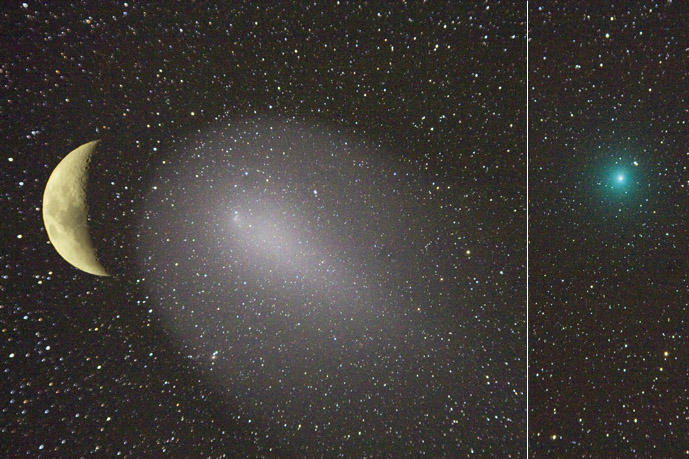
Comet Holmes

From Hubble site here.

Hubble first observed Comet 17P/Holmes on June 15, 1999, when there was virtually no dusty shroud around the nucleus. From that observation, astronomers deduced that the nucleus had a diameter of approximately 2.1 miles (3.4 kilometers), about the length of New York City's Central Park. Astronomers hope to use the new Hubble images to determine the size of the comet's nucleus to see how much of it was blasted away during the outburst.

Hubble's two earlier snapshots of Comet Holmes also showed some interesting features. On Oct. 29, the telescope spied three "spurs" of dust emanating from the nucleus, while the Hubble images taken on Oct. 31 revealed an outburst of dust just west of the nucleus.

The Hubble images, however, do not show any large fragments near the nucleus of Comet Holmes, unlike the case of Comet 73P/Schwassmann-Wachmann 3 (SW3). In the spring of 2006 Hubble observations revealed a multitude of "mini-comets" ejected by SW3 after the comet increased dramatically in brightness.

Ground-based images of Comet Holmes show a large, spherically symmetrical cloud of dust that is offset from the nucleus, suggesting that a large fragment did break off and subsequently disintegrated into tiny dust particles after moving away from the main nucleus.
From NASA here.

Harmony's hooked up


From CNN here.

Commander Peggy Whitson and Daniel Tani spent hours hooking up power and heater cables and fluid lines between the space station and the Harmony compartment that was delivered by the shuttle last month. It was tedious, hand-intensive work.

"Yay! Got it," Whitson exclaimed after making a particularly difficult connection. "Those were hard."

Not long afterward, Tani commented on how strong Whitson looked.

"She's the king of the world," Tani shouted. "Queen," replied the space station's first female skipper, sparking laughter between the two.

Wednesday, November 14, 2007

Smelling smoke in a suit

Late last week a Russian astronaut trainee, working at Johnson Space Center, smelled smoke in his spacesuit and felt heat on his neck during a test in a pressure chamber.

NASA feels the problem will be cleared up and is examining CO2 scrub cans, which have not functioned properly in the past, said NASA spokesman Lynette Madison at Johnson Space Center.

"There is no evidence of a combustion source," said Madison. "They feel like this is going to be cleared up and there won't be any issue for the spacewalks." Late today, Mission Control radioed to tell the crew they expect to clear the spacesuits soon.

From Flame Trench here.

A fire in a spacesuit would be fatal to the astronaut. The Oxygen would ignite and instantly kill the occupant of the spacesuit.

Monday, November 12, 2007

Delta IV Heavy


I watched the launch Saturday night. It took half a minute to clear the launch pad. Great night launch. HT Florida Today.

The payload:

Weighing 5,200 pounds, the DSP-23 satellite completed a 6 hour, 20 minute mission and was deployed into its proper orbit at 3:10 a.m., today. The DSP-23 launch completes the deployment of this important constellation of satellites. DSP satellites provide early warning for intercontinental ballistic missile launches and have been used by the military for more than 30 years.

The United Launch Alliance site is here.

Wednesday, November 07, 2007

Ready Houston, here we come!


Discovery is getting ready for re-entry burn. Weather is clear enough at KSC to land. I will be live blogging as much as I can.

Discovery will be coming over British Columbia, Flying over the heartland of America! And landing at KSC.

-- 9:00 AM PST Good Burn No trim required

-- 9:30 AM PST Discovery is near atmosphere re-entry. It's about a half hour to touch down at the cape.
Discovery is beginning to encounter the effects of the atmosphere, a point called "entry interface." Now flying at about 16,000 miles per hour, the orbiter is angled upward with wings level. The shuttle is set to touch down in just over 30 minutes.
HT from NASA Landing Blog here.

-- 9:36 AM PST Discovery is closing in on the coast of Canada. They will be the first to hear the double sonic booms.
What causes the booms?
Air pressure. As the shuttle cuts through the atmosphere flying faster than the speed of sound, air molecules get pushed aisde (like water around a fast-moving boat). The air molecules form a shock wave around the nose and the tail of an aircraft. The rapidly increasing air pressure can be heard as a loud boom.

Why two sonic booms?
The space shuttle is big for a supersonic aircraft. A typical aircraft capable of this kind of speed would be a fighter jet, something about 50 feet or so long. For those small fighters, the shock waves generated at the nose and the tail of the aircraft happen less than one-tenth of a second apart. On the ground, people would hear what sounds like one boom. The orbiter is 122 feet long. The time between the nose and tail shock waves is half of a second, just long enough for us to hear both of the booms.
HT from Flame Trench here
-- 9:40 AM PST Right over Montana. 22 minutes to Florida coast!
-- 9:42 AM PST Right over Nebraska with 18 minutes to go to landing.
-- 9:44 AM PST Right over Kansas TODO! 16 minutes to go.
-- 9:46 AM PST Right over Missuiori with 14 minutes to go.
-- 9:47 AM PST Right over Mississippi and Alabama! 13 minutes to go.
-- 9:49 AM PST Right over Alabama toward Georgia. Florida here we come! 12 Minutes.
-- 9:50 AM PST Merrius Island tracking station has Discovery on site. Less then 11 minutes to go. GPS and tracking a-go.
-- 10:01 AM PST TOUCH DOWN! Great landing! Photos of banking and landing were fantastic! Good Job Pam!

15 days in space

Were did the time go? This mission was a great accomplishment in space. The space walk to repair the solar wings was phenomenal. Placing an astronaut on a boom then extending the station arm as far as it could reach. The station commander was worried it would not reach the proper place to fix it. But with a hockey stick in one hand ( to avoid electrocution) and home made cuff links (materials found on the ISS) in the other the repair was done. Well done!

I wish I could have spend more time space blogging on the mission but my life has been busy with kids, getting the flu and cars breaking down, etc. But I did keep an eye on Space Trench and NASA TV. It was a wonderful mission getting the ISS fitted to Harmony and ready for other modules to come.