Thursday, October 26, 2006

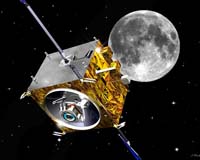
STEREO launched yesterday


NASA'S FIRST 3-D SOLAR IMAGING MISSION SOARS INTO SPACE

NASA's twin Solar Terrestrial Relations Observatories mission, known
as STEREO, successfully launched Wednesday at 8:52 p.m. EDT from Cape
Canaveral Air Force Station, Fla.

STEREO's nearly identical twin, golf cart-sized spacecraft will make
observations to help researchers construct the first-ever
three-dimensional views of the sun. The images will show the star's
stormy environment and its effects on the inner solar system, vital
data for understanding how the sun creates space weather.

STEREO website is here.

Tuesday, October 17, 2006

Loma Prieta Earthquake 17 years ago

I remember standing in line at Longs Drug in Ventura 17 years ago when I felt the ground sway back and forth. Good article on BBC on a Look back here.
On Tuesday, October 17, 1989 at 5:04 p.m. Pacific Daylight Time, a magnitude 7.1 earthquake occurred on the San Andreas fault 10 miles northeast of Santa Cruz. This earthquake was the largest earthquake to occur in the San Francisco Bay area since 1906, and the largest anywhere in California since 1952. The earthquake was responsible for 67 deaths and about 7 billion dollars worth of damage, making it the biggest dollar loss natural disaster in United States history. This article describes the seismological features of the earthquake, and briefly outlines a number of other geologic observations made during study of the earthquake, its aftershocks, and its effects. Much of the information in this article was provided by the U. S. Geological Survey (USGS).

Shuttle delays

The Shuttle launch planned for the beginning of the year will be delayed. The manufacturing of the external tanks have been effected by good ol' hurricane Katrina from last year.
NASA will likely delay by as much as a month some space shuttle launches scheduled for next year because of a backlog in processing the shuttles' external fuel tanks, an agency spokesman said Monday.

If approved, the revised schedule would push back the first launch of 2007 to March 16 from February 22; the launch of space shuttle Endeavour to June 28 from June 11; and the launch of Atlantis to September 7 from August 9. Two other flights carrying international space station parts constructed by the European and Japanese space agencies still are scheduled for later in 2007.

In the three years since the Columbia disaster, NASA's efforts to get the external fuel tanks ready for launch have been confounded by design changes and Hurricane Katrina, which damaged the tank assembly plant in New Orleans last year.

"The effects of Katrina are still being felt somewhat," NASA spokesman Kyle Herring said. "Getting back on track with the tank is obviously the biggest challenge there."

Monday, October 16, 2006

Hawaii shaking up

My parents live in Hilo and I havn't heard from them yet. Phones were busy when I tried to call. Here is the USGS Map of the 6.6 here.
Like most Hawaiian earthquakes, the temblor was related to the volcanic activity that built the Hawaiian Islands as the top of undersea mountains sprouting from the deep ocean. This quake happened when accumulated weight of layers of cooled magma became too heavy for the earth's crust to hold — so it simply gave way.

"Volcanoes grow over time," said Harley Benz of the U.S. Geological Survey. "They become so massive just the sheer weight of the volcano, of the solid rock that's been built up over thousands and millions of years, alone will cause earthquakes."


Good thing no one was killed in the quake. I'll hopefully get in touch with my parents today.

Thursday, October 12, 2006

Give me a break!

Nurmeburg type Hearings for Us Non-Global Warming believers? GMAB Please!
Gore and Moyers have not yet commented on Grist's advocacy of prosecuting skeptics of global warming with a Nuremberg-style war crimes trial. Gore has used the phrase "global warming deniers" to describe scientists and others who don't share his view of the Earth's climate. It remains to be seen what Gore and Moyers will have to say about proposals to make skepticism a crime comparable to Holocaust atrocities.

Those who disbelieve will be tried for Crimes against the Global Warming Deniers! Let the court be held in the Hauge. Let Bill Hansen be the head Judge and the prosicuter will be Bill Clinton! Oh! Just a bad dream.
Rush and William Gray will be tried for sure.

Monday, October 09, 2006

NoKo nuke Test

From all the clamor this morning about the nuke test in North Korea, it was only about 550 tons. The Russians said it was like Hiroshima at 15,000 tons. Capt. Ed has more here.

Right now, it looks like the North Koreans failed. The seismic activity shows a much smaller explosion than anyone would have predicted. The White House won't even confirm a nuclear test has taken place with the evidence at hand; in fact, only the Russians have confirmed the event as a nuclear test. American officials told the AP that it looks like "more fizzle than pop", given that its force only amounts to 1/30th of Hiroshima. In fact, with a yield that small, it's questionable whether it could possibly have been a nuclear explosion.


I agree with Capt. that this is a fizzle. I'm glad President Bush did not call it an actual "Nuke" test. We need more information and I hope something is done about it.

Friday, October 06, 2006

Ad Astra article by OCSS

Larry Evans our OCSS president has an article on our August activity with the NASA Vision for Space Exploration trailer display here.
NASA’s Vision for Space Exploration trailer is a beautiful piece of public relations for the future of human spaceflight. When our organization, the Orange County Space Society, does educational outreach work, we are often asked why this information is not more readily available. Many people we come in contact with are surprised at all that is currently happening in space or planned for the near future. This is the reason OCSS does what it does, to make the public aware, and we have been very successful in what we have accomplished. It is great that NASA is also out there doing this sort of work, because, as we all know, you can never have too much positive attention when it comes to the space program.

Thursday, October 05, 2006

Opportunity outshines Mars


Over at the Science Dude at OCRegister has a wonderful picture of a crater here.

This is a geologist's dream come true," said Dr. Steve Squyres of Cornell University in Ithaca, N.Y., principal investigator for Opportunity and Spirit. "Those layers of rock, if we can get to them, will tell us new stories about the environmental conditions long ago. We especially want to learn whether the wet era that we found recorded in the rocks closer to the landing site extended farther back in time. The way to find that out is to go deeper, and Victoria may let us do that."

Monday, October 02, 2006

Armstrong's words, "One small step for a man.....

Mr Armstrong has long insisted that he meant to say “one small step for a man . . .” — which would have been a more meaningful and grammatically correct version, free of tautology. But even the astronaut himself could not be sure.

“Damn, I really did it. I blew the first words on the Moon, didn’t I?” he is reported to have asked officials later, amid uncertainty as to whether he had blown the moment or simply been drowned out by static interference as his words were relayed 250,000 miles back to Earth.

Now, after almost four decades, the spaceman has been vindicated. Using high-tech sound analysis techniques, an Australian computer expert has rediscovered the missing “a” in Mr Armstrong’s famous quote. Peter Shann Ford ran the Nasa recording through sound-editing software and clearly picked up an acoustic wave from the word “a”, finding that Mr Armstrong spoke it at a rate of 35 milliseconds — ten times too fast for it to be audible.

Friday, September 22, 2006

DP Eris

Now with Pluto demoted to a DP (Dwarf Planet) the UB313 now has a name from a Greek Godess,
This background, according to discoverer Michael Brown, makes the name assigned to the new object entirely appropriate. "The Goddess Eris," said Brown, "created all sorts of problems by causing people to quarrel among themselves. That's exactly what the dwarf planet Eris did as well." Explaining why he and his collaborators had proposed the name to the IAU in the first place, he said simply: "it was just too perfect to pass up."


And the "moon" orbiting UB313 known as S/2005 (2003 UB313)1:
Eris's moon, formerly known by the catchy designation S/2005 (2003 UB313) 1, was also given a name – Dysnomia, who in Greek mythology is Eris's daughter and the Daimon spirit of lawlessness. In addition to the implicit reference to the ongoing controversy, Dysnomia's name is also a nod towards the unofficial nickname by which 2003 UB313 had been known until now – "Xena," the warrior princess of television fame. "Although Xena is now gone from the sky," explained Brown, "we wanted her fans to know that the spirit of Lucy Lawless is still out there." Lucy Lawless is the actress who played Xena on television.

Wednesday, September 20, 2006

Atlantis will land tomorrow

Attired in Russian Sokol launch and entry suits, astronaut Michael E. Lopez-Alegria (right), Expedition 14 commander and NASA space station science officer; cosmonaut Mikhail Tyurin, flight engineer representing Russia's Federal Space Agency; and spaceflight participant Anousheh Ansari join hands as they pose for a portrait in Star City, Russia.
It's been a busy nine days and I've have not blogged at all! My kids are going to a new school and the routine has changed a bit. But space has been in the back of my mind all this time!

--The ISS will change crews along with having the first woman space tourist.
--The space junk found floating under Atlantis is just that--junk not tiles.
--The ISS had its first toxic waste spill.

OC Register has an article on Michael E. Lopez-Algeria a former OC resident here.

Tuesday, September 12, 2006

134340 by the Minor Planet Center (Former Pluto)

Pluto has been given a new name to reflect its new status as a dwarf planet.

On Sept. 7, the former 9th planet was assigned the asteroid number 134340 by the Minor Planet Center (MPC), the official organization responsible for collecting data about asteroids and comets in our solar system.

The move reinforces the International Astronomical Union's (IAU) recent decision to strip Pluto of its planethood and places it in the same category as other small solar-system bodies with accurately known orbits.

Pluto's companion satellites, Charon, Nix and Hydra are considered part of the same system and will not be assigned separate asteroid numbers, said MPC director emeritus Brian Marsden. Instead, they will be called 134340 I, II and III, respectively.

There are currently 136,563 asteroid objects recognized by the MPC; 2,224 new objects were added last week, of which Pluto was the first.

Other notable objects to receive asteroid numbers included 2003 UB313, also known as "Xena," and the recently discovered Kuiper Belt objects 2003 EL61 and 2005 FY9. Their asteroid numbers are 136199, 136108 and 136472, respectively.

The MPC also issued a separate announcement stating that the assignment of permanent asteroid numbers to Pluto and other large objects located beyond the orbit of Neptune "does not preclude their having dual designations in possible separate catalogues of such bodies."

Marsden explained that the cryptic wording refers to the future possibility of creating a separate astronomical catalogue specific to dwarf planets. There might even be more than one catalogue created, he said.

The recent IAU decision implies "that there would be two catalogues of dwarf planets—one for just the trans-Neptunian Pluto type and the other for objects like Ceres, which has also been deemed a dwarf planet," Marsden told SPACE.com. "That's why that statement was put there, to reassure people who think there would be other catalogues that this numbering of Pluto doesn't preclude that."

Pluto's asteroid number was first reported today on the website of Sky and Telescope magazine.

Saturday, September 09, 2006

Way to go Atlantis


From NASA here:
The STS-115 astronauts entered their sleep period at 5:15 p.m. EDT Saturday for a well-deserved rest after the successful launch of Space Shuttle Atlantis. They will begin their first full day in space at 1:15 a.m. Sunday with a wake-up call from the Mission Control Center in Houston. Sunday's activities will focus on shuttle heat shield inspections and preparations for STS-115's arrival at the International Space Station.

During a post-launch briefing on Saturday, Space Shuttle Program Manager Wayne Hale said Atlantis appears to have come through launch in good shape and unscathed. Hale's announcement follows analysis of imagery of the shuttle's climb into space provided by cameras on the ground around Kennedy Space Center and mounted onboard the vehicle. Hale even went so far as to apologize for bringing no images to the news conference. "There's just nothing to look at," said an obviously pleased Hale.

Hale did acknowledge that five objects believed to be foam and ice harmlessly released from the space shuttle beginning at approximately four minutes into Atlantis' flight. He added that due to the thinness of the atmosphere and other factors the debris didn't have anywhere near the velocity needed to cause damage to the orbiter.

All go so far at the Cape!

--5:36 AM PDT
I've just got up on the westcoast to live blog the launch! Have my coffee in hand. The Flame Trench does such a great job here. The white room crew is working. All crew members are abroad now. They will be doing com checks next.

--5:40 AM PDT
NASA's Launch Blog is here.

--5:45 AM PDT
Com Checks!

--5:53 AM PDT
Com Checks all done. (Air to ground)

--5:58 AM PDT
Ready for Hatch Closure.

--6:00 AM PDT
T- Minus 1 hour and 18 minutes. Weather looks good at 20% not making launch. Showers are more than tem miles off the Cape. Green to go. Hatch is closed. Sealing the hatch and final close out of white room.

--6:12 AM PDT
T- Minus 1 Hr. 7 Mins. Weather Green, Leek checks now. No major issues right now.

--6:28 AM PDT
Interesting over at the Live Launch NASA Blog. This is the 200th time a shuttle has been tanked up. That is over 60 million gallons of Liquid Hydrogen!

--6:33 AM PDT
Shuttle training plane is up and doing final weather checks. Steve Lindsey from the last Discovery crew is on the plane.(T-Minus 45mn)

--6:40 AM PDT
Shuttle offical Launch time (In Eastern) is 11:14:55 AM EDT to coordinate with ISS docking.

--6:51 AM PDT
Clouds approaching but still in Green for weather. Steve Lindsey and Kent Rominger are flying the STA (Shuttle Training Aircraft) to check it out.

--6:58 AM PDT
Close out team leaving pad. T-Minus 20 for a ten minute hold. Clouds not a problem at this time.

--7:10 AM PDT
Out of T-Minus 20 hold and counting. Clouds still being evaluated.

--7:15 AM PDT

Emergancy purge for engines are being checked.

--7:21 AM PDT
T- Minus Nine Mins and holding. Final hold before launch.

-- 7:30 AM PDT
Clouds will be thin at 15,000 feet. KFC weather still a go.

--7:35 AM PDT
Generator failed. Looking into it now. It's a backup and will not violate flight rules via Flame Trench.

--7:46 AM PDT
History of Atlantis via NASA Launch Blog:
This is the 27th flight of Space Shuttle Atlantis, which was delivered to the Kennedy Space Center in April, 1985. Atlantis' last launch was Oct. 7, 2002, carrying the S-1 Truss to the International Space Station. It was the fourth spaceship in the orbiter fleet, and first lifted off on Oct. 3, 1985, on the second Air Force dedicated mission. Atlantis is named after a two-masted sailing ship that was operated for the Woods Hole Oceanographic Institute between 1930 and 1966. Two of the most notable payloads it has flown are Galileo and Magellan.


--8:00 AM PDT
14 mins to launch. STA up again to check cealing levels on clouds.

--8:01 AM PDT
Launch polls are in process. All Go! Yeah!

--8:03 AM PDT
Launch clock to go in 3 (Minutes T-9) and holding.

--8:06 AM PDT
T minus 9 and counting!

--8:08 AM PDT
Orbital access arm is being retracted.

--8:10 AM PDT
Less than 5 minutes to launch.

--8:11 AM PDT
Engine check with controlers. T-Minus 4 to go.

--8:12 AM PDT
T-Minus 3 minutes.

--8:14 AM PDT
T-minus 2 to go.

--8:15 AM PDT
10, 9, 8, 7, 6, 5, 4, 3, 2, 1, Lift off!

--8:19 AM PDT

3 minutes into launch. Had to go run into the living room to watch with the kids. Neg return to KSC now.

Wednesday, September 06, 2006

Fuel Cell problems

From The Flame Trench here:
An erratic current reading from one of Atlantis' fuel cells stopped NASA from fueling the shuttle overnight and ultimately forced postponement of today's launch. Engineers are scrambling this morning to figure out the problem in time to ready the spaceship for back-to-back launch attempts on Thursday and Friday.

Mission managers will meet later today to review engineers' progress and decide whether they can try to launch Thursday or not. Liftoff would be at 12:03 p.m. But fuel cell problems are notoriously complex and the fuel cell glitch has the potential to delay the flight until late September at the earliest.

The fuel cell problem cropped up overnight. Launch crews started to activate the fuel cells, which provide electricity for life support and other systems once the orbiter reaches space. The voltage dropped in fuel cell No. 1, an indication that the fuel cell might not be working properly. All three must work or NASA won't fly.

Mission managers, meeting at 1:45 a.m., opted not to start fueling Atlantis as scheduled at 2:30 a.m. By 4 a.m., with the problem still unsolved, they gave up on a Wednesday launch attempt and let the engineers continue their troubleshooting.

Fuel cell problems can be complicated and hard to diagnose. In the most optimistic view, the problem could be something as simple as a faulty instrument reading. In a worst case scenario, if the fuel cell or a related component is bad, NASA could be facing a rollback to the Vehicle Assembly Building.

Monday, September 04, 2006

Star Wars test worked

I'm grateful to Ronald Reagan and SDI technology.
The Raytheon-developed Upgraded Early Warning Radar (UEWR) at Beale Air Force Base, Calif., successfully tracked the target system for approximately 15 minutes during its flight downrange to the test several hundred miles west of California.

The test marked the first time an operationally configured ground-based interceptor was launched from an operational GMD site, Vandenberg Air Force Base, Calif. The target was launched from Kodiak, Alaska.

This test, designated Flight Test-2 (FT-2), did not have a target interception as a primary objective, but it demonstrated the EKV's ability to successfully detect, track, discriminate and destroy a target in space.

"This highly successful test of the GMD system demonstrates Raytheon's systems performance and reliability," said Louise Francesconi, Raytheon Missile Systems president. "FT-2 clearly demonstrates the maturity of our technology and our ability to provide this critical capability to the nation."

Smart-1 crashes into the Moon


The ESA probe SMART-1 crashed into the moon yesterday. It made a crater about ten meters wide and one meter deep into the "Lake of Excellence" on the Moon. A French-Canadian telescope in Hawaii recorded the crash and the cloud of dust.

Smart-1 had the same techonolgy as the Deep Space 1 probe here:
"SMART-1 is the vanguard" of future space missions, said the craft's operations manager, Octavio Camino-Ramos. "Almost everything on board was innovative. It was a mission to test technology, the science was an extra plus."

A revolutionary ion thruster engine has propelled the cube, which measured just one metre across and weighed in at a paltry 350 kilos (770 pounds), since it was launched in September 2003.

The engine type has only been used once before -- with the US craft Deep Space 1, launched in 1998 to rendezvous with an asteroid and then a comet.

Ion engines are fuelled by xenon gas. The gas atoms are charged by electric guns powered by solar panels and are then expelled from the rear of the spacecraft, delivering a tiny thrust, visible as a ghostly blue glow.

Compared with the blast, roar and smoke of chemical rockets, ion engines seem almost laughably puny.

But chemical engines burn out after a couple of minutes, whereas an ion engine can push on gently for months or even years, for so long as the Sun shines and the small supply of propellant lasts.

Friday, September 01, 2006

Save Pluto!

I was at the World Science Fiction Convention during the Demise of Pluto as one of our outermost planets. Even the WSFC meetings debated the demotion of Pluto. I Love parlementray procedures! Just like PTSA!


Pluto is no longer a planet, but not without a struggle. After tumultuous discussions at the general assembly of the International Astronomical Union in Prague, Czech Republic, several hundred astronomers have agreed for the first time on a definition of a planet.

Three attempts at a definition were needed, and the discussion was sometimes heated, but there was widespread support among astronomers for the final result.

According to the new definition, a planet is a celestial body that (a) is in orbit around the sun, (b) has enough mass to be nearly round and (c) dominates its orbit. The astronomers were trying to define only what "planet" means in our own solar system, without considering planets around other stars.

The new resolution also defines a class of "dwarf planets" that meet the first two criteria above, but not the last. This class includes Pluto as well as a slightly larger object known as 2003 UB313 that was discovered in 2005, and probably several other icy bodies in the Kuiper Belt beyond Neptune. It also includes Ceres, the biggest of the rocky asteroids circling the sun between the orbits of Mars and Jupiter.


And will the New Horizon's mission(here) be demoted to a dwarf planet?
Poor New Horizons. When it launched in January 2006 it was with all the prestige of the first spacecraft to study Pluto, the last unvisited planet in the solar system.

That changed seven months later, when astronomers decided that Pluto was not a planet. For the time being, New Horizons is at least the first mission to a dwarf planet -- the new class of objects into which scientists dumped Pluto.

But that doesn't mean it will be the first spacecraft to visit a dwarf planet. Under the new definition (it's still unclear), Ceres may be upgraded from asteroid to dwarf planet, and if NASA's Dawn mission launches as planned next summer, it will arrive at Ceres in February 2015, five months before New Horizons gets to Pluto.

In the meantime, New Horizons' mission remains the same: to unlock one of the solar system's last, great secrets. The spacecraft will cross the orbits of all the planets from Earth to Neptune and fly by Pluto and Charon in July 2015.


Update: A Simi Valley Assemblyman has proposed legislation here:
Frustrated over the Legislature's inability to pass legislation to create an independent redistricting commission or make other political reforms, Richman on Thursday penned a resolution asking the Assembly to condemn the International Astronomical Union for its decision to strip Pluto of its planetary status.


"The downgrading of Pluto reduces the number of planets available for legislative leaders to hide redistricting legislation and other inconvenient political reform measures," the resolution says in part. "The California Legislature, in the closing days of the 2005-06 session, has been considering few matters important to the future of California, and the status of Pluto takes precedence."

In a few short hours, Richman was able to round up 53 co-authors — 26 Republicans and 27 Democrats.

The resolution notes the matter is of particular concern to California, since the slighted former planet shares the name "of California's most famous animated dog."

It also notes that the action constitutes "an unfunded mandate" on public schools since it "renders millions of textbooks ¿ obsolete."

In an e-mail to associates, Richman notes, "Sadly, there is probably a much better chance that the Assembly will vote on HR36 than independent redistricting."

What have we learned since Viking?

From MarsDaily here:
First, there's the unsung hero - the Mars Global Surveyor, the mission no one's ever heard about. It did a fantastic job. Its orbital laser altimeter gave us a sense of the elevation everywhere on Mars. It basically gave us the globe we have today and the sense of what we're doing. It also had a thermal emission spectrometer on it, with which we identified a possible water-laden mineral of hematite. That then became the fundamental piece of information from which we made the decision to land at Meridiani with one of the two Mars Exploration Rovers, and that of course is where we found the outcrop and the first initial sense that there had been water there for a long period of time. So all these things are tied together.

Pathfinder, from a scientific history point of view, did not add much, but that's not important. Pathfinder re-engaged the public. Following that, there was an Odyssey mission that took gamma ray spectrometry and determined with its neutron detector that there was water pretty close to the surface in lots of places, and then we had the most recent mission, the Mars Exploration Rovers.

There's one mission that in the United States has not received as much play as it should have. If you spend any time in Europe, you know how jubilant they are about the successes of Mars Express. Mars Express has been in orbit for a couple of years, and it has made some fundamental discoveries. I'm not going to enter the debate about whether or not methane has been found. They announced that they found methane and other people have announced that they didn't, but nevertheless it is at least an interesting scientific puzzle that needs to be worked out.

What I am the most surprised and delighted by are the observations made by the OMEGA spectrometer, which has identified not only the sulfates, of the hematite variety and many different kinds, but also what are called phyllosilicates, or clay minerals which, the geologists tell me, means there had to be standing water for extended periods of time. So the Mars Express observations have set up a new picture of the evolution of the planet. Once again we have a new Mars that has emerged.

Think about it. A new Mars emerged in '71, with the Mariner observations. A new Mars emerged with Viking. Another one with Mars Global Surveyor. Another one with MER. Now still another one with Mars Express.

We are so lucky. This is only going to happen to us. Five hundred years from now, maybe someone will be finding something new about Mars, but it'll be some rare, isolated discovery. What is happening in our lifetime is the emergence of another world. It has given us the ability to think about what we are, and who we are, and where we are going in a way unlike we've ever been able to do before.

Did life start on Mars? If not, why not? If so, was it knocked off of Mars and carried to the Earth, and perhaps formed the beginnings of life on Earth? These are wonderful puzzles, and as the days pass, we're learning more and more about how to answer them."

STS-115 launch date set Sept. 6th

As launch preparations resumed at NASA's Kennedy Space Center's Launch Pad 39B on Thursday, mission managers set Sept. 6 as the new date for the launch of Atlantis on Mission STS-115 to the International Space Station. Liftoff time would be 12:29 p.m. EDT.

No damage to facilities or flight hardware is reported at the Kennedy Space Center following the exit of Ernesto from Florida. As the tropical depression passed through the area on Wednesday, the peak wind recorded on Launch Pad 39B, where Space Shuttle Atlantis stands, was measured at 44 miles per hour at 4:45 p.m. EDT. The shuttle was surrounded by the rotating service structure as NASA decided to protect it in place when weather forecasts improved.

On Tuesday, mission managers halted a rollback of the space shuttle to the protection of the Vehicle Assembly Building as the projected path of the tropical storm skirted further west than first expected, allowing a sufficient decrease in winds to permit the shuttle to ride out the storm at the pad.