Sunday, August 06, 2006

Mars Hoax again!

From Space Weather daily update:
MARS HOAX: A bogus email is going around the Internet. It claims that Mars will be historically close to Earth on August 27, 2006--so close that Mars will look as large as the full Moon. This is not true. Here are the facts: On August 27th, Mars will be on the other side of the solar system, about 385 million kilometers from Earth. The red planet will look tiny and dim, nothing like a full Moon.

The "Mars Hoax" email first appeared in 2003. On August 27th of that year, Mars really did come historically close to Earth. But the email's claim that Mars would rival the Moon was grossly exaggerated. Every August since 2003, the email has staged a revival. It's as wrong now as it was then.


I'm sure we're going to get many calls about this on Coast2CoastAM. (LOL!)

SOHO and Saturn


From Space Weather a SOHO picture with the image of Saturn here:

The SOHO site with live updated pictures here:

From Dr. SOHO's FAQ on what is SOHO:
What is SOHO and how can society benefit from its science?

SOHO stands for Solar and Heliospheric Observatory and is a satellite that studies the Sun 24 hours a day, 365 days a year without interruptions. The spacecraft has 12 scientific instruments collecting information about the Sun ranging from activity in the Sun's corona to vibrations deep in the Sun's interior.

Because the Sun is the only star close enough to have real and dramatic effects on our life here on Earth, we certainly expect and hope that improving our observations and our understanding of this beautiful, awesome object will in the course of time bring about beneficial applications. While it's never possible to tell where the quest for knowledge will lead, at this time the area where we have the greatest expectation of useful fallout is in the "space weather" arena.

"Space Weather" may sound abstruse, but it's a concept that is growing in importance as mankind pushes further and further against the limits within which we live. When a farmer had only an acre or two to worry about, a look out the window was a good enough weather forecast for the day's plowing. When he has thousands of acres to plow, seed, and fertilize, he may find it necessary to plan on a much broader scale in order to avoid disaster; thus, we need weather satellites and global forecasting systems for tropospheric weather. Similarly, when communication and electrical grids connected only local communities, the worst threat might have been a lighting strike on a local utility pole. But today, our electrical power grids span entire continents, and our communication lines reach across hemispheres, linked by synchronous-altitude satellites. It's not too early to be thinking about the effects on these extended systems, of vast clouds of atomic particles and magnetic fields thrown out by the Sun on an almost daily basis.

Saturday, August 05, 2006

Hurricane Prediction downsized

From USA Today:
Thursday, hurricane researcher William Gray at Colorado State University said the season won't be as bad as he had predicted. Gray and his forecast team reduced the number of expected hurricanes from nine to seven and said a monster storm like Katrina is unlikely.

In May, government forecasters predicted 13 to 16 tropical storms, eight to 10 of which could grow into hurricanes, during the six-month Atlantic hurricane season that started June 1. The hurricane center will update its forecast Tuesday.

Conditions were favorable for hurricane development much earlier last year than is typical, and they persisted, producing a record number of storms. Those conditions — warmer sea-surface temperatures and the absence of high-altitude, west-to-east wind shear that breaks up storms as they're forming — weren't repeated this June and July.

“All of the ingredients that were in place last year simply weren't this year,” Feltgen said. “Now winds are lightening up, sea surfaces are warming, and all the conditions are becoming quite favorable for activity to really take off like it's supposed to this time of year.”

Friday, July 28, 2006

Charles E. Brady, Jr. (Captain, USN) , RIP


Just saw this on Drudgereport here:

I remember his flight very well. It was the "international" flight on Columbia STS-78 June 20 to July 7, 1996 here:

Brady was celebrated for his many accomplishments. His space flight 10 years ago remains the longest such mission to date. Brady and six other astronauts orbited the earth 271 times and broke the shuttle endurance record by eight hours.

That mission included studies sponsored by 10 nations and five space agencies, and the crew included a Frenchman, a Canadian, a Spaniard and an Italian. Brady was one of three mission specialists who conducted a number of experiments -- mostly on themselves -- in the orbiter's Life and Microgravity Spacelab.


He took his own life. Sorry to hear about his loss. My thoughts and prayers go out to his family. Brady's NASA BIO here.

Wednesday, July 26, 2006

Japan to N. Korea: We will be watching you!


From AstroExpo.com:

Tokyo, July. 19 : Japan will launch a third spy satellite in September to monitor North Korean activity, a news report said on Wednesday.

Japan's space agency, JAXA, will launch the country's third spy satellite using an H-2A rocket on Sept. 10, Kyodo News agency said, quoting unidentified government officials.

JAXA plans to launch a fourth by the end of the year, according to Kyodo. Japan first launched two spy satellites in March 2003.

The four satellites will enable Japan to survey any point in the world and will be used especially to monitor North Korea, the report said.

Officials at JAXA could not be reached for comment late Wednesday.

Alantis Rolled out


Shuttle Alantis has been rolled out of the Hangar and into the VAB at Kenndey. Alantis has not been flown since 2002. Launch is Aug. 28 with a window until Sept. 7. There might be a conflict with a Soyuz mission to the ISS in the middle of September. Work to be done on the ISS is installation of the Port 3/4 truss segment with its two large solar arrays on the station.

Saturday, July 22, 2006

Project Orion

Here are some posts about the new project Orion:

Slasdot Via Space.Com
NASA intends to use the moniker Orion as both the title for its next generation manned craft, the Crew Exploration Vehicle (CEV), and as the project’s name. This approach is modeled after the 1960's program when Apollo Command Modules launched astronauts under Project Apollo.

Under Project Orion, NASA would launch crews of four astronauts aboard Orion capsules, first to Earth orbit and the International Space Station and then later to the Moon.


The Name Orion is not offical but NASA got some approval here:
Yet a publicly-accessible federal trademark search shows that NASA was granted the use of Orion on July 14, 2006 for use with "command modules" and "crew capsules", as well as crew and cargo launch vehicles.

Sources close to the agency confirmed to collectSPACE that the name Orion was in the final stages of approval.

Earlier documents obtained in January by collectSPACE used the names Antares and Artemis as 'notional' titles for the CEV. Orion will soon officially replace those other names for internal and external use, though when NASA will announce Orion is not yet known.


BlogsOfWar has placed his Misc. posts in Offtopic were the space articles will be. (For those who want to avoid articles that are war realted.)
Orion and NASA's Return to the Moon.

Great Blog, I read all of his posts to get tech, war and space all in one place!

Friday, July 21, 2006

Alantis moving out of Hangar


Monday, July 24, Atlantis is scheduled to be moved out of its hangar
at NASA's Kennedy Space Center, Fla. The first motion is expected at
6 a.m. EDT. Media must arrive at Kennedy's News Center by 5 a.m. to
attend the event.

The move from the Orbiter Processing Facility to the Vehicle Assembly
Building is referred to as a "rollover." Inside the assembly
building, Atlantis will be attached to its external fuel tank and
twin solid rocket boosters.

Atlantis' launch window begins Aug. 28. During its 11-day mission to
the International Space Station, the STS-115 crew of six astronauts
will install the Port 3/4 truss segment with its two large solar
arrays.

Crew members are:
  • Commander Brent Jett
    A veteran of three space missions, Jett will lead the crew of STS-115, the shuttle's 19th mission to the space station.
  • Pilot Chris Ferguson
    Ferguson will make his first journey into space as the pilot of the STS-115 shuttle mission.
  • Mission Specialist Joe Tanner
    With five spacewalks to his credit, STS-115 Mission Specialist Tanner will be making his fourth spaceflight.
  • Mission Specialist Dan Burbank
    Assigned as a mission specialist for STS-115, Burbank previously flew on STS-106.
  • Mission Specialist Steve MacLean
    On his second spaceflight, Canadian Space Agency Astronaut MacLean will visit the space station as an STS-115 mission specialist.
  • Mission Specialist Heidemarie Stefanyshyn-Piper
    A member of the 1996 astronaut class, Stefanyshyn-Piper is assigned to STS-115 as a mission specialist.

Thursday, July 20, 2006

37 years ago...


US test Minuteman III at VAFB

Via Drudgereport:
VANDENBERG AIR FORCE BASE, Calif. (AP) -- The Air Force successfully launched an unarmed intercontinental ballistic missile early Thursday.

The Minuteman III dummy warheads were fired at 3:14 a.m. and traveled about 4,200 miles before hitting a water target in the Marshall Islands.

The launch was delayed by a day because of a power outage at a radar facility that handles flights in and out of Southern California. The purpose is to test the defense system's reliability and accuracy.

Earlier this month, North Korea shook up the world by firing several missiles into the Sea of Japan, including a failed long-range missile.


The North Korean launch raised questions about the readiness of the U.S. missile defense system, which includes interceptors housed in underground silos in California and Alaska.


I heard on Sean Hannity and Drudge that the July 4th launch of missles in No. Korea were witnessed by Iranian operatives. The Axis of Evil I say.
One or more Iranians witnessed North Korea's recent missile tests, deepening U.S. concerns about growing ties between two countries with troubling nuclear capabilities, a top U.S. official said on Thursday.

Asked at a U.S. Senate hearing about reports that Iranians witnessed the July 4 tests, Assistant Secretary of State Chris Hill, the chief U.S. negotiator with Pyongyang, replied: "Yes, that is my understanding" and it is "absolutely correct" that the relationship is worrisome.


And the Patriot is being readied in Japan in anticipation of No. Korea's launching more missles.
Japan and the U.S. on Thursday announced a plan to deploy advanced Patriot interceptor missiles at American bases on southern Okinawa island, and a top government spokesman called for more pressure on North Korea to stop its missile tests.

The U.S. government will have Patriot Advanced Capability-3 missiles operational by the end of the year and post 600 more troops on Okinawa, the Foreign Ministry said. Officials on the island 1,000 miles southwest of Tokyo questioned the need for the missiles.

Japan stressed the deployment would be purely for defense purposes.

"In view of the development, deployment and proliferation of ballistic missiles in the region, and the clear and present threats such as the recent missile launches by North Korea ... Japan will continue to do its utmost to build its ballistic missile defense capabilities in close cooperation with the U.S.," the statement said.

Monday, July 17, 2006

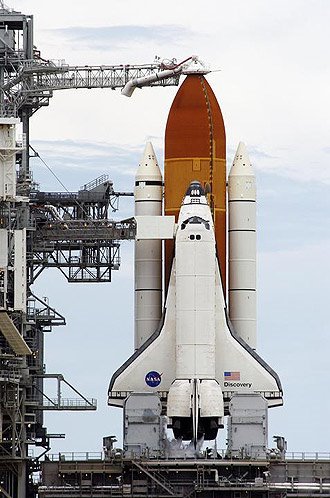
Discovery is Home!

Discovery is home! Now What? Well for starters there will be 15 more flights until 2010 when the fleet will be retired. So we have 4 years to go and average 3 to 4 shuttle flights a year. Then the CEV will be readied by 2014. That means we will have about 3 years of non-manned flights by NASA. (2011-2014) My hope is private enterprise will take up the low-earth actives, which will let NASA to do the exploring of MOON and MARS.

I also hope the ISS will be more utilized as a stepping-stone to the Moon and Mars and beyond. Developing and using the space elevator technology will help in transporting crews and supplies without the need of a rocket to get to zero g orbit. Oh the possibilities are endless. I'll keep my fingers crossed!

From AP via PJ Media here:

Griffin noted that NASA faces 16 more shuttle flights to complete the space station and, hopefully, repair the popular Hubble Space Telescope. A decision is expected by fall on whether to send a shuttle to Hubble one final time, to extend the observatory's life.

NASA is up against a hard 2010 deadline for completing the space station. That's when the three remaining shuttles will be retired to make way for a new spaceship capable of carrying astronauts to the moon and eventually on to Mars.

"We don't have any slack. We have just enough shuttle flights left to do the job so we can't afford to mess up," Griffin said. "The team performed superbly systemwide (with Discovery) and what we have to do is exactly that same thing again from now until the end of 2010."

Complicating matters is that NASA faces a series of tremendously difficult assembly flights, beginning with Atlantis' upcoming mission to deliver and install a massive beam and set of solar wings. NASA is aiming for a liftoff as early as Aug. 27.

Shuttle program manager Wayne Hale said he wants just as much intense scrutiny _ and differing opinions among engineers _ for the next flight and all the ones after that.

A few weeks before Discovery's liftoff, NASA's chief engineer and top safety officer argued for putting off the mission until more design changes could be made to one area of the fuel tank. Hale was all for going ahead. Griffin cast the final, decisive vote.

After landing, Lindsey said he trusted that launch decision and noted it was an outgrowth of the management culture lessons learned from Columbia. The successful conclusion of the mission is more of a beginning to space station assembly and exploration, he said, than an end to the post-Columbia recovery era.

"I don't think we want to ever put Columbia behind us," Lindsey said.


I'll Blog the next launch (Atlantis) at WorldCon in Anaheim on Aug 27th.

Blogging the Landing

--3:25 AM PDT
Well I'm awake on the westcoast and laptop warmed up. Weather looks good at KSC. I have NASA TV on and it's almost sunrise on the landing strip. I'm checking Flame Trench and Nasa landing blog. All looks go so far. The doors are closed on Shuttle Discovery. All switches are being thrown to landing postions. The training aircraft at KSC are up checking the weather. Deorbit starts around 7 AM with 8:14 AM landing at KSC. (time Central).

--4:05 AM PDT
The NASA landing blog is up and running at Landing Blog here. And the Flame Trench Via Florida Today.

--4:08 AM PDT
One hour to de-orbit burn. The Astronauts are drinking the sports drinks to give their bodies fuild. Weather might be in question due to some thunder storms but out of the 30 mile area so far.

--4:50 AM PDT
All Systems a go, just waiting on the weather. De-orbit in about 15 minutes. Over at Flame Trench photos of the landing site show overcast skies. Dosen't look so good on the weather for de-orbit. Update soon.

--4:55 AM PDt
OK for De-Orbit. Weather is within limits.

--5:08 AM PDT
Astronauts are strapped in and ready to de-orbit. Landing at 6:14 AM PDT.
Discovery has fired its Orbital Maneuvering System engines to slow the vehicle down so that it will drop out of orbit and begin the high-speed freefall back to Earth. The three-minute engine burn sets Discovery on an irreversible course for home.

They's comming home no backin' out now! Godspeed Discovery!

--5:12 AM PDT
De-orbit burn takes about 3 Minutes. Discovery is over the Indian Ocean off the coast of Sumatra.

--5:15 AM PDT
De-Orbit Burn is done. Recovery team is driving to the landing pad.

--5:26 AM PDT
They should be feeling the heat as the friction is building up on reentry. The propellants on board are being let go.

--5:28 AM PDT
Mission control gives last landing condtions to Commander Lindsey.

--5:33 AM PDT
40 Minutes to touch down. Will be landing on runway 33.

--5:36 AM PDT
Five minutes to interface. 63 hundred miles to runway. 3 APU's are good to go too.

--5:41 AM PDT
1 minute to entry interface. 54 hundred miles to runway.

--5:43 AM PDT
Interface now and 30 minutes to touchdown.
Discovery is currently at an altitude of 108 statute miles and 6,300 miles from the runway. Today will be the 62nd landing of the shuttle at Kennedy Space Center.


--5:46 AM PDT
They are definatly feeling the atmoshpere now. I bet their bodies will start to feel the heavyness and the g's on their faces.

--5:48 AM PDT
Comming to the coast of Central America. APU's still good.
Discovery is now 4,600 miles to the runway, traveling at approximately mach 24.8.

Looks like they are switching to landing srips from 33 to 15 because of weather conditons.

--5:33 AM PDT
The course change whould mean instead of a right turn to approach it would be a left turn to approach. This is because of a small thunder cloud is building up on approach to 33.

--6:00 AM PDT
It will be 15 landing strip and 15 Minutes to touchdown at KSC. And they will be turning left on approach.

--6:03 AM PDT
Heading to Florida over the Gulf of Mexico.

--6:05 AM PDT
Just entering the Florida coast and 9 minutes to touchdown.

--6:06 AM PDT
21 Miles and Mach 4.5 now. In a few minutes the pilots camera will be active.

--6:08 AM PDT
Loose switch on Air data probe.

--6:09 AM PDT
5 Minutes to landing.
Discovery's current speed is Mach 6.2 (4,650 mph), 25 miles in altitude and 214 miles from the runway. Discovery is approaching Florida's southwestern coast. Nine minutes until touchdown.


Camera is ready and looking good. Discovery at Mach one now.
6:11 AM PDT
Booms are heard. Now at 3 Minutes to touchdown. 500 mph. On target.

6:13 AM PDT
420 MPH now. Fast approach and line up to runway now. Chase plane pics now.

6:14 AM PDT Runway in sight all good. Approach is good.

6:15 AM Here we are! Bird has landed. The Chute is out. Looking good! Great job you guys!
6:16 AM All stop at KSC. Just waiting to de-plane the bird. The exhaust fumes have to disapate before exit.

6:20 AM PDT
The Leeky APU was not a problem on landing.

Sunday, July 16, 2006

Now for the Spacewalkers


Robo Chicks in action


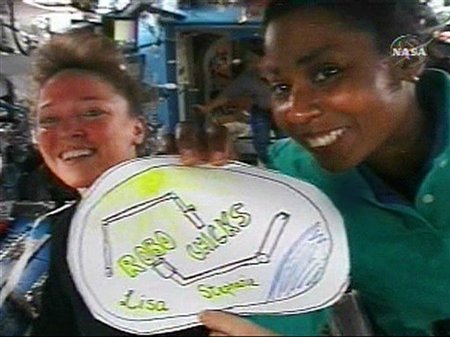
My girls did watch parts of the spacewalks. Some were boring to them, but they loved it when they showed the "Robo Chicks" in action. It was something to do with the pony tails (in parallel) and working on the robotic arms. They want a hair style like that on earth! Go Lisa and Stephanie!

Shuttle Landing Monday

I've been in the middle of the summer activites with the girls. Blogging has been light because of the distractions. I plan to live blog the Discovery Landing on Monday, July 17. Here is NASA's release of today July 16:
The six STS-121 astronauts are preparing for landing. Today's activities include stowage of items, engine tests and system checkouts.

Landing is scheduled for 9:14 a.m. EDT Monday at Kennedy Space Center, Fla. The deorbit burn is set for 8:07 a.m. A second landing opportunity for Monday would see the deorbit burn at 9:43 a.m. for a landing at 10:50 a.m. Weather forecasts call for a chance of showers at the landing site.

Crew members will take a break from their work to talk with media with CNN, CBS, ABC, NBC and the Fox News Channel at 11:53 a.m.

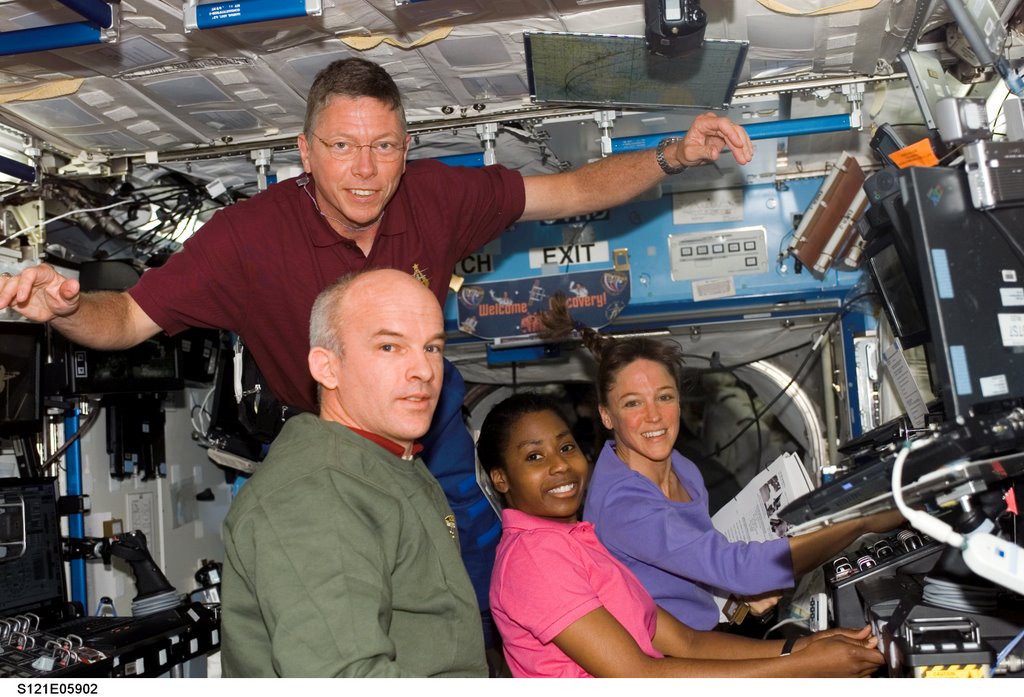
Discovery’s landing will mark the end of a successful mission for the STS-121 astronauts. They delivered supplies, equipment and a new Expedition 13 crew member to the International Space Station. During three spacewalks, they performed maintenance on the station’s mobile transporter and tested orbiter heat shield techniques.

Thursday, July 13, 2006

Testing our missle defense


Our system's are working after a test in New Mexico on Wednesday, here via Drudgereport.
When the target missile was destroyed, sending a brilliant white, mushroom-like cloud into the dark sky, the crowd began to applaud and cheer wildly.

" We smashed it," several people cheered as the rainbow colored contrail gave way to the cotton ball cloud of destruction above.

Eckles said contrails and explosions from previous tests have been seen as far away as Phoenix and Tucson. On Wednesday, Phoenix residents again were treated to a colorful contrail pattern over the Arizona skies, while closer-to-home reports were received from Lordsburg, Silver City and Doña Ana County from early risers who observed the same display.

"All evidence is that it was totally destroyed," Driessnack said of the target missile during an interview after the test was complete. "We knew from the last test, 60 days ago, that it was working as it should."

He said the test indicates THAAD could be ready for emergency deployment "as soon as a year from now."


Just in time when North Korea is shooting off duds. Iran's a threat we have to deal with also. A good defense to protect North American lifes. Thanks to Ronald Reagan who went though on SDI. WE really need it now!

Links to stories:

Space War story on THADD here.

Also in the news Northrop-Grumman has Skyguard Laser Defense system out of Redondo Beach, CA (Former TRW) here.

Sunday, July 09, 2006

China gets a slapping for aiding Iran

HT from Strategy page here.

The United States has ordered sanctions on two Chinese missile technology companies. The Chinese are accused of providing missile technology to Iran. One of the Chinese companies, China Great Wall Industry Corporation ("Great Wall" for short) has long been accused of aiding the North Korean missile effort. Great Wall is owned by the Chinese government, but is run for profit, and its managers are under orders to make money, or lose their jobs. Great Wall earns most of its profits by putting foreign satellites into orbit. Great Wall does this more cheaply than anyone else, and has had 24 successful launches for foreign customers so far. The two Chinese companies are major suppliers of missile technology to the Chinese armed forces, but the export business is where they rack up their biggest profits. The American sanctions block the Chinese firms from using any American banks in their dealings.

Friday, July 07, 2006

The Shuttle debate

The Orange County Register (here) had an editorial on NASA getting rid of the shuttle right now and privatizing the fleet.
The best approach now would be to scuttle all three shuttles, or privatize the fleet. The problem isn't just safety, but economics, said Ed Hudgins, an adjunct scholar at the Cato Institute and editor of "Space: The Free Market Frontier." He said each shuttle launch now costs $500 million to $1 billion.

"From a scientific view, very little is gained" from a shuttle flight, Mr. Hudgins said. The shuttle also provides services for the International Space Station, which in the 1980s was projected to cost $8 billion, but whose real cost now is expected to be $50 billion to $100 billion. "Again, the space station is doing very little science," Mr. Hudgins said.

I wonder if the private sector will be geared up to go. If we privatize will the space station be completed? A good argument for private enterprise, but my belief is private enterprise will not have the government red tape to go through.
In sum, half of NASA's $7 billion yearly budget goes to human space exploration – the shuttle and space station – money that could go to better uses, such as unmanned space exploration.
I still think "manned" or the PC "Human" exploration is important to the US. If we give up the shuttle and private enterprise does not ramp up then were will we be? Is the US going to let China or Russia take over space exploration for six years waiting for the CEV to be build?

Granted I favor private enterprise getting into space. But space exploration's history has had some hurtles to face. Will privatizing the shuttle help or hinder the USA space program stay the front runner in space exploration? My option is to complete the shuttle flights within NASA and retire it in six years. But I also favor private companies getting into the space exploration business. They will eventually take over the low orbit activities while NASA explores the outer regions.

Tuesday, July 04, 2006

Back from the Parade! Happy 4th of July!

I'm back from the parade and ready for Launch! It was great to see so many people in Fullerton enjoy the 4th of July.

--11:07 AM PDT
Looks like they plan a T -31 sec hold for monitoring Liquid oxygen inlet tank temp.

--11:10 AM PDT
Weather looks great! No Anvils this time. All green.
T -9 Mins. and holding. We have about 15 mins. left in the hold.

--11:17 AM PDT
All polled and ready for count down.

--11:20 AM PDT
Weather a go, no techincal problems. 5 mins left in hold.

--11:25 AM PDT
Final Go's Polled! Ready to Go!!!!!!!!!!!!!!
A great day to launch and celebrate America's 230th Birthday!
"I can't think of a better place to be on the Fourth of July," Commander Steve Lindsey responded from within the orbiter. He said that the crew is ready to give Florida an up close and personal look at the rockets' red glare.


--11:29 AM PDT T-9 and counting!!!!!!!

--11:31 AM PDT T-7 White Room retracting and pre-start precedures.

--11:33 AM PDT T-4:30 and counting.

--11:35 AM PDT T-4 mins. Readness test of rocket engines.

--11:36 AM PDT T-3 Mins. and Vent hood is retacted.

--11:38 AM PDT Blast off! Bird looks good!

--11:40 AM PDT Go with thothle up!

--11:42 AM PDT Solids go by by.

-11:46 AM PDT Roll over.

--11:48 AM PDT Liquid tank detached. Main engine cut off.

Shuttle a go Go!


I have a 4th of July parade to go to. My daughter's troop will be marching in it. I might just get home in time for the launch. So live blogging won't happen today.

The foam issue has been looked at and was agreed it could go ahead and launch.
Carnegie Mellon University engineering and risk analysis professor Paul Fischbeck, who had been worried earlier in the day by the falling chunk of foam, said NASA's rationale in going ahead made sense and he is slightly more comfortable with a launch try Tuesday.

Fischbeck, who has consulted with NASA on the shuttle's delicate heat protection system, wondered why foam had broken off on the launch pad. "It's something you might want to understand before you launch," he said.

The patch of foam fell off an area that covers an expandable bracket holding a liquid oxygen feed line against the huge external tank. NASA engineers believe ice built up in that area from condensation caused by rain Sunday.

The tank expanded when the super-cold fuel was drained after Sunday's launch was canceled because of the weather. The ice that formed "pinched" some of that foam, causing the quarter-inch-wide crack and the piece of foam to drop off, officials said.

The size of the fallen foam was less than half the size of one that could cause damage, NASA officials said.

NASA managers decided to go ahead with the launch attempt because of three criteria: They are confident enough foam still is on the bracket to prevent a large piece of ice from forming; that the area of foam where the piece dropped was still intact; and they don't believe the area will be exposed to extreme heat during ascent.

Inspectors spotted the crack in the foam insulation during an overnight check of the shuttle. NASA had scrubbed launch plans Saturday and Sunday because of weather problems.

The forecast for a Tuesday liftoff was better than previous days, with just a 40 percent chance that storm clouds would prevent liftoff.


Live Blogging sites:
NASA Shuttle Launch
Flame Trench
***Update****
A backup Circuit Breaker to the controls of primary heaters on the segment joints on both solid rocket boosters is acting up. A crew is going to replace the 100 amp backup breaker. Ice patrols are out inspecting.