As launch preparations resumed at NASA's Kennedy Space Center's Launch Pad 39B on Thursday, mission managers set Sept. 6 as the new date for the launch of Atlantis on Mission STS-115 to the International Space Station. Liftoff time would be 12:29 p.m. EDT.
No damage to facilities or flight hardware is reported at the Kennedy Space Center following the exit of Ernesto from Florida. As the tropical depression passed through the area on Wednesday, the peak wind recorded on Launch Pad 39B, where Space Shuttle Atlantis stands, was measured at 44 miles per hour at 4:45 p.m. EDT. The shuttle was surrounded by the rotating service structure as NASA decided to protect it in place when weather forecasts improved.
On Tuesday, mission managers halted a rollback of the space shuttle to the protection of the Vehicle Assembly Building as the projected path of the tropical storm skirted further west than first expected, allowing a sufficient decrease in winds to permit the shuttle to ride out the storm at the pad.
Friday, September 01, 2006
STS-115 launch date set Sept. 6th

Thursday, August 31, 2006
The Ozone layer is recovering
From NASA news:
The Montreal Protocol makes sence with a little bit of change. It does not restrict growth like the Kyoto Protocol accord does.
A new study using NASA and National Oceanic and Atmospheric
Administration (NOAA) data finds consistent evidence that Earth's
ozone layer is on the mend.
A team led by Eun-Su Yang of the Georgia Institute of Technology,
Atlanta, analyzed 25 years of independent ozone observations at
different altitudes in Earth's stratosphere, which lies between six
and 31 miles above the surface. The observations were gathered from
balloons, ground-based instruments, NASA and NOAA satellites.
The stratosphere is Earth's second lowest atmospheric layer. It
contains approximately 90 percent of all atmospheric ozone. The
researchers concluded the Earth's protective ozone layer outside of
the polar regions stopped thinning around 1997. Ozone in these areas
declined steadily from 1979 to 1997.
The abundance of human-produced ozone-destroying gases such as
chlorofluorocarbons peaked at about the same time (1993 in the lowest
layer of the atmosphere, 1997 in the stratosphere). Such substances
were phased out after the 1987 international Montreal Protocol was
enacted.
The Montreal Protocol makes sence with a little bit of change. It does not restrict growth like the Kyoto Protocol accord does.
Tuesday, August 29, 2006
Shuttle going back to the PAD!

Boy, can they change their mind or what? I just hope the Hurricane stays far, far away!
NASA Mission Managers have decided to return Atlantis to Launch Pad 39B today. The space shuttle is expected to be back in place by about 8 p.m. EDT. The decision came as Tropical Storm Ernesto was predicted to skirt further west than first expected, allowing a sufficient decrease in winds to permit the shuttle to ride out the storm at the pad. Launch Director Mike Leinbach and the team made the determination at 2:40 p.m. EDT. Atlantis had begun its trek to the Vehicle Assembly Building, atop the crawler-transporter, at 10:04 a.m. this morning.
Let's hope for no more lightning strikes!
Shuttle will be moved into Hangar

From NASA:
NASA DECIDES TO MOVE SHUTTLE ATLANTIS OFF LAUNCH PAD
NASA has decided to roll the Space Shuttle Atlantis off its launch pad
and back inside the protection of the Vehicle Assembly Building at
the Kennedy Space Center, Fla. The roll back is targeted to start at
approximately 10:05 a.m. EDT Tuesday.
The decision was made due to Tropical Storm Ernesto's track. Ernesto
is expected to bring high winds as it passes Kennedy.
A new launch date is not yet scheduled for Atlantis' flight, STS-115,
to the International Space Station. NASA and the Russian Federal
Space Agency continue to discuss the timing of Atlantis' mission and
the Soyuz spacecraft, which will send the next crew to the station in
September. Factors to be considered are the lighting constraints for
the shuttle launch and Soyuz landing and the timing for docking and
undocking the spacecraft with the station. NASA is also investigating
additional launch windows later in the fall.
The STS-115 crew will return to NASA's Johnson Space Center, Houston.
Commander Brent Jett, Pilot Chris Ferguson, and mission specialists
Joe Tanner, Dan Burbank, Heide Stefanyshyn-Piper and Canadian
astronaut Steve MacLean will continue training as they await a new
target launch date.
This means Atlantis will probably miss the September 7th deadline for a Launch. It takes eight days for a turn-around from Hangar to pad. With the Soyuz docking later in September the Shuttle can't be there at the same time. Also, with the new launch laws in effect, if there is not enough light to photograph the shuttle launch then we only have 3 launch windows this year to Launch Atlantis. I think they should wave the sunlight rule for this. We got to get the ISS built. I'm confident that the foam on the fuel tank is now stable. They can photo the shuttle out in space with the camera arm. The good thing is after Friday's lightning strike, the techs can give Atlantis a good checkup while in the hangar.
Monday, August 28, 2006
500 Million Dollar COTS Progarm
“I’ve said many times that I think — obviously by the fact that I’m gambling a half-billion dollars here — commercial space has a pretty strong supporter in me as NASA administrator,” Griffin said in a recent interview. “If it doesn’t work, I’ve frankly made the wrong bet … with a good amount of money that we could have used for other purposes if the entrepreneurial sector is, in fact, not able to step up.”
That $500 million wager has been placed on two very different firms that both have the same goal: building a vehicle that will meet NASA’s need for a new way to deliver supplies to the international space station after the space shuttle fleet is retired in 2010.
The two winners of the COTS demonstration contracts NASA awarded Aug. 18 — Space Exploration Technologies Corp. (SpaceX) and Rocketplane Kistler — both intend to develop new kerosene-fueled rockets to launch their proposed crew and cargo modules on confidence-building test flights before shooting for the international space station.
Both SpaceX and Rocketplane Kistler have a considerable amount of hardware already on hand — more, in fact, than any of the four other COTS finalists the pair beat out for the awards.
Both companies intend to combine the money they receive from NASA — SpaceX is getting $278 million and Rocketplane Kistler $207 million — with additional private investment. Both companies also plan to berth their cargo modules to the international space station with the aid of the outpost’s giant robot arm.
From Space.com here.
Wednesday, August 23, 2006
Golf balls in space etc
I'll be heading off for the World con in Anaheim today. Just a few space articles I've checked out today.
Here is the Golf ball promo for a company in Canada. The Russian Commander on the ISS will test out a gold golf ball in space in November. I just hope as it becomes space junk that it avoids any Space Shuttles in the near future...
Another story is one of the ISS crew was not up to date on the NASA memo telling them to wait until friday to mention the name ORION. Opps!
Here is the Golf ball promo for a company in Canada. The Russian Commander on the ISS will test out a gold golf ball in space in November. I just hope as it becomes space junk that it avoids any Space Shuttles in the near future...
Another story is one of the ISS crew was not up to date on the NASA memo telling them to wait until friday to mention the name ORION. Opps!
Tuesday, August 22, 2006
Sea Launch success

Yesterday Sea Launch successfully launched a South Korean comm satellite.
South Korea's first dual-use commercial and military communications satellite is now in space after a successful blastoff from a floating platform in the central Pacific Ocean.The 22nd mission for Sea Launch's Zenit 3SL rocket began with a fiery liftoff from the Odyssey launch platform at 0327 GMT Tuesday (11:27 p.m. EDT Monday). Positioned along the Equator at 154 degrees West longitude, the former Norwegian oil-drilling rig was in a prime location for the three-stage rocket to receive a boost from Earth's faster rotation at such low latitudes.
It took just over an hour for the launcher to release the Koreasat 5 satellite in the targeted oval-shaped orbit stretching from a low point of about 1,800 miles to a high point of around 22,300 miles. Its inclination was zero degrees.
A few minutes after spacecraft separation, controllers in the Sea Launch command ship received word that an Italian ground station had heard the first radio signals from Koreasat 5, proving the 9,806-pound satellite was in good health following the harrowing ride to orbit.
Friday, August 18, 2006
Bolt Swap out
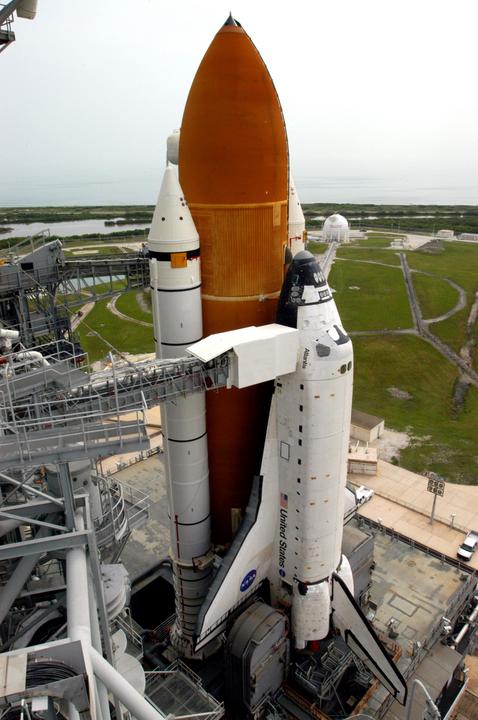
Atlantis will get the correct bolts put in this weekend in preparation for the launch next Sunday.
CAPE CANAVERAL, Florida (AP) -- NASA managers decided Friday to change out two bolts they fear may not be secure enough in attaching an important communications antenna to space shuttle Atlantis' payload bay.
The swap-out will take place over the weekend while Atlantis is on the launch pad in preparation for an August 27 liftoff. Technicians will have to build scaffolding on top of a platform six stories off the ground to reach the bolts.
The two days of work likely will wrap up Sunday but won't affect the launch schedule or the start of the countdown on Thursday, unless there is a problem, said NASA spokesman Kyle Herring.
Wednesday, August 16, 2006

Shuttle ready to go Aug 27
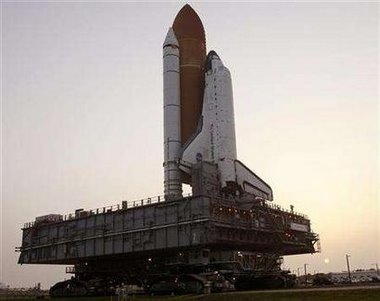
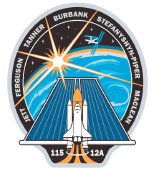
"We have set the launch date again for the 27th (of August)," Bill Gerstenmaier, the NASA associate administrator for space operations, said in a televised news conference from the
Kennedy Space Center in Florida. "We are ready to go for that."
NASA officials voted unanimously to go ahead with the launch after a two-day flight readiness review, Gerstenmaier said. The shuttle has an August 27-September 13 launch window.
......
A technical issue also arose during the readiness review, as officials discussed a design flaw in bolts attaching an antenna to the orbiter, said shuttle program manager Wayne Hale. NASA will likely have to replace the bolts, he said.
God Speed Atlantis!
Shuttle Alantis has a bolt problem

Among the many items to be discussed during the meeting is whether engineers need to replace a set of four bolts connecting Atlantis’ primary data and video antenna to the upper right side of the orbiter’s payload bay.
“I know they’re going to present it and we’re going to lay out a plan on what the work would take,” said NASA spokesperson Bruce Buckingham, of the agency’s Kennedy Space Center (KSC) where the meeting is underway, adding that it’s still far from final whether additional work will be required at the shuttle’s launch pad.
The four bolts latching Atlantis’ antenna dish in place are shorter than those stipulated in engineering specifications, but have flown on all 26 of the shuttle’s spaceflights. Engineers have expressed some concern that the bolts could shake loose during launch, which could send the antenna plunging down the length of Atlantis’ 60-foot (18-meter) payload bay and cause serious damage to the orbiter.
“If we did decide to go do the work, it could in all likelihood not affect our launch date,” Buckingham said.
Atlantis is slated to launch from KSC’s Pad 39B site no earlier than 4:30 p.m. EDT (1030 GMT) on Aug. 27 to begin an 11-day mission to the International Space Station (ISS).
Its STS-115 mission, commanded by veteran shuttle astronaut Brent Jett, will deliver a new solar array and pair of truss segments to the orbital laboratory.
But first Atlantis must pass muster before teams of safety engineers and top shuttle officials during a standard pre-launch meeting known as the Flight Readiness Review
HT Space.com
Pluto's Planet Definition or we'll have 53 more in the solar system
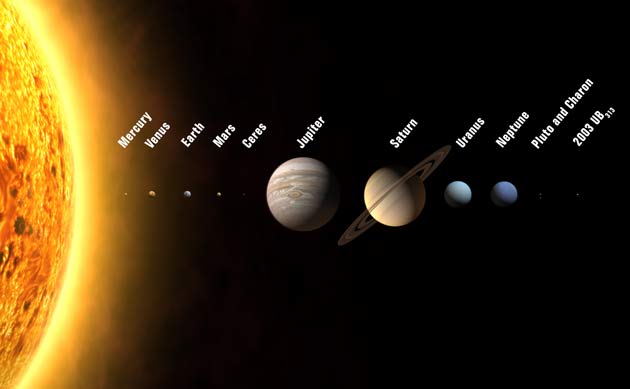
The IAU will be voting next week on the definition of what a planet is (here).
The tally of planets in our solar system would jump instantly to a dozen under a highly controversial new definition proposed by the International Astronomical Union (IAU).
Pluto and Charon would become pluton's along with Mark Brown's discovery 2003UB313.
That would make Caltech researcher Mike Brown, who found 2003 UB313, formally the discoverer of the 12th planet. But he thinks it's a lousy idea.
"It's flattering to be considered discoverer of the 12th planet," Brown said in a telephone interview. He applauded the committee's efforts but said the overall proposal is "a complete mess." By his count, the definition means there are already 53 known planets in our solar system with countless more to be discovered.
Brown and other another expert said the proposal, to be put forth Wednesday at the IAU General Assembly meeting in Prague, is not logical. For example, Brown said, it does not make sense to consider Ceres and Charon planets and not call our Moon (which is bigger than both) a planet.
Here is the definition:
The definition, which basically says round objects orbiting stars will be called planets, is simple at first glance:
"A planet is a celestial body that (a) has sufficient mass for its self-gravity to overcome rigid body forces so that it assumes a hydrostatic equilibrium (nearly round) shape, and (b) is in orbit around a star, and is neither a star nor a satellite of a planet."
Text of the proposal is here.
USAF commander for Space Defense
HUNTSVILLE, Alabama (Reuters) - The Air Force's new top commander for space predicted on Tuesday future attacks on U.S. satellites and called for greatly expanded tracking and identification of payloads launched by other countries.
Currently, U.S. efforts are focused on determining if an overseas launch is a ballistic missile or designed to put an object in orbit, then cataloging it over a period that can take weeks, said Air Force Gen. Kevin Chilton, who heads the Air Force Space Command at Peterson Air Force Base, Colorado.
"I say those days are over," he told an annual conference here on the fledgling, multibillion-dollar U.S. anti-missile shield. "If it's a space launch, we can't afford to relax."
"We need to know what the intent of that launch is," he said, including whether an object could jam or otherwise harm satellites or spread micro-satellites that could do so.
Chilton said his goal was to learn all this in the object's first orbit of the Earth so the United States could take unspecified actions "before an adversary can cripple us."
The increased "situational awareness" he had in mind could be achieved largely through improved computer work that would present information in easy-to-understand displays, he said.
Foes would be foolish not to be thinking of how to deny the United States the advantages of space, on which it relies heavily for military and commercial purposes, said Chilton, who took over the space command a month and a half ago.
HT Drudge
Tuesday, August 15, 2006


Parts from Old Apollo Rockets
While engineers are trying to get the Ares 1 designed they are going to Apollo exhibits to see how the Apollo program did it. They are even getting old NASA engineers to help the new guys and gals with the Ares project.
Snoddy, a manager at NASA's Marshall Space Flight Center, has been removing valves and other parts from Apollo exhibits as he oversees construction of the upper-stage engine on the new moon rocket, dubbed Ares 1. Some of the pieces and accompanying documentation are not available anywhere but museums, he said.
The move makes sense: The new engine Snoddy is working on, a J-2X, is an updated version of the J-2 engine that powered the third stage of the 363-foot (109-meter) Saturn V rocket during Apollo.
LA Con IV

Next week my family and I will be attending the World Science fiction Convention at Anaheim convention Center. There will be some internet access and I hope to blog there about the Space Science panels. There will be Many displays on Science Fiction, Robots, Lunar Rover, Mars Rover, etc. Lots of panels, Art Show, masquerade etc. The main function I will be at is the Babel Diplomatic Conference/40th Star Trek Celebration wearing my ST uniform (ST II/VI movies) and my girls will be TNG. Kathryn will be Dr. Crusher and Megan will be a female Worf (or Alexandra). My Husband will be Scotty, Black Vest from (ST II/VI).



Friday, August 11, 2006
Count down test a success
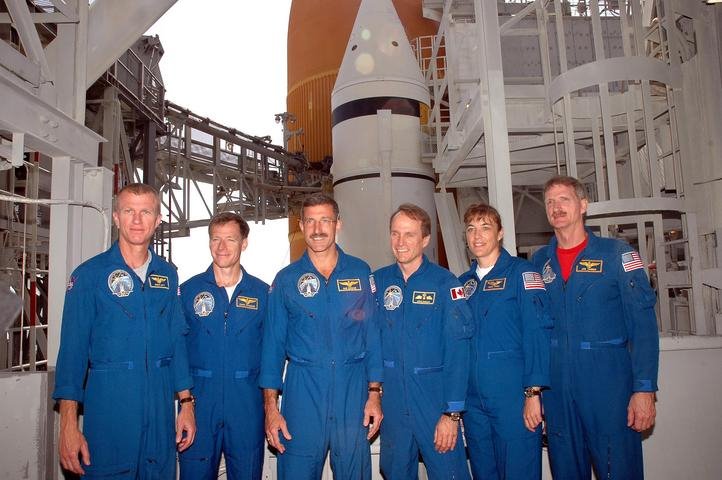

Atlantis' astronauts strapped into the space shuttle Thursday for a practice launch countdown more than two weeks before they are scheduled to blast off on a mission to resume construction of the international space station.
The six crew members, dressed in their orange spacesuits, waved to photographers as they walked out of crew quarters at the Kennedy Space Center and boarded a van that took them to the launch pad. The launch window opens August 27.
The practice went smoothly with the countdown clock stopping at 4 seconds, said NASA spokesman Bruce Buckingham.
Thursday, August 10, 2006
NASA Display at DCS
NASA will have a display at the Discovery Science Center on August 20 - 22. From Larry Evans, President of the Orange County Space Society:
The exhibit is called the "Vision for Space Exploration" and
will highlight the new NASA mission of sending people back to the Moon and
onward to Mars. The exhibit is housed in a large trailer that is traveling
cross-country over the next several months. During the three days in Orange
County, the exhibit will be parked at the Discovery Science Center (DSC) in
Santa Ana.
--Description of Exhibit:
The first section of the trailer features a gaming section with Moon and
Mars globes. Visitors are surrounded by stars and planets. Holographic video
screens create floating images, allowing visitors' hand motions to control
and create bases for human life on the planets. The second section of the
trailer has a hexagon-shaped, three-dimensional theater featuring a
five-screen presentation on the Vision for Space Exploration. The Dome's
interior becomes a seamless floor-to-wall-to-ceiling window for a journey to
other-worldly destinations. Explorers see themselves in space to fully
experience environments in other parts of our Solar System, giving travelers
the illusion of stepping on the surfaces of Earth, the Moon and Mars.
Visitors will also have a chance to actually touch a real moonrock brought
back by Apollo astronauts. This is one of only three lunar samples able to
be touched by the public anywhere in the world. At the end of the
experience, people will have the opportunity to get a free photo of
themselves standing on either the Moon or Mars!
Wednesday, August 09, 2006
Van Allen has died.


IOWA CITY, Iowa (AP) -- Physicist James A. Van Allen, a leader in space exploration who discovered the radiation belts surrounding the Earth that now bear his name, died Wednesday. He was 91.....
Explorer 1, which weighed just 31 pounds, was launched January 31, 1958, during an emotional time just after the Sputnik launches by the Soviet Union created new Cold War fears. The instruments that Van Allen developed for the mission were tiny Geiger counters to measure radiation.
Near the 35th anniversary of the launch, Van Allen recalled in an Associated Press interview how scientists waited tensely for confirmation the satellite was in orbit.
When the signal finally came, "it was exhilarating. ... That was the big break, knowing it had made it around the Earth, that it was actually in orbit."
The success of the flight created nationwide celebration. Equally exciting for the scientists was the discovery of the radiation belts, a discovery that happened slowly over the next weeks and months as they pieced together data coming from the satellite.
"We had discovered a whole new phenomenon which had not been known or predicted before," Van Allen said. "We were really on top of the world, professionally speaking." Later in 1958, another scientist proposed naming the belts for Van Allen.
Read the whole thing.
Related posts:
Flame Trench
StarBaseOC: 48 years of Space Exploration
Subscribe to:
Posts (Atom)