Wednesday, June 14, 2006

Shuttle Crew gets ready


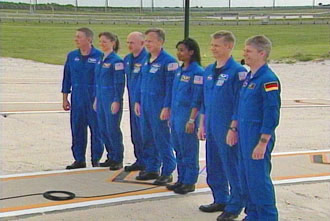
Image above: STS121-S-002 (5 April 2006) -- These seven astronauts take a break from training to pose for the STS-121 crew portrait. From the left are astronauts Stephanie D. Wilson, Michael E. Fossum, both mission specialists; Steven W. Lindsey, commander; Piers J. Sellers, mission specialist; Mark E. Kelly, pilot; European Space Agency astronaut Thomas Reiter of Germany; and Lisa M. Nowak, both mission specialists. Image credit: NASA

Monday, June 12, 2006

First storm of the season


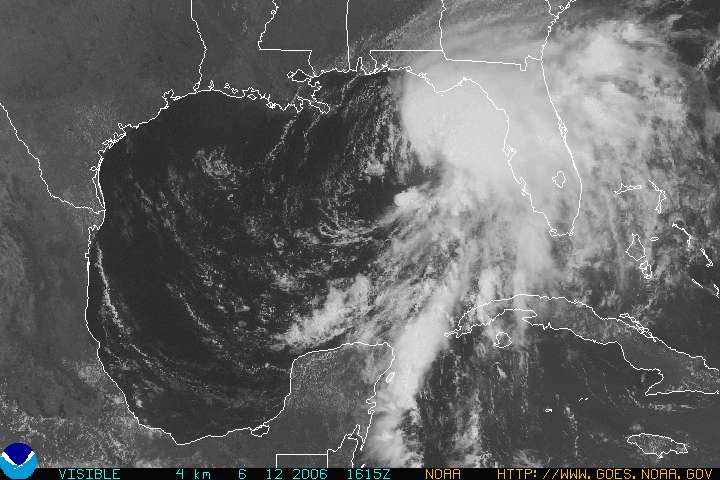
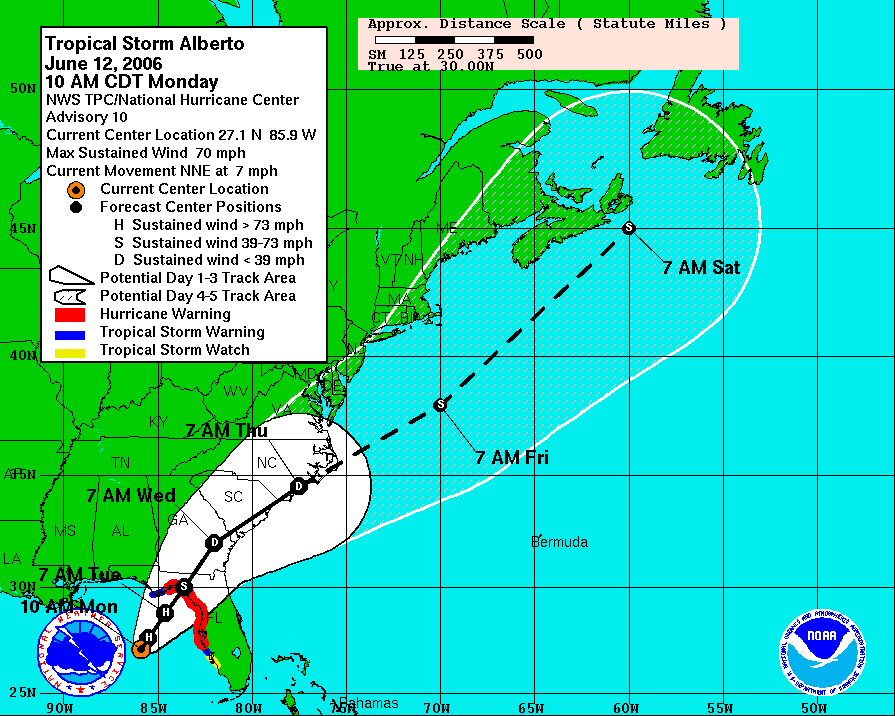
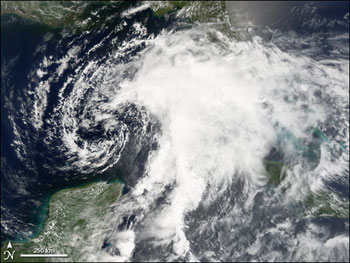
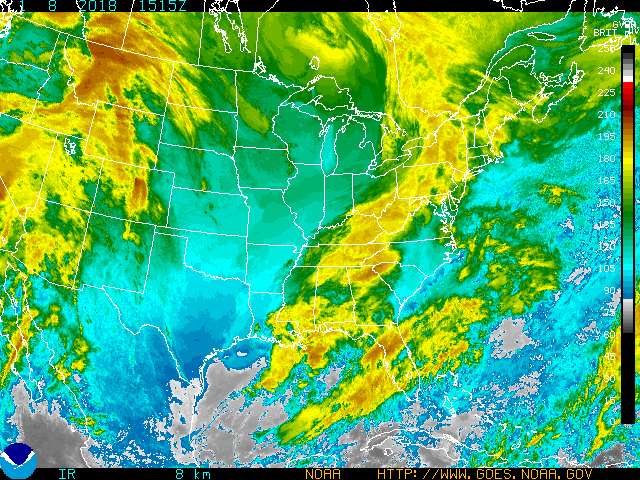
Alberto is a Stage 1 Hurricane now. Here's the GOES image.

National Hurricane Center site here.


The NASA Hurricane site is here.

Wednesday, June 07, 2006

Cloudsat images


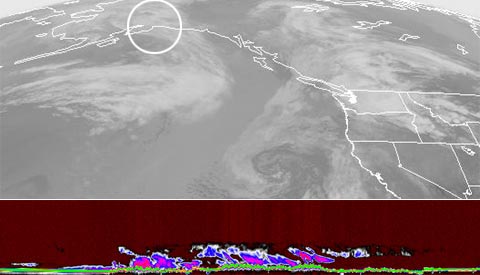
The first images from Cloudsat are in. They show the 3-D aspects of clouds instead of the flat satellite pictures shown on the weather channel.
"We're seeing the atmosphere as we've never seen it before," said Deborah Vane, CloudSat deputy principal investigator at NASA's Jet Propulsion Laboratory, Pasadena, Calif. "We're no longer looking at clouds like images on a flat piece of paper, but instead we're peering into the clouds and seeing their layered complexity."

The first-ever millimeter wavelength radar, CloudSat's Cloud-Profiling Radar is more than 1,000 times more sensitive than typical weather radar. It can observe clouds and precipitation in a way never before possible, distinguishing between cloud particles and precipitation. Its measurements are expected to offer new insights into how fresh water is created from water vapor and how much of this water falls to the surface as rain and snow.

CloudSat was launched April 28 from Vandenberg Air Force Base, Calif., along with NASA's Cloud-Aerosol Lidar and Infrared Pathfinder Satellite Observations satellite. Both satellites will orbit 705 kilometers (438 miles) above Earth aboard NASA's "A-Train" constellation of five Earth Observing System satellites. The A-Train satellites will work together to provide new insights into the global distribution and evolution of clouds to improve weather forecasting and climate prediction.

CloudSat is managed by JPL, which developed the radar instrument with hardware contributions from the Canadian Space Agency. Colorado State University provides scientific leadership and science data processing and distribution. Ball Aerospace and Technologies Corp., Boulder, Colo., designed and built the spacecraft. The U.S. Air Force and U.S. Department of Energy contributed resources. U.S. and international universities and research centers support the mission science team.

The flat image is on top (circled) while the bottom image is the 3-D of the same cloud formation here.

Monday, June 05, 2006

Space Race

The National Geographic Channel has a great 2 part series on the Space Race between USSR and USA. Here is the interactive site on NGC. Its on tonight. Here's the time listings.

From Denver Post on William Gray

I've been telling people for some time this guy William Gray has (OVER) 50 years of climate data on Hurricanes. He said the record doesn't lie and the global warming freaks have it wrong. HT to Drudge (and RUSH talked about it too) on this Denver Post here.
"Let's just say a crowd of baby boomers and yuppies have hijacked this thing," Gray says. "It's about politics. Very few people have experience with some real data. I think that there is so much general lack of knowledge on this. I've been at this over 50 years down in the trenches working, thinking and teaching."

Gray acknowledges that we've had some warming the past 30 years. "I don't question that," he explains. "And humans might have caused a very slight amount of this warming. Very slight. But this warming trend is not going to keep on going. My belief is that three, four years from now, the globe will start to cool again, as it did from the middle '40s to the middle '70s."

Both Gray and Pielke say there are many younger scientists who voice their concerns about global warming hysteria privately but would never jeopardize their careers by speaking up.

"Plenty of young people tell me they don't believe it," he says. "But they won't touch this at all. If they're smart, they'll say: 'I'm going to let this run its course.' It's a sort of mild McCarthyism. I just believe in telling the truth the best I can. I was

I love it! Just when ALGORE's movie comes out.

Thursday, June 01, 2006

Hurricane forcast for 2006

USA today has Max Mayfield and his prediction for the 2006 Hurricane season.
Mayfield, who has barnstormed hurricane country for weeks to preach the gospel of readiness, sees trouble in a recent poll of coastal residents in 12 Atlantic and Gulf states. The survey of 1,100 people by Mason-Dixon Polling & Research found that more than half don't feel vulnerable to hurricanes, and three in five have no family disaster plan.

The poll, released in mid-May by the National Hurricane Survival Initiative, a public-private partnership that includes the hurricane center, also found that more than two-thirds of the respondents have no hurricane survival kit. And half erroneously believe that masking tape makes windows shatterproof in a storm. Thirteen percent say they wouldn't evacuate, even if ordered to leave.


I wonder what if the ratio is the same for California residents prepaired to face Earthquakes?


Another site to check out is William Gray's Colorado State here.

Droids on the ISS


Saw this on Free Republic:
Six years ago, MIT engineering Professor David Miller showed the movie Star Wars to his students on their first day of class. There's a scene Miller is particularly fond of, the one where Luke Skywalker spars with a floating battle droid. Miller stood up and pointed: "I want you to build me some of those."

So they did. With support from the Department of Defense and NASA, Miller's undergraduates built five working droids. And now, one of them is onboard the International Space Station (ISS).


How cool is that? The article goes on why small satellites are needed and how difficult it is to gather them together to work on moving other vehicles in space. (Ever been in a crowd of people?)
Tiny satellites are a hot new idea in space exploration: Instead of launching one big, heavy satellite to do a job, why not launch lots of little ones? They can orbit Earth in tandem, each doing their own small part of the overall mission. If a solar flare zaps one satellite—no problem. The rest can close ranks and carry on. Launch costs are reduced, too, because tiny satellites can hitch a ride inside larger payloads, getting to space almost free of charge.

But there's a problem: Flying in formation is trickier than it sounds. Ask a crowd of people to line up single file, and they'll be able to figure it out and do it rather easily. Getting a group of orbiting satellites to do the same thing, it turns out, is extremely hard.

Shuttle Launch a go (so far)

Here's theNYT article on the Shuttle launch upcoming in July.
Although there is still a risk of dangerous foam debris, NASA officials cleared the space shuttle's external fuel tank on Wednesday for launching of the Discovery in July, after a year on the ground.

Shuttle program officials, meeting at the Kennedy Space Center in Florida, said enough modifications had been made on the tank since the last shuttle flight to give them confidence that the foam risk was minor.

N. Wayne Hale Jr., manager of the shuttle program, said at a news conference that foam debris from different areas on the fuel tank would continue to come off and pose some risk of damaging a shuttle. But he called the risk "acceptable" and said, "We have eliminated the largest hazards."

Repeating a note often sounded by NASA officials and astronauts, Mr. Hale said the shuttle would always be risky to fly.

Michael D. Leinbach, the shuttle launching director at Kennedy, said the Discovery should be ready to launch within a window lasting from July 1 through July 19. In the approach to that window, managers will have unusually long contingency time, almost two weeks, to deal with problems that might arise.

Mr. Leinbach also said the shuttle Atlantis was on schedule to roll out to its launching pad on July 25 in anticipation of a mission beginning Aug. 28 or shortly thereafter.


--Space is risky business to begin with.

From Space Today net here:
NASA managers concluded Wednesday that foam shedding from the space shuttle's external tank does not pose a significant risk to the shuttle orbiter, clearing the way for next month's launch of the shuttle Discovery. Officials concluded that while foam will fall off the tank during the launch, the hazards posed by large chunks of foam have been mitigated so that those risks are in line with other aspects of the shuttle system. That risk could be further decreased with on later missions if NASA decides to proceed with the removal of foam "ice/frost ramps" on the external tank that are particularly prone to shedding. The decision allows NASA to proceed with preparations for the launch next month of the shuttle Discovery on mission STS-121: the launch window for that flight runs from July 1-19. An official launch date will be set during a flight readiness review in mid-June.

From Florida Today:
"It's a risky vehicle to fly, and nobody should mistake that. There are a number of things that can cause bad outcomes on this vehicle," shuttle program manager Wayne Hale said.

But the chance of potentially catastrophic damage from foam debris "is consistent with the entire overall risk we fly with the space shuttle," he added.

Hale's comments came at the conclusion of a two-day review considered key to clearing Discovery for launch of NASA's second flight since the 2003 Columbia accident.

Wednesday, May 31, 2006

Protest at NOAA today

I heard about this protest this morning. (Now on Drudge here.)

Hundreds of concerned citizens and leaders from across the nation will join Hurricane Katrina survivors Wednesday to call for the resignation of the heads of the National Hurricane Center (NHC) and the National Oceanic and Atmospheric Administration (NOAA) at the NOAA Headquarters just outside of Washington, D.C. During an 11 a.m. demonstration, advocates will demand that NOAA stop covering up the growing scientific link between severe hurricanes and global warming while insisting on real solutions to the problem of global warming.

Oh My! Max Mayfield is a bad man! Why, He even called Mayor Nagen to warn him about Katrina! Now who would do that and not care about the masses. To blame the weather forecasters who are doing their jobs and claim it's global warming and they are the cause for it! (LOL! Just kidding!)

The protest is headed by the Climate Crisis Coalition and others here's the release. The CCC website is here.

Monday, May 29, 2006

Global Warming debate with ALGORE

I love to hear the debate on Global Warming. I'm a firm believer in the cycle of 11,000 to 12,000 years of the glacial ice age. The record proves we are going in cycles; the position of the Earth (relative to the sun) is what drives the cycle of warming and cooling. I don't think the advent of Mankind will do much damage to the climate. Granted we have cleaned up our act on pollution and could do better. It's just this pseudo-science the liberal left clings onto that does not make sense to me.
(From Drudge) The Non-Global warming side:
In one corner, subscribing to the theory that the Atlantic Basin is in a busy cycle that occurs naturally every 25 to 40 years, are Chris Landsea, science and operations officer at the National Hurricane Center in Miami, and William Gray and Phil Klotzbach of Colorado State University, who pioneered much of modern hurricane-prediction theory.
"There has been no change in the number and intensity of Category 4 or Category 5 hurricanes around the world in the last 15 years," Mr. Landsea said, in a telephone interview from Miami.

The Pro-Global Warming side:
On the other side are Kerry Emanuel of the Massachusetts Institute of Technology, one of the most respected hurricane scientists in the world, a team of meteorologists from Georgia Tech led by Peter Webster, an MIT-educated monsoon specialist, and Greg Holland, who earned his doctorate at Colorado State under Mr. Gray.
"You cannot blame any single storm or even a single season on global warming. ... Gore's statement in the movie is that we can expect more storms like Katrina in a greenhouse-warmed world. I would agree with this," said Judith Curry. She is chairwoman of Georgia Tech's School of Earth and Atmospheric Sciences, and is co-author, with Mr. Webster, Mr. Holland and H.R. Chang, of a paper titled "Changes in Tropical Cyclones," in the Sept. 16 issue of Science, a weekly publication of the American Association for the Advancement of Science.
The paper concluded that there has been an 80 percent increase in Category 4 and Category 5 hurricanes worldwide

Sunday, May 28, 2006

10th Planet

The tenth "planet" found last year will be determined by IAU in a paper due out in September 2006. The title is Definition of a Planet. (Is it a Planet or a Kelper body? Good question.) If they determine it not a Planet, will Pluto be a non-planet also?
Previous estimates by ground-based telescopes suggested the object known as 2003 UB313 was 30 percent bigger than Pluto.

But the latest measurement by the Hubble Space Telescope has a smaller margin of error and is probably a more accurate estimate, said lead researcher Michael Brown of the California Institute of Technology.

According to Hubble, UB313's diameter measures 1,490 miles, give or take 60 miles. Pluto is about 1,422 miles across.

Brown previously reported that UB313 could be up to 2,175 miles in diameter based on its brightness. He said he was surprised by Hubble's findings, which will be published in an upcoming issue of Astrophysical Journal.

The discovery of UB313, which Brown nicknamed Xena, after the syndicated-television warrior princess, reinvigorated the debate about what is considered a planet.

Some astronomers have questioned whether Pluto should keep its planetary status, while others say UB313 should be the 10th planet because it is bigger than Pluto.

(HT Fox news here.)

The website for 2003 UB313 is here.

Friday, May 26, 2006

GOES goes!


Sorry to have miss the launch. Had Kid patrol.

IT went off without a hitch. Right on time at 3:11 PM (PDT) last Weds.
GOES-N lifted off aboard a Boeing Delta IV rocket from Space Launch Complex 37 at Cape Canaveral Air Force Station, Fla. at 6:11 pm EDT. After GOES-N reaches its geosynchronous orbit of approximately 22,300 miles and a successful post-launch checkout is performed, the satellite will be placed in an on-orbit storage mode where it will be able to more rapidly replace a failure of any existing operational GOES.

Wednesday, May 24, 2006

More Discovery Pictures


GOES this afternoon

And a launch to watch out for:
BOEING, PART DEUX
The launch of the country's newest weather satellite -- GOES-N -- is scheduled to occur during a one hour window that opens at 6:11 a.m. EDT (3:11 a.m. PDT) (note: The OCRegister got the AM and PM mixed up) on Wednesday. Boeing-Huntington Beach will use its huge Delta IV booster to loft GOES-N from Cape Canaveral, Fla. You can watch the launch by clicking here shortly before lift-off.

GOES-N was supposed to go into orbit almost a year ago. The launch has been delayed by technical problems, a labor dispute and, most recently, bad weather at Cape Canaveral. When the satellite enters service, it'll provide data for weather forecasts, including the movement of hurricanes, and will monitor weather on the sun, which can affect conditions on Earth.

Here is the GOES site to watch the launch live at 3:11 p.m. PDT Weds. May 24th.

Launch of Shihab 3 in Iran

A siren from the DrudgeReport on Iran launching a rocket. From the Jerusalem Post here:
Iran conducted a test launch Tuesday night of the Shihab-3 intermediate-range ballistic missile, which is capable of reaching Israel and US targets in the region, Israel Radio reported. The test came hours before Prime Minister Ehud Olmert met with US President George W Bush in Washington to discuss the Iranian threat.

Military officials said it was not clear if this most recent test indicated an advance in the capabilities of the Shihab 3. They said the test was likely timed to coincide with the Washington summit and with comments made by Hizbullah leader Hassan Nasrallah during celebrations in Beirut marking the 6th anniversary of Israel's withdrawal from southern Lebanon.


From SpaceNews Daily here on the possible Missle sites in Europe:
Although Whitman would not say whether the move is aimed at Iran, Washington clearly views Tehran as the top US threat in the Middle East.

It comes amid a mounting confrontation with Iran over a uranium enrichment program that Washington believes is aimed at developing fissile material for nuclear weapons. Iran says its nuclear programs are for power generation.

Iran in April said it had tested a new generation medium-range missile featuring multiple warheads and radar-evading technology. Pentagon officials were skeptical of the claims.

A senior US defense official told AFP last year the European site could be very similar to the US site in Fort Greely, Alaska where half a dozen ground-based missiles are positioned to intercept potential long-range missile attacks from North Korea.

Tuesday, May 23, 2006

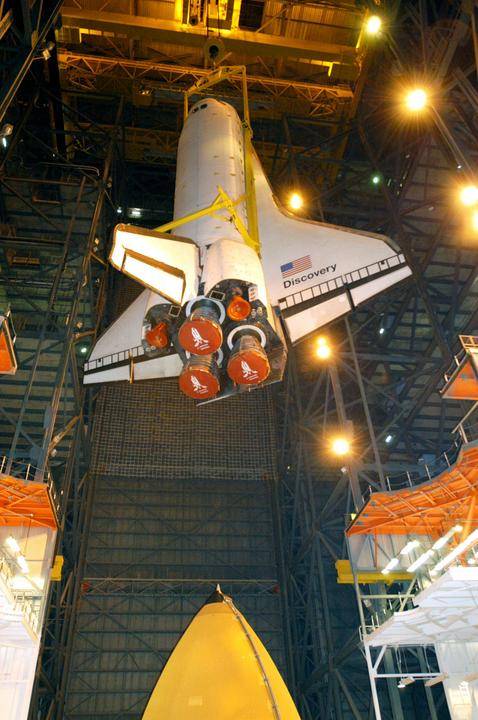
Discovery roll out


The roll out of Discovery happend on Friday, May 19. I'm just catchin' up.
Space Shuttle Discovery's 4.2-mile journey from the Vehicle Assembly Building to Launch Pad 39B is complete! The move brings NASA one step closer to the STS-121 mission, targeted for launch no earlier than July 1.

Mounted on the Mobile Launcher Platform and carried by the mammoth crawler-transporter, Discovery emerged from the assembly building at 12:45 p.m. EDT. The "stack" rolled along at less than one mile an hour, and arrived at the launch pad early Friday evening.

This mission will continue the evaluation of flight safety procedures, including shuttle inspection and repair techniques. It also will deliver more supplies and cargo for future station expansion.

Steve Lindsey will command the mission, flying with pilot Mark Kelly, spacewalkers Mike Fossum and Piers Sellers and mission specialists Stephanie Wilson and Lisa Nowak. European Space Agency astronaut Thomas Reiter is also part of the crew and will remain on the station for several months. Reiter's arrival will give the station its first three-person crew since May 4, 2003.

Fail Safe for Minuteman III

Local space news from OC Resigter here.
FAIL SAFE
Boeing-Anaheim will build on its long history in defense, developing hardware that will allow controllers to destroy Minuteman III intercontinental ballistic missiles if they become a safety hazard during flight. The U.S. Air Force awarded Boeing-Anaheim $25.2 million to create the device, a wafer that also will improve the military's ability to track the missiles and gauge their accuracy.

The Minuteman is the land-based arm of the nation's nuclear arsenal. Nukes also can be fired by submarines and dropped by long-range bombers. The "M-3" has a range of more than 6,000 miles and can deliver multiple warheads. Unarmed Minuteman missiles are periodically launched on test flights from Vandenberg Air Force Base and produce contrails visible from Orange County.

Boeing-Anaheim has specialized in control-and-guidance systems for decades, and it developed the navigation systems for virtually all submarines in the modern American fleet.

OC Astronaut going to ISS

Michael Lopez-Alegria will be going to the ISS for a six month trip around the Earth! Yeah!
Veteran astronaut-spacewalker Michael Lopez-Alegria, who was raised in Mission Viejo, has been assigned to spend six months aboard the International Space Station, where he'll serve as mission commander, NASA says on its Web site.

Lopez-Alegria, 47, also will serve as science officer when he arrives at the space station aboard a Russian Soyuz spacecraft in September, NASA says.


Another OC resident will be on a Shuttle mission next year.
Caldwell, 36, will be part of a six-member crew that is expected to use shuttle Endeavour to carry a 3,900-pound section of space station framework that was built at Boeing-Huntington Beach. The shuttle also will transport supplies to the station, which is only half- finished.

NASA hasn't set a date for the flight, which will be Caldwell's first trip into space. But the mission is tentatively scheduled for June 2007 and could be historic. The crew also includes astronaut-educator Barbara Morgan, who was the backup for Christa McAuliffe, the teacher who died when shuttle Challenger exploded in 1986.

I'm glad that Barbara Morgan will be on the flight also.

The Vision in trouble?

Ht from Instapundit on this article in Popular Mechanics by Tom Jones:
If Administrator Mike Griffin is responsible for this hard-eyed approach top NASA’s future, he is to be commended. But the constant tinkering with launchers and the cost and schedule difficulties still to be grappled with in getting the new Crew Exploration Vehicle off the ground will only exacerbate Congressional suspicions that NASA, faced with painful budget choices, is trying to low-ball the costs for its exploration plans. The agency tried the same tactic 15 years ago with the Space Station, and suffered a huge loss in credibility with the administration, Congress and the public. NASA knows it must not squander the Vision opportunity, but can it avoid a repetition of its past missteps? If America hopes to fly astronauts again once the shuttle retires, the answer must be yes.

Thursday, May 11, 2006

Titan Video

"It was a very complicated process," said Erich Karkoschka, a senior staff scientist with the Lunar and Planetary Laboratory at the University of Arizona who integrated the Huygens images into mosaics and videos. Putting the images together "to build mosaics and make it without any seams ... that took quite a lot of time."

Huygens spent about 147 minutes descending through Titan's atmosphere. During that time, the probe's NASA-funded Descent Imager/Spectral Radiometer (DISR) photographed the moon's orangish atmosphere and mottled, gullied surface from three separate angles.

(Via CNN here.)

Video here via Space.com.

Wonderful view of Titan and the flight and landing of Huygens. Great job University of Arizona!