


++Most spacewalks -- five -- during a station assembly mission.
The Endeavour astronauts tied a record jointly held by astronauts on four Hubble Space Telescope servicing missions.
++Longest shuttle stay at the station: 11 days, 20 hours and 36 minutes.
The astronauts delivered the first segment of the Japanese Kibo science research facility, and they assembled a two-armed Canadian robot poised to do maintenance work outside the station.
They knocked off other seemingly mundane-yet-critical construction chores during a mission that raised the bar for future assembly crews.
Said senior NASA manager LeRoy Cain: "It's just been remarkable."
Endeavour and its crew are scheduled to land 33 minutes before sunset Wednesday: 7:04 p.m. EDT.
"A climate model is not a crystal ball," he says. "It's impossible to make a perfect representation of climate. There are choices you make in model development that lead to a range of model behaviors. Often it is not possible to say that one [model] is better than another."

A European space freighter as big as a double-decker bus is set to blast off from a South American spaceport Saturday night, heading toward a docking test with the International Space Station.
Weighing 20 tons, the unmanned spacecraft is almost four stories tall and is equipped with an automated docking system never tested in orbit.
Independent investigators raised concerns last year about trying to dock it at the station without a test flight to a target spacecraft first.
Two orbital dress rehearsals are planned before it attempts to dock at the station, and project officials insist the hookup can be performed without endangering the $100 billion outpost or its crew.
"We're absolutely confident with the safety aspects of this spacecraft," NASA station program manager Mike Suffredini said.
The Automated Transfer Vehicle, or ATV, is a key component of the European Space Agency's $7.4 billion contribution to the station project.
Launch of the first ATV, which is named after pioneering 19th-century science fiction writer Jules Verne, is the culmination of a $1.9 billion project that dates back to 1995.
Launch tonight is targeted for 11:03 p.m. EST, and we will have live coverage of the countdown. We will have live video of the launch, via NASA TV, and a second feed from the European Space Agency. Our coverage will pick up with fueling, around 7 p.m. EST. The live video webcast begins just after 10 p.m.HT Flame Trench here.
Federal climatologists today declared an end to Orange County’s long and damaging drought, reclassifying the region as abnormally dry, the lowest level of concern in a comparatively dry year.
Orange County thus becomes the last area of coastal Southern California to be removed from any of the drought categories that climatologists list on the U.S. Drought Monitor, which is updated weekly.

"The fact that NASA is using, for the very first time, recovered Columbia pieces -- that obviously has real impact when people see it," KSC spokesman Allard Beutel said. "People have had an emotional response."
A cockpit switch panel is displayed behind the glass.
The Columbia crew would have used it to control the fuel drain and purge system on the shuttle's lefthand orbital maneuvering engine, which propelled the spaceship onto its final trajectory.
The Crew Module Side Hatch Pyro-Initiator T-Handle also is displayed. It would have been used to jettison the orbiter's side hatch had the astronauts been able to bail out of the shuttle.
Snow cover over North America and much of Siberia, Mongolia and China is greater than at any time since 1966.
The U.S. National Climatic Data Center (NCDC) reported that many American cities and towns suffered record cold temperatures in January and early February. According to the NCDC, the average temperature in January "was -0.3 F cooler than the 1901-2000 (20th century) average."
China is surviving its most brutal winter in a century. Temperatures in the normally balmy south were so low for so long that some middle-sized cities went days and even weeks without electricity because once power lines had toppled it was too cold or too icy to repair them.
And remember the Arctic Sea ice? The ice we were told so hysterically last fall had melted to its "lowest levels on record? Never mind that those records only date back as far as 1972 and that there is anthropological and geological evidence of much greater melts in the past.
The ice is back.
Gilles Langis, a senior forecaster with the Canadian Ice Service in Ottawa, says the Arctic winter has been so severe the ice has not only recovered, it is actually 10 to 20 cm thicker in many places than at this time last year.
"We have a fireball, and given that there's no fuel (on the tip of the missile), that would indicate that that's a hydrazine fire," he said.
The video showed the three-stage SM-3 missile launching from the USS Lake Erie at 10:26 p.m. EST Wednesday northwest of Hawaii, and of the missile's small "kill vehicle" - a non-explosive device at the tip - maneuvering into the path of the satellite and colliding spectacularly.
Cartwright said the satellite and the kill vehicle collided at a combined speed of 22,000 mph about 130 miles above Earth's surface, and that the collision was confirmed at a space operations center at 10:50 p.m. EST.
The satellite was described as the size of a school bus and weighing about 5,000 pounds.
 From Bob Christy here.
 by Rob Ratkowski
"I'm still having a hard time believing I actually caught the debris, but two others with us also saw a bright dot move fast from what was to be the intercept position," Hawaii-based skywatcher Rob Ratkowski told SPACE.com.
He observed a meteor shower of sorts when, apparently, bits of debris from the broken-up satellite burned up as they fell through Earth's atmosphere. Ratkowski, a professional photographer and astronomy enthusiast, took photos of what he saw from Maui, near where the U.S. Navy ship fired the missile that intercepted the satellite.
A missile launched from a Navy ship successfully struck a dying U.S. spy satellite passing 130 miles over the Pacific on Wednesday, a defense official said. Full details were not immediately available.
It happened just after 10:30 p.m. EST.
Two officials said the missile was launched successfully. One official, who is close to the process, said it hit the target. He said details on the results were not immediately known.
The goal in this first-of-its-kind mission for the Navy was not just to hit the satellite but to obliterate a tank aboard the spacecraft carrying 1,000 pounds of a toxic fuel called hydrazine.
U.S. officials have said the fuel would pose a potential health hazard to humans if it landed in a populated area. Although the odds of that were small even if the Pentagon had chosen not to try to shoot down the satellite, it was determined that it was worth trying to eliminate even that small chance.
Officials said it might take a day or longer to know for sure if the toxic fuel was blown up.
 From Reuters
The Greyhound bus-sized intelligence satellite failed shortly after launch in 2006. Intended to conduct both electronic eavesdropping and photographic intelligence-gathering, the satellite contains a large tank of unused toxic fuel called hydrazine. The fuel would pose a health risk if the tank survived re-entry and landed in a populated area. The satellite has been gradually moving closer to the atmosphere and could come down some time in the next several weeks.
Since the satellite cannot be maneuvered to fall into the ocean, the plan calls for firing a modified Navy SM-3 anti-missile interceptor from an Aegis battle management system equipped warship in the northern Pacific, as the satellite nears the atmosphere.
It will be the first time a missile defense interceptor will be used against a satellite, something that has not been attempted since the 1980s, when the Pentagon tested an anti-satellite missile from a jet fighter.
Iran plans to launch two more rockets into space
Feb 11 06:46 AM US/Eastern
Iran is to launch two more rockets into space in the next few months, President Mahmoud Ahmadinejad announced on Monday, after a firing of a rocket earlier this month sparked international concern.
"Two other rockets will be launched so that we can then send a satellite into space," Ahmadinejad said at a rally in Tehran broadcast live on state television.
"We home that Iran's first home-produced satellite will be launched in the summer," he added, reiterating a prediction made by other Iranian officials who said the satellite would be launched in May.
On February 4, Iran fired a rocket into space to mark the opening of its first space centre, triggering swift condemnation from the United States amid continued tensions over the Iranian nuclear drive.
Ahmadinejad hailed the launch of the rocket, named Kavoshgar-1, as a success and for the first time gave some technical details about its launch.

Fifty years ago today, missile pioneers here thrust the United States into a space race with the Soviet Union, launching America's first "man-made moon."
Ike Rigell and Terry Greenfield peered through tinted green bulletproof glass in a blockhouse at Launch Complex 26 as an Army rocket lit up night skies over the Atlantic coast.
Kelly Fiorentino stood in a Quonset hut on an island in the Bahamas, ready to transmit a second-stage ignition signal — a precisely-timed switch-flip critical to propelling the Explorer 1 satellite into orbit.
And on that frigid Friday night in Huntsville, Ala., Norm Perry and dozens of Army Ballistic Missile Agency workers shivered beneath loudspeakers in a downtown square.
A telltale beep-beep finally blared out about an hour and 45 minutes after launch, signaling mission success. The crowd erupted in cheers.
"We had no idea it was in orbit until it had completely gone around Earth," said Perry, 74, of Titusville. "As soon as it came across, the whole square heard (the beep). We heard it, and we went wild."
With good reason, too.
Four months earlier, on Oct. 4, 1957, the Soviet Union launched Sputnik, the world's first artificial satellite, a 184-pound sphere the size of a medicine ball.
Then less than a month later, on Nov. 3, the Soviets sent up a half-ton orbiter with a living, breathing creature, a dog named Laika.
The American public panicked. The back-to-back Sputniks created hysteria. Fearful people realized Soviet rockets were powerful enough to rain nuclear bombs on U.S. soil. Anytime. Anywhere.

Researchers once thought Mercury to be much like Earth's moon, but MESSENGER has found many differences. For instance, unlike the moon, Mercury has huge cliffs with structures snaking hundreds of miles across the planet's face. The spacecraft also revealed impact craters that appear very different from lunar craters. One particularly curious crater has been dubbed "The Spider."
This formation never has been seen on Mercury before and nothing like it has been observed on the moon. It lies in the middle of a huge impact crater called the Caloris basin and consists of more than 100 narrow, flat-floored troughs radiating from a complex central region.
"The Spider has a crater near its center, but whether that crater is related to the original formation or came later is not clear at this time," said James Head, science team co-investigator at Brown University, Providence, R.I.

In yet another NASA first, the robotic Messenger probe beamed back pictures this week of parts of the planet Mercury that never have been seen by spacecraft before.
Soon after sweeping within 124 miles of the planet's surface on Monday, Messenger snapped this photo of half of a hemisphere that was missed by the only other spacecraft to visit Mercury -- Mariner 10, which made three flybys in 1974 and 1975.
I am astounded by the naiveté of those folks who seem to think there is some magic, non-polluting energy source out there that “Big Oil” has been hiding from us until all of the petroleum runs out. As these reality deniers continue to drive cars and fly in airplanes, they deny the fact that mankind’s dependence on oil is not out of choice, but necessity.
It makes me cringe when I see bloggers and pundits say things like, “What’s the downside of reducing greenhouse-gas emissions? Even if we’re wrong about man-made global warming, we’ll end up with better energy technologies and cleaner air. And if we’re right, we’ll save the planet!”
The only problem is, no matter how serious you think global warming will be, our current renewable-energy technologies and conservation will make virtually no difference to future global temperatures.
As I said above - and this may come as a surprise - scientists are mere mortals.
The tendency to succumb to group-think and the herd-instinct (now formally called the "informational cascade") is perhaps as tempting among scientists as any group because we, by definition, must be the "ones who know" (from the Latin sciere, to know).
You dare not be thought of as "one who does not know"; hence we may succumb to the pressure to be perceived as "one who knows".
This leads, in my opinion, to an overstatement of confidence in the published findings and to a ready acceptance of the views of anointed authorities.
Scepticism, a hallmark of science, is frowned upon. (I suspect the IPCC bureaucracy cringes whenever I'm identified as an IPCC Lead Author.)
The signature statement of the 2007 IPCC report may be paraphrased as this: "We are 90% confident that most of the warming in the past 50 years is due to humans."
We are not told here that this assertion is based on computer model output, not direct observation. The simple fact is we don't have thermometers marked with "this much is human-caused" and "this much is natural".
So, I would have written this conclusion as "Our climate models are incapable of reproducing the last 50 years of surface temperatures without a push from how we think greenhouse gases influence the climate. Other processes may also account for much of this change."
New observations of the Mars-bound Asteroid 2007 WD5 have allowed astronomers to refine their predictions for the space rock's position during its red planet rendezvous on Jan. 30, according an update by NASA's Near-Earth Object (NEO) program office.
"As a result, the impact probability has dropped dramatically, to approximately 0.01 percent or 1-in-10,000 odds, effectively ruling out the possible collision with Mars," researchers said in the Jan. 9 report.
The new odds were released one day after astronomers with NASA's NEO office at the Jet Propulsion Laboratory (JPL) in Pasadena, Calif., lowered 2007 WD5's chances of striking Mars from 3.6 percent to 2.5 percent, or about a 1-in-40 chance, on Tuesday. After analyzing results from a new round of observations between Jan. 5 and Jan. 8, scientists now estimate the asteroid will make its closest pass by Mars at a maximum distance of about 16,155 miles (26,000 km).
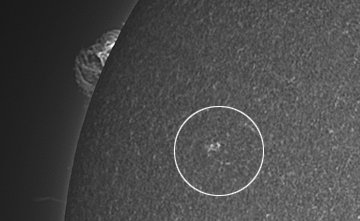
Many forecasters believe Solar Cycle 24 will be big and intense. Peaking in 2011 or 2012, the cycle to come could have significant impacts on telecommunications, air traffic, power grids and GPS systems. (And don't forget the Northern Lights!) In this age of satellites and cell phones, the next solar cycle could make itself felt as never before.
The furious storms won't start right away, however. Solar cycles usually take a few years to build to a frenzy and Cycle 24 will be no exception. "We still have some quiet times ahead," says Hathaway.
Solar physicists have been waiting for the appearance of a reversed-polarity sunspot to signal the start of the next solar cycle. The wait is over. On Jan. 4th, a magnetically reversed sunspot emerged at solar latitude 30 N, shown in this photo taken by Greg Piepol of Rockville, Maryland.
Well here is the news release from the Space and Science Research Center here.
Today, the Space and Science Research Center, (SSRC) in Orlando, Florida announces that it has confirmed the recent web announcement of NASA solar physicists that there are substantial changes occurring in the sun’s surface. The SSRC has further researched these changes and has concluded they will bring about the next climate change to one of a long lasting cold era.
Today, Director of the SSRC, John Casey has reaffirmed earlier research he led that independently discovered the sun’s changes are the result of a family of cycles that bring about climate shifts from cold climate to warm and back again.
“We today confirm the recent announcement by NASA that there are historic and important changes taking place on the sun’s surface. This will have only one outcome - a new climate change is coming that will bring an extended period of deep cold to the planet. This is not however a unique event for the planet although it is critically important news to this and the next generations. It is but the normal sequence of alternating climate changes that has been going on for thousands of years.
UPDATE: I have been informed that SSRC's John Casey could be a fake. After going though the Climate Change blogs the consensus is this is an ad-hoc web site here. I stand corrected. However I still do not agree that global warming is caused by C02 or human made. I don't think the label "denier" is correct either for those who do not agree that the theory of AGW is happening. I still think Solar Cycles do play a part in Global cooling and warming.

Observations of the asteroid between Dec. 29 and Jan. 2 allowed astronomers to slightly lower the space rock's odds of striking Mars to about 3.6 percent (down from 3.9), giving the object a 1 in 28 chance of hitting the planet, according to Tuesday report from NASA's Near Earth-Object program office at the Jet Propulsion Laboratory in Pasadena, Calif.
More observations may further reduce the asteroid's impact chances to nil, NEO officials said. The space rock's refined course stems from observations by astronomers at New Mexico Tech's Magdalena Ridge Observatory.
But if WD5 does smack into Mars, some astronomers have a fair idea of what havoc it may spawn. The likely strike zone would be near the equator, but to the north of the current position of NASA's Opportunity rover at Victoria Crater, NASA officials have said.
Mark Boslough, a collision dynamics expert at New Mexico's Sandia National Laboratory, said the atmosphere at Mars' surface is similar to that of Earth at an altitude of 12 miles (20 km). Some space rocks that target Earth explode under the pressure created as they stream into our atmosphere. But they tend not to explode until much below the 12-mile mark.
The one candidate whose positions on space have received the most attention—and scrutiny—has been Sen. Hillary Clinton. That attention is based in part on her standing as one of the front runners in the Democratic race, but also because she is the one candidate, Democratic or Republican, who has provided any sort of detailed position on what she would do in space policy if elected. Even Dave Weldon, a Republican Congressman from Florida, said earlier this month, “The best person with a space policy—actually, the only candidate with any kind of substantial space policy on their Web site—is Hillary.”
Another question about Clinton’s policy is her support for the Vision for Space Exploration. Her policy does mention support for “later human missions” beyond the completion of the International Space Station, but does not explicitly endorse the goals laid out nearly four years ago by President Bush to return humans to the Moon by 2020 and, later, send humans to Mars. In a New York Times article the day after her speech, Clinton indicated that such goals would be set aside in favor of restoring funding for aeronautics and space policy. Such exploration, she told the Times, “excites people,” but “I am more focused on nearer-term goals I think are achievable.”
 From SpaceWeather.com
These are star trails--slow, graceful arcs traced by the stars as Earth spins on its axis. "A full 180° rotation of the circumpolar stars can be obtained only at this time of year when the astronomical night lasts more than 12 hours," says photographer Lorenzo Comolli. "I took this all-night picture on Dec. 28-29 using my Canon 350D on a tripod in light polluted Tradate, Italy."
The stubby arc near the center of the swirl is Polaris, also known as "the North Star" because Earth's north pole points almost directly at it. Polaris may be the most famous star in the heavens--but fame is fleeting! Earth's spin axis is precessing and in 10,000 years or so white-hot Vega (six times brighter than Polaris) will take over as North Star. Star trail photos will look even prettier then, with an intense bright dot illuminating the core of the starry whirlpool.
After removing foam protection on Friday, technicians were scheduled to remove a suspect connector from Atlantis' external tank today.
The failed connector, which scrubbed launches on Dec. 6 and 9, will be sent away for testing. It provides readings from redundant low-fuel sensors in the bottom of the external tank and instruments that would shut down the shuttle's main engines before the turbopumps ran dry and flew apart.

Crossing the Winter Finish Line ... for Now
Human explorers would be hard pressed to show more persistence than NASA's Mars rover Spirit. After weeks of careful driving with a broken front wheel, Spirit finally made it to a north-facing slope of "Home Plate."
The rover gradually descended over the north edge to get into position, as shown here, tilting its solar panels 13 degrees toward the sinking winter Sun to maximize power. Rover drivers plan to continue nudging Spirit forward, increasing the tilt, to track the Sun as it moves lower in the northern sky.
Image credit: NASA/JPL-Caltech/Hazard avoidance camera

"In January 2008 we celebrate the 50th Anniversary of Explorer 1, the first American satellite, which was built at JPL.? This is a historic milestone not only for the Jet Propulsion?Laboratory, Caltech and Pasadena, but for the country," said Charles Elachi, director of?JPL. "I can think of nothing better than kicking off the celebration?with a float in the ultimate New Year's pageant, the Rose Parade." JPL is managed for NASA by the California Institute of Technology in Pasadena.
UPDATE 1/6/08: An article about the JPL float here at About Space.com.

The chance that a rogue mini-world — asteroid 2007 WD5 — will smack into Mars on January 30th has increased from 1.3 percent to 3.9 percent.Read more at Live Science here.
That’s the new estimation from officials at the Near Earth Object Program at the Jet Propulsion Laboratory (JPL), stemming from several sky watching teams in Alaska, New Mexico, and in Arizona.
The pre-discovery observations were located by Andy Puckett, a recent Ph.D. from the University of Chicago who has since moved to the University of Alaska Anchorage. Dr. Puckett located the observations in the archive of the Sloan Digital Sky Survey II, which contains extensive repeat coverage of 300 square degrees along the sky's celestial equator. The observations were taken using a 2.5 meter aperture telescope at the Apache Point Observatory near Cloudcroft, New Mexico. For the recent orbit refinement, these pre-discovery observations on November 8 were added to the existing observations provided by the Catalina Sky Survey and Spacewatch observatories (both near Tucson AZ) as well as New Mexico Tech's Magdalena Ridge Observatory.

William Anders:
"For all the people on Earth the crew of Apollo 8 has a message we would like to send you".
"In the beginning God created the heaven and the earth.
And the earth was without form, and void; and darkness was upon the face of the deep.
And the Spirit of God moved upon the face of the waters. And God said, Let there be light: and there was light.
And God saw the light, that it was good: and God divided the light from the darkness."
Jim Lovell:
"And God called the light Day, and the darkness he called Night. And the evening and the morning were the first day.
And God said, Let there be a firmament in the midst of the waters, and let it divide the waters from the waters.
And God made the firmament, and divided the waters which were under the firmament from the waters which were above the firmament: and it was so.
And God called the firmament Heaven. And the evening and the morning were the second day."
Frank Borman:
"And God said, Let the waters under the heavens be gathered together unto one place, and let the dry land appear: and it was so.
And God called the dry land Earth; and the gathering together of the waters called he Seas: and God saw that it was good."
Borman then added, "And from the crew of Apollo 8, we close with good night, good luck, a Merry Christmas, and God bless all of you - all of you on the good Earth."

Mars is retrograding (moving westward) through the stars of Gemini and will cross over into Taurus on Dec. 30. It will come closest to the Earth on the night of Dec. 18 (around 6:46 p.m. EST). The planet is then 54,783,381 miles (88,165,305 kilometers) from Earth. It is at opposition – exactly opposite from the sun, with Earth in the middle – six days later, on Christmas Eve, Dec. 24.
It will then gleam at magnitude -1.6, and through Jan. 2, 2008, will outshine Sirius, the brightest star.
The night that Mars will probably attract the most attention, from even those who don't normally look up at the sky, will be on the night before Christmas Eve: Sunday, Dec. 23. That will be the night of a full moon, and Mars will serve as a companion to it all through that night. In fact, it will result in an exceptionally close approach between the two across much of the United States, while for parts of the Pacific Northwest, southern and western Canada and Europe, the moon will actually occult (hide) Mars.
NASA could still pick up its original 2008 schedule after launching Atlantis on Jan. 10. A five-week turnaround between the launches of Atlantis and Endeavour would make that possible.
"If we launched on the 10th (of January), it does not affect the ability to launch on Feb. 14," said NASA spokesman Kyle Herring.
A Valentine's Day launch of Endeavour will return NASA to the schedule the agency proposed to complete the space station before the shuttle program ends in 2010.
However, if Atlantis' launch is delayed until Jan. 13 or 14, that would force a day for day slip in Endeavour's Valentine's Day mission. Laboratory modules will be delivered on both missions to the International Space Station.
"All of that still fits," said Herring.

"We wanted to say happy Thanksgiving to all our NASA viewers,"
Expedition 16 Commander Peggy Whitson, an Iowa native, said. "We feel particularly privileged and thankful to be up here on board the International Space Station this Thanksgiving, and we're looking forward to our activities this week. We have a busy week with spacewalks, and we hope that you also are having a great
Thanksgiving."
"My family, we gather for Thanksgiving, and we spend a minute just thinking about the things we're thankful for and, of course, I'm thankful for the continued health of my family and my loved ones," Flight Engineer DanTani, an Illinois native, said. "Also this year,I'm thankful that I'm safely on the space station, conducting our
mission successfully and having a great time doing it."
Perhaps the greatest tribute to shuttle commander Pam Melroy and station commander Peggy Whitson, and to their ground-breaking (perhaps we should say space-breaking?) predecessors such as Sally Ride, Kathy Sullivan, Shannon Lucid, Eileen Collins, and three dozen others, is that an examination of their technical credentials—their education, experience, and career achievements—couldn’t give a clue as to their gender. Their ultimate “firsts” were logical step-by-step progressions from their solid professional competence.
 From Hubble site here.
Hubble first observed Comet 17P/Holmes on June 15, 1999, when there was virtually no dusty shroud around the nucleus. From that observation, astronomers deduced that the nucleus had a diameter of approximately 2.1 miles (3.4 kilometers), about the length of New York City's Central Park. Astronomers hope to use the new Hubble images to determine the size of the comet's nucleus to see how much of it was blasted away during the outburst.From NASA here.
Hubble's two earlier snapshots of Comet Holmes also showed some interesting features. On Oct. 29, the telescope spied three "spurs" of dust emanating from the nucleus, while the Hubble images taken on Oct. 31 revealed an outburst of dust just west of the nucleus.
The Hubble images, however, do not show any large fragments near the nucleus of Comet Holmes, unlike the case of Comet 73P/Schwassmann-Wachmann 3 (SW3). In the spring of 2006 Hubble observations revealed a multitude of "mini-comets" ejected by SW3 after the comet increased dramatically in brightness.
Ground-based images of Comet Holmes show a large, spherically symmetrical cloud of dust that is offset from the nucleus, suggesting that a large fragment did break off and subsequently disintegrated into tiny dust particles after moving away from the main nucleus.

Commander Peggy Whitson and Daniel Tani spent hours hooking up power and heater cables and fluid lines between the space station and the Harmony compartment that was delivered by the shuttle last month. It was tedious, hand-intensive work.
"Yay! Got it," Whitson exclaimed after making a particularly difficult connection. "Those were hard."
Not long afterward, Tani commented on how strong Whitson looked.
"She's the king of the world," Tani shouted. "Queen," replied the space station's first female skipper, sparking laughter between the two.
Late last week a Russian astronaut trainee, working at Johnson Space Center, smelled smoke in his spacesuit and felt heat on his neck during a test in a pressure chamber.
NASA feels the problem will be cleared up and is examining CO2 scrub cans, which have not functioned properly in the past, said NASA spokesman Lynette Madison at Johnson Space Center.
"There is no evidence of a combustion source," said Madison. "They feel like this is going to be cleared up and there won't be any issue for the spacewalks." Late today, Mission Control radioed to tell the crew they expect to clear the spacesuits soon.

The payload:
Weighing 5,200 pounds, the DSP-23 satellite completed a 6 hour, 20 minute mission and was deployed into its proper orbit at 3:10 a.m., today. The DSP-23 launch completes the deployment of this important constellation of satellites. DSP satellites provide early warning for intercontinental ballistic missile launches and have been used by the military for more than 30 years.


Discovery is beginning to encounter the effects of the atmosphere, a point called "entry interface." Now flying at about 16,000 miles per hour, the orbiter is angled upward with wings level. The shuttle is set to touch down in just over 30 minutes.HT from NASA Landing Blog here.
What causes the booms?HT from Flame Trench here
Air pressure. As the shuttle cuts through the atmosphere flying faster than the speed of sound, air molecules get pushed aisde (like water around a fast-moving boat). The air molecules form a shock wave around the nose and the tail of an aircraft. The rapidly increasing air pressure can be heard as a loud boom.
Why two sonic booms?
The space shuttle is big for a supersonic aircraft. A typical aircraft capable of this kind of speed would be a fighter jet, something about 50 feet or so long. For those small fighters, the shock waves generated at the nose and the tail of the aircraft happen less than one-tenth of a second apart. On the ground, people would hear what sounds like one boom. The orbiter is 122 feet long. The time between the nose and tail shock waves is half of a second, just long enough for us to hear both of the booms.

With the shuttle and the station linked 220 miles above Earth, Discovery mission commander Pam Melroy floated through the hatch of the U.S. Destiny laboratory around 10:39 a.m. as the spacecraft flew over the Atlantic Ocean off the coast of North Carolina.
Melroy immediately embraced station skipper Peggy Whitson, the first woman to command the outpost. It was the first time two female space mission commanders have met in low Earth orbit.
While the astronauts practiced for launch, shuttle program managers held two days of meetings in advance of today's review. One of the topics discussed before the conclusion of last week's program review involved the reinforced carbon-carbon, or RCC, on Discovery's wing leading edge panels. In the past, there have been post-flight indications that the edges of a couple of panels have lost small amounts of their upper-level coating. Thermography, or thermal imagery, has been used to inspect the panels in order to identify any internal defects that could lead to coating loss.
The NASA Engineering and Safety Center has been working with shuttle engineers to better understand the potential causes of coating loss. At last Wednesday's meeting, the center recommended replacing three of Discovery's 44 panels.
Discovery has flown at least twice with these panels in the current condition, and with no indications of degradation based on thermography. At this point, the Space Shuttle Program has determined that Discovery's astronauts can safely carry out their mission without having to replace the panels.
"We're brainwashing our children," said Dr Gray, 78, a long-time professor at Colorado State University. "They're going to the Gore movie [An Inconvenient Truth] and being fed all this. It's ridiculous."
Dr Gray, whose annual forecasts of the number of tropical storms and hurricanes are widely publicised, said a natural cycle of ocean water temperatures - related to the amount of salt in ocean water - was responsible for the global warming that he acknowledges has taken place.
However, he said, that same cycle meant a period of cooling would begin soon and last for several years.
"We'll look back on all of this in 10 or 15 years and realise how foolish it was," Dr Gray said.
One of the topics discussed before the conclusion of the program review Wednesday involved the reinforced carbon carbon, or RCC, on Discovery’s wing leading edge panels. In the past, there have been post-flight indications that the edges of a couple of panels have lost small amounts of their upper-level coating. Thermography, or thermal imagery, has been used to inspect the panels in order to identify any internal defects that could lead to coating loss.
The NASA Engineering and Safety Center (NESC) has been working with shuttle engineers to better understand the potential causes of coating loss. At Wednesday's meeting, NESC recommended replacing three of Discovery's 44 panels.
Discovery has flown at least twice with these panels in the current condition, and with no indications of degradation based on thermography. At this point, the Space Shuttle Program has determined that Discovery's astronauts can safely carry out their mission without having to replace the panels.


On October 4 at 10:28 p.m. Moscow time, a brilliant and deafening detonation of smoke and flame illuminated the Soviet Union's rocket test site near Tyuratam, Kazkhistan, as the 32 nozzles announced the rise of the Russian R-7 intercontinental ballistic missile. 295 seconds and 142 miles later, the last of the R-7's engines shut down for good. Soon after, pneumatic locks were activated, a nosecone fairing separated, and an antenna spike was released. Then, in one final act that signaled the dawn of the space age, a pushrod connected to a bulkhead of the R-7 was activated, shoving a 183-pound beach ball-sized aluminum sphere into the cold, harsh blackness of space. Sputnik had arrived.

NASA wants the next astronauts visiting the moon to be driving a pressurized rover they could ride in like it was a motor home. If the crew spotted something intriguing outside, they'd climb into attached spacesuits and go explore.
"It's not much bigger than the Apollo rover. I call it a cross between a sports car and a spacesuit," said NASA astronaut Mike Gernhardt, who is working with engineers to develop more capable moon buggies.
The ice-shielded rover would protect the astronauts inside from solar storm radiation. The crew could spend most of its time in the comfort of shirtsleeves during trips from lasting hours to more than a week. If they need to go out, they can hop through a porthole into the ready-to-go spacesuits.
"It would only take 10 minutes to get in the suit and be boots on the surface," Gernhardt said.

A NATO fleet passing nearby reported seeing a "catastrophic volcanic eruption" at 7 p.m. local time Sunday on the island, about 70 miles off the Yemeni coast, said Ken Allan, a Navy Public Affairs with the Canadian Armed Forces.
"At this time, the entire island is aglow with lava and magma as it pours down into the sea," Allan said in an e-mail Sunday evening. "The lava is spewing hundreds of feet into the air, with the volcanic ash also (rising) a thousand feet in the air."
The NATO fleet was sailing toward the Suez Canal when it spotted the eruption. The government of Yemen asked NATO to assist in the search for survivors and the closet ship, the HMCS Toronto, was heading toward the island. The Canadian Armed Forces said they are trying to locate nine people believed to be at sea after the Yemen coast guard requested help. It is unclear why there was a discrepancy with the SABA report on the number of missing.

In preparation for the targeted Oct. 23 launch, Discovery is set to roll from the Vehicle Assembly Building out to the Launch Pad 39A aboard the crawler transporter this weekend. Earlier in the week, the orbiter was attached to the external fuel tank and twin solid rocket boosters atop the mobile launch platform.
In the predawn hours Thursday, the payload canister for mission STS-120 arrived at Launch Pad 39A at NASA's Kennedy Space Center. The Italian-built U.S. Harmony module destined for the International Space Center will be transferred to Discovery's payload bay once the space shuttle reaches the pad.
The pressurized component was named "Harmony" by U.S. students in a nationwide contest. "This module will allow all international partner pieces of the station to connect together, so it's really wonderful that kids recognize that harmony is necessary for space cooperation," said Bill Gerstenmaier, NASA's associate administrator for space operations, when the six winning schools who submitted the name were announced.
VANDENBERG AIR FORCE BASE, Calif. - A ground-based missile successfully intercepted a target missile Friday in a test of the nation's defense system, the Missile Defense Agency said.
ADVERTISEMENT
An intercontinental ballistic missile interceptor blasted out of an underground silo at Vandenberg Air Force Base shortly after 1:15 p.m., and tracked a target missile that had lifted off from the Kodiak Launch Complex in Alaska, the Boeing Co. said in a statement.
The Missile Defense Agency said initial results show the interceptor's rocket motor system and kill vehicle performed as planned. Boeing said the warhead was tracked, intercepted and destroyed.
Boeing is the prime contractor for what is formally known as the Ground-Based Midcourse Defense system.
The MDA expects to invest $49 billion in ballistic missile defense development and fielding over the next five years.
Two operational interceptor missiles are currently based at Vandenberg and there are 11 deployed at Fort Greely, Alaska.
Crews plan weekend search near Death Valley
By Brendan Riley
ASSOCIATED PRESS
7:35 p.m. September 25, 2007
CARSON CITY, Nev. – Relying on new leads from Air Force experts, crews looking for famed aviator Steve Fossett plan to comb a rugged area near Death Valley by air and foot, authorities said Tuesday.
Gary Derks, the state Department of Public Safety official in charge of the search, said the Air Force analyzed images picked up by radar and satellite and “picked up what could be Mr. Fossett, his track.”
“It gives us an idea, if it's him, what direction he was going,” Derks said of the wealthy adventurer, missing for more than three weeks.
Derks said the area stretches about 100 miles to the southeast from where Fossett took off Sept. 3, an airstrip on a million-acre ranch owned by hotel mogul Barron Hilton. Maps show the area would include Nevada's remote Silver Peak Range, close to Death Valley National Park in California.
“There's nothing definite, nothing concrete,” Derks said. “These are just some hits that we want to track.”
Search planes will fly over the area Saturday and Sunday, Derks said.
The area is “very rough terrain,” Derks said. “If he's there, he's going to be hard to see. That's why we're sending in the ground search-and-rescue crews, too.”
A private search effort by Fossett's family and friends continued Tuesday when a plane with sophisticated camera gear took off from the ranch.
Fossett, 63, has not been seen since he left on what was supposed to be a short ride in a lightweight acrobatic plane to scout locations to break the land speed record.
The adventurer, who made millions as a commodities broker in Chicago, is the first person to circle the globe solo in a balloon. He has also swum the English Channel, completed the Iditarod sled dog race and scaled some of the world's best-known peaks.
James Hansen received $720,000 from OSI, Open Society Institute a Geroge Sorros group and to fund his media campaign. Then he received $250,000 from the Heinz group (Mrs. John Kerry) and supported John Kerry in 2004.
Then the hockey puck theory was kicked out from him here:
After the the GISS data error was revealed, Hansen finally agreed to make public the method he uses to generate "official" temperature records from the actual readings. That process has been revealed to be thousands of lines of source code, containing hundreds of arbitrary "bias" adjustments to individual sites, tossing out many readings entirely, and raising (or lowering) the actual values for others, sometimes by several degrees. Many areas with weak or no rising temperature trends are therefore given, after adjustment, a much sharper trend. A full audit of the Hansen code is currently underway, but it seems clear that Hansen has more explaining to do.

The film also devotes time to a disaster that never happened - Armstrong and Aldrin being stranded on the moon. There's astonishing footage of President Richard Nixon delivering a eulogy to the astronauts, which, of course, never aired. Obviously, the fact that the speech was written and recorded says a lot about NASA's lack of confidence about the success of the mission - and the effect that failure would have had on the American public. The film continually makes the point - as do some of the astronauts - that the Apollo program represented what was good about the United States not only to Americans but also to the rest of the world.
 From Flame Trench
“The only moon landing in history is NASA’s Apollo expedition in 1968.”
MOSCOW (AFP) - Russia plans to send a manned mission to the Moon by 2025 and wants to build a permanent base there shortly after, the head of Russian space agency Roskosmos said Friday.I guess the AFP in Moscow doesn't fact check at all!
"According to our estimates we will be ready for a manned flight to the Moon in 2025," Anatoly Perminov told reporters. An "inhabited station" could be built there between 2027 and 2032, he said.


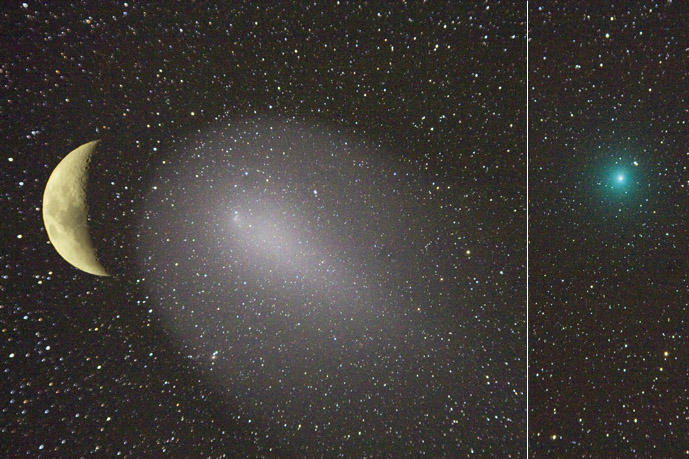 Comet Tuttle
 Fron SpaceWeather
 HT Florida Today


