Monday, January 22, 2007

China's Military Space program

Chinese Foreign Ministry officials have told a visiting US diplomat that the recent test of an anti-satellite weapon should not be regarded by any country as a threat nor does it signal the beginning of a race to militarize space, the State Department said Monday.

Assistant Secretary of Christopher Hill raised the issue with Chinese officials over the weekend in Beijing. China has not made a public announcement of the January 11 test, but officials acknowledged it during their meeting with Hill, State Department spokesman Sean McCormack said.

Hill, who heads the State Department's East Asia bureau, told the Chinese they should be more transparent about their military activities and their defense budget. These issues have been a long-running concern of the United States, and McCormack said the Chinese have taken only "baby steps" thus far toward more openness.


Yeah, right. Those baby steps caused a bunch of space junk to float around the Earth.Update: From Reuters on the Space junk here:
Trash from China's satellite-killing missile test has spread widely in space, creating a debris cloud that could jeopardize spy satellites and commercial imagery satellites in low orbits around Earth, U.S. officials said on Monday.

Even the manned International Space Station is vulnerable to being hit by some of the thousands of pieces of trash created when China slammed a ground-based medium-range ballistic missile into an aging Chinese weather satellite about 537 miles above Earth on January 11, the officials said.

"The test created a lot of debris. It definitely raises the possibility that something is going to be hit, including the space station," Peter Hays, a senior adviser to the Pentagon's National Security Space Office, told Reuters.

From Mars Blog and the silence from the Anti-nuke in space crowd here.
There is a tendency among people in Bruce's camp to see "The Other" as both morally superior and absolved from moral considerations at the same time. Being oppressed and exploited by the greedy, corporatist, racist, militaristic, imperialist U.S. relieves the The Other of any moral responsibility for their actions, leaving them free do as they wish -- to commit violence against whomever they please, for whatever reasons they choos, employing the most morally questionable means at their disposal. Whatever the acts of The Other, they will invariably escape the notice of the utopian pacifists. Yet when the U.S. (or Israel) take any military or intelligence-gathering action, it just as invariably registers in the microscopes of such "peace warriors", signalling them to gather together the peace community for a protest vigil and organic vegan potluck, and triggering yet another round of melodramatic handwringing about the death of democracy under the jackboot heel of corporate fascism and the insatiable war-hunger of the Military-Industrial Complex™.

It's always America's fault. Even, I suppose, the selective outrage and moral blindness of peace-radical moonbats.

I agree with Mars Blog that the Other (Chinese doing what they wish and WE the US is responsible for the Military Build up in Space.) Well this test is a threat even if they destroyed their own satellite. The junk left behind is in jeopardy of destroying and or damaging our space space station. Real great China. Now clean up your mess!

From Strategy page here:
Most of the pieces are tiny, but about 800 are truly dangerous (at least four inches long, wide or in diameter). What China did was, in terms of technology, something the U.S. and Russia had demonstrated over three decades ago. No big deal, unless you actually use it. While China has now demonstrated its ability to destroy satellites (at the cost of a launcher and a maneuverable KillSat), it has also caused a major stink among the dozens of nations that own, or use (usually via leasing arrangements) the several hundred satellites in orbit. That's because this Chinese test increased the amount of dangerous space debris by about eight percent. That's a lot. By common agreement, nations that put up satellites, include the capability for the bird, once it has reached the end of its useful life, will slowly move closer to earth, until it burns up as it enters the thicker atmosphere. This approach leaves no debris, which can collide with other satellites, behind. Even a small piece of satellite debris can, when hitting another satellite at high speed, destroy, or fatally damage, it.

Glen Reynolds has written about Military use of space here:
The United States is the world's biggest user of satellite services, both civilian and military -- but especially military. This puts us in a unique position. We have the strongest incentive to protect this sort of thing, and to maintain our lead, but we're also the most vulnerable. Space assets serve as an enormously important force multiplier for the U.S. Knock out every satellite in orbit and the United States military will suffer a considerable degradation in effectiveness; the Chinese military, or even the French, will lose much less.

Baa Hoo Weather Channel!

I was off the Internet part of the week due to software problems. I wanted to post about the Weather Channel's Climate person Heidi Cullen threat to TV meteorologists who are certified if they don't tow under the Global Warming mantra.

The Weather Channel’s most prominent climatologist is advocating that broadcast meteorologists be stripped of their scientific certification if they express skepticism about predictions of manmade catastrophic global warming. This latest call to silence skeptics follows a year (2006) in which skeptics were compared to "Holocaust Deniers" and Nuremberg-style war crimes trials were advocated by several climate alarmists.

The Weather Channel’s (TWC) Heidi Cullen, who hosts the weekly global warming program "The Climate Code," is advocating that the American Meteorological Society (AMS) revoke their "Seal of Approval" for any television weatherman who expresses skepticism that human activity is creating a climate catastrophe.


Other Links

From American Thinker (HT Anchoress)
OK. The human-caused global warming hypothesis is completely model-dependent. We can't directly observe cars and cows turning up the earth thermostat. Whatever the human contribution there may be to climate constitutes just a few signals among many hundreds or thousands.
All our models of the earth climate are incomplete. That's why they keep changing, and that's why climate scientists keep finding surprises. As Rummy used to say, there are a ton of "unknown unknowns" out there. The real world is full of x's, y's and z's, far more than we can write little models about. How do you extract the human contribution from a vast number of unknowns?
That's why constant testing is needed, and why it is so frustrating to do frontier science properly.


Blogs for Bush
And then there is the money - very large amounts of money for those who advocate global warming, very little for those who question the concept. If you're someone who wants to eat, which side will you find yourself on?

Update***From the Hill here:
Internet surfers trying to access the Senate’s website on Friday (oh, c’mon, you know you were) might have encountered a bit of a delay. For part of the day, all of the Senate’s Web pages, including senators’ personal pages and committee sites, were down.

The culprits? Two oft-blamed scourges: DrudgeReport.com and global warming. Well, sort of.

Traffic to a blog posted by Republicans on the Environment and Public Works Committee was so heavy Friday, thanks to a link posted on DrudgeReport.com, that the Senate site got bogged down. The blog entry that caused the stir was critical of the Weather Channel’s call for decertification of meteorologists who are skeptical of global warming.

An e-mail sent to Senate offices by the Sergeant at Arms, whose office was scrambling to fix the problem on Friday, read in part, “Drudgereport.com established a link on their web site to a press release on a Senate committee Web site. This link was creating 30-50,000 queries per hour to senate.gov, which in turn was generating a query to the Press Application for each of those hits.”

EPW ranking member Sen. James Inhofe (R-Okla.) started the blog in December.

Hmm, now if only the Senate could generate that kind of readership for such scintillating online features as “The Senate’s First Decade on the Web.”

Tuesday, January 16, 2007

Monday, January 15, 2007

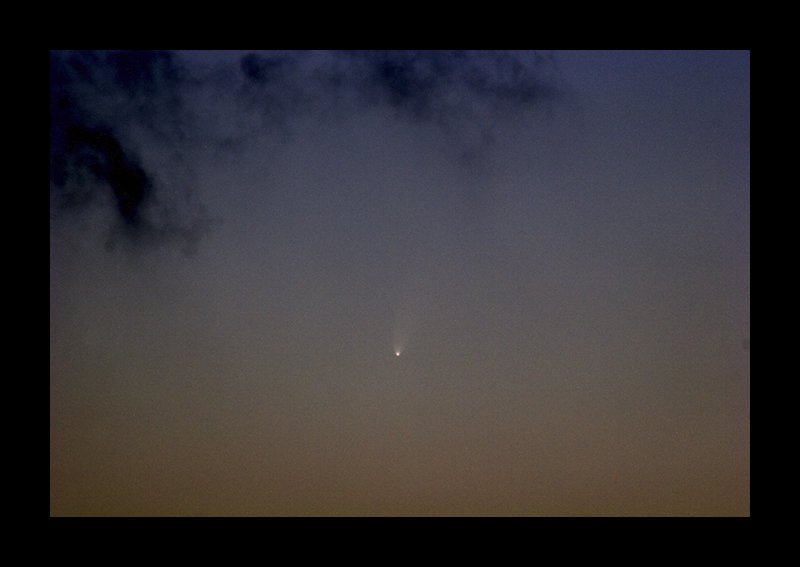
Comet Downunder


from spaceweather.com

NASA Budget cuts

With the new congress comes new worries about the space program. HT Drudge article in the Houston Chronicle here:
Congress' failure to approve a new annual budget for NASA could force the agency to lay off workers, gut science programs or delay the development of spacecraft to return astronauts to the moon, according to lawmakers and space experts.

The crunch comes because Congress is freezing most 2007 spending at 2006 levels through Sept. 30. NASA's budget will be held at $16.3 billion, more than $520 million short of President Bush's request as part of his vision for exploration of the moon and Mars.

"Congress votes on what size space program they want to buy," NASA Administrator Michael Griffin told the agency's workers last week during a question-and-answer session broadcast on NASA TV. " ... And we will remove a half-billion dollars of content to match what they have told us to do.

"We will do what we have to do to get our programs into the budget that we are given," he said.

Griffin stopped short of saying what exactly will be sacrificed, and NASA spokesman David Steitz said the agency is waiting for guidance from lawmakers on 2007 spending and the White House proposal for the 2008 budget.

"It's like planning your family's budget," Steitz said. "Until you have the paycheck in the bank, you can't figure out what bills you're going to pay."

But in an internal NASA memo, posted recently on the independent NASA watchdog Web site nasawatch.com, agency officials warned that the budget freeze could delay development of a manned spacecraft named Orion and its accompanying launch vehicle.

We can't have any delays in exploring the universe. Everyone must write their congressman and Senators to save the space program again. Also, we need to foster young people that space is important, it is the future, and will provide us prosperity for our nation.

Thursday, January 11, 2007

Comet McNaught

Comet McNaught

HT From Spaceweather:
Comet McNaught has continued to brighten as it approaches the sun and it is now the brightest comet in 30 years. For observers in the northern Hemisphere, tonight is probably the best time to see it: Go outside this evening and face the sunset. A clear view of the western horizon is essential, because the comet hangs very low. As the twilight fades to black, it should become visible to the naked eye. Observers say it's a fantastic sight through binoculars.

In the days ahead, Comet McNaught will pass the sun and emerge in good position for southern hemisphere viewing later this month. Meanwhile, solar heating will continue to puff up the comet, causing it to brighten even more. It could become one of the brightest comets in centuries, visible even in daylit skies.

Visit Spaceweather for photos and updates.

Monday, January 08, 2007

"Plutoed"


Plutoed. To pluto, as the ADS press release states, means "to demote or devalue someone or something, as happened to the former planet Pluto when the General Assembly of the International Astronomical Union decided Pluto no longer met its definition of a planet."


Ht from Language Log.

The press release at Disneyland when Pluto was demoted here:
BURBANK, CALIF (Thursday, August 24, 2006) – In reaction to news today that Pluto was demoted to the status of “dwarf planet,” the Seven Dwarfs issued their own short statement:

“Although we think it's DOPEY that Pluto has been downgraded to a dwarf planet, which has made some people GRUMPY and others just SLEEPY, we are not BASHFUL in saying we would be HAPPY if Disney's Pluto would join us as an 8th dwarf. We think this is just what the DOC ordered and is nothing to SNEEZE at.”

As Mickey Mouse’s faithful companion, Pluto made his debut in 1930 – the same year that scientists discovered what they believed was a ninth planet.

Said a white-gloved, yellow-shoed source close to Disney’s top dog, “I think the whole thing is goofy. Pluto has never been interested in astronomy before, other than maybe an occasional howl at the moon.”

NO KILL I

Two NASA space probes that visited Mars 30 years ago may have stumbled upon alien microbes on the Red Planet and inadvertently killed them, a scientist theorizes in a paper released Sunday.

The problem was the Viking space probes of 1976-77 were looking for the wrong kind of life and didn't recognize it, the researcher said in a paper presented at a meeting of the American Astronomical Society in Seattle.

This new report, based on a more expansive view of where life can take root, may have NASA looking for a different type of Martian life form when its next Mars spacecraft is launched later this year, one of the space agency's top scientists told The Associated Press.

Last month, scientists excitedly reported that new photographs of Mars showed geologic changes that suggest water occasionally flows there _ the most tantalizing sign that Mars is hospitable to life.

In the '70s, the Viking mission found no signs of life. But it was looking for Earth-like life, in which salt water is the internal liquid of living cells. Given the cold dry conditions of Mars, that life could have evolved on Mars with the key internal fluid consisting of a mix of water and hydrogen peroxide, said Dirk Schulze-Makuch, author of the new research.

That's because a water-hydrogen peroxide mix stays liquid at very low temperatures (-68 degrees Fahrenheit), doesn't destroy cells when it freezes, and can suck scarce water vapor out of the air.

The Viking experiments of the '70s wouldn't have noticed alien hydrogen peroxide-based life and, in fact, would have killed it by drowning and overheating the microbes, said Schulze-Makuch, a geology professor at Washington State University.


O Well. What would Sagan think?

HT from Space.com

Hawkings in space

Astrophysicist Stephen Hawking says he wants to undertake a zero-gravity flight aboard an airplane this year as a precursor to a journey into space, a newspaper reported Monday.

“This year I'm planning a zero-gravity flight and to go into space in 2009,'' he was quoted as saying in The Daily Telegraph newspaper.

Hawking, 65, has said he hopes to travel on British businessman Richard Branson's Virgin Galactic service, which is scheduled to launch in 2009. The service will charge space tourists about US$200,000 (about 100,000 pounds; euro155,000) for a two-hour suborbital trip some 87 miles (140 kilometers) above the Earth.

Branson was keen to help the scientist realize his dream of space flight, Virgin Galactic spokesman Stephen Attenborough said Monday.

HT From Space.com

Friday, January 05, 2007

Denver UFO? Video of meteor shower (?) over Denver Colorado

UFO? Naw, just a spent booster!

Spent Booster from Heaven

PETERSON AIR FORCE BASE, Colo. (AP) -- A spent Russian booster rocket re-entered the atmosphere Thursday over Colorado and Wyoming, the North American Aerospace Defense Command said.

Eyewitnesses reported seeing flaming objects in the sky at the time the rocket was re-entering, NORAD spokesman Lt. Cmdr. Sean Kelly said.

"It was pretty spectacular," said Riverton Police Capt. Mark Stone, who said he saw the burning object while he was retrieving his newspaper. "My first concern is that we had some sort of aircraft that was coming down. It was definitely leaving a burning debris trail behind it."

Stone said he could tell it was fairly large object, but it was too high to make out exactly what it was.

Kelly said the agency was unable to confirm a report that a piece of the rocket may have hit the ground near Riverton, Wyo., at about 6 a.m. MST.

No damage was reported, and any debris that may have hit the ground was not believed to be hazardous, NORAD said.

NORAD identified the rocket as an SL-4 that had been used to launch a French space telescope in December, and Kelly said U.S. spacewatchers knew the rocket was coming down.

"Objects falling from space are almost an everyday occurrence," Kelly said.

Note last post on falling rocks from Heaven.

Thursday, January 04, 2007

Rocks rain down from Heaven


"It's not all that uncommon to have rocks rain down from heaven," said Pryor, who had not seen the object that struck the Monmouth County home. "These are usually rocky or a mixture of rock and metal."

Pryor said laboratory tests would have to be conducted to determine if the object was a meteorite.

Police received a call Wednesday morning that the metal object had punched a hole in the roof of the single-family, two-story home, damaged tiles on a bathroom floor, and then bounced, sticking into a wall.

The object was heavier than a usual metal object of its size, said Brightman, who added that no radioactivity was detected.


HT Drudge

Monday, January 01, 2007

Happy New Year!


The running joke is "Aren't you too short for a Storm Trooper?"

HT from Instapundit a list of space books here.

The top science stories of 2006 here from Florida Today here.

Cassini sends a year to end greeting here.
The movie in quicktime is here.
Saturn's moon Hyperion appears to tumble toward Cassini in this movie that shows variations in color across the moon's surface.

The movie was created from 14 frames and represents about 12 hours as the spacecraft encountered Hyperion in early 2006. Most of the observable motion is due to the spacecraft's trajectory during the flyby.

The dark areas in the bottoms of craters are seen on all parts of Hyperion.


Year three for Mars Rovers here.

Flame Trench Mars Rover Aniversary link here.

Pluto was demoted this summer, here.
"Pluto is not a planet," Brown said. "There are finally, officially, eight planets in the solar system."

The vote involved just 424 astronomers who remained for the last day of a meeting of the International Astronomical Union (IAU) in Prague.

"I'm embarassed for astornomy," said Alan Stern, leader of NASA's New Horizon's mission to Pluto and a scientist at the Southwest Research Institute. "Less than 5 percent of the world's astronomers voted."

"This definition stinks, for technical reasons," Stern told SPACE.com. He expects the astronomy community to overturn the decision. Other astronomers criticized the definition as ambiguous.


The New Horzion mission to the Dwarf planet here.

Saturday, December 30, 2006

Follow the water


From SpaceDaily on the debate on finding life and the Viking Mars landers.
In the context of this debate, this is for fun, just to discuss what we can imagine out of our own brains about what life might be like if it were not so Earth-centric.

Steve Benner: I agree with that. The Viking 1976 experiments were designed by Joshua Lederberg, Norm Horowitz and Gil Levin, excellent outstanding molecular biologists. They should have been designed by organic chemists, and that was a paid political announcement brought to you by the American Chemical Society - and a card-carrying member of that.

One of the problems with life detection on Mars was that the 1976 experience contaminated the history of designing life detection. What's quite clear is that we have to throw at Mars whatever we can get in terms of sophisticated chemical analysis and instruments.

Every paper that I write, I say that it makes absolutely good sense for pragmatic reasons to follow the water, not because I can't conceive in an atmosphere of a life form that lives in ammonia or supercritical hydrogen helium fluids, but because it's the most likely way to not only find life, but to be able to recognize it if we do find it. It's hard enough to design something to find life in water. I couldn't even begin to design something to detect life that's a little bit different chemically from what we know.


From Astrobiology the series of discussions on finding life in the cosmos called "Launching the Alien Debates":

Thursday, December 28, 2006

President Ford's Space legacy


Do you remember Apollo-Soyuz? The Mars Viking landers? And the beginnings of the Shuttle program? All under President Ford's watch. Here is the Space.com article here.

On July 17, 1975, Gen. Thomas Stafford and Col. Alexei Leonov met in the middle, between their docked Apollo and Soyuz spacecraft, and heralded a new era of space travel and cooperation.


Later, Astronauts Vance Brand and Donald "Deke" Slayton, along with cosmonaut Valery Kubasov joined them for two days of scientific experiments and goodwill exchanges.

"Flying this mission required more than technological know-how," said NASA Administrator Dan Goldin. "It required courage, diplomacy, hardheaded perseverance and good humor -- not unlike what is necessary for the International Space Station."

Apollo-Soyuz not only set the stage for the Shuttle-Mir program, where astronauts flew aboard the Russian station Mir, but also provided what will likely be the template for an era of space exploration that takes us beyond Earth orbit.


And a year later the Viking I and II lands on Mars:
Viking was an ambitious mission. Altogether there were four spacecraft, two orbiters and two landers. Each orbiter and lander flew as a coupled pair from Earth to Mars, and separated in Mars orbit when the lander was ready to descend to the Martian surface. The twin Viking orbiters had cameras, an infrared thermal mapper, and a Mars atmospheric water detector. In addition to instrumentation to measure the composition and structure of the Martian atmosphere during descent, the Viking landers carried a full suite of sophisticated science experiments, including cameras, a meteorology boom, three biological instruments, separate organic and inorganic chemistry experiments, and a seismometer. Although the primary purpose of the landed mission was the search for life, the characterization of the Martian surface was also of great scientific importance.

Saturday, December 16, 2006

Fourth Space Walk at ISS

NASA Photos From Day 5


Those pesky solar panels still are giving the space walkers a hard time. They were successful in rewiring half the ISS Thursday. Today they should finish the wiring job then go to the stuck solar panels to see if they can unstuck them.
NASA hopes to duplicate the success it had with rewiring the international space station earlier this week so it can continue tackling a problem that has vexed it for days.

Spacewalking astronauts rewired half of the orbiting lab on Thursday and were set to rewire the other half on Saturday. The task went so flawlessly last time that U.S. astronaut Robert Curbeam and Swedish astronaut Christer Fuglesang were ready to go back into the space shuttle Discovery an hour ahead of schedule.

This time, Curbeam, a veteran spacewalker, and Sunita Williams, a rookie, will venture out to complete the rewiring task. If they have time to spare, they plan to make their way over to a halfway retracted solar panel, which so far has refused to fold properly.


The Flame Trench has the latest and video of the space walk that will occur about 2:30 EST today here.

Thursday, December 14, 2006

The ISS tele is fixed


Sen. Inhope's “SKEPTIC GUIDE TO DEBUNKING GLOBAL WARMING”

I saw this on friday about Senator's Inhofe's guide to debunking Global Warming here.
Senator James Inhofe (R-Okla.), the outgoing Chairman of Environment & Public Works Committee, is pleased to announce the public release of the Senate Committee published booklet entitled “A Skeptic’s Guide to Debunking Global Warming Alarmism. Hot & Cold Media Spin Cycle: A Challenge To Journalists who Cover Global Warming.”

Click here to download the "Skeptic's Guide"


The color glossy 64 page booklet -- previously was only available in hardcopy to the media and policy makers -- includes speeches, graphs, press releases and scientific articles refuting catastrophe climate fears presented by the media, the United Nations, Hollywood and former Vice President turned-foreign-lobbyist Al Gore.


Too bad this Senator will step down from his committee in the new year.

Wednesday, December 13, 2006

Space Storm a'coming

It looks like we will have a space storm due to the sunspot 930 flare activity. So that means our cell's, telcoms and satellites will have difficulties Thursday afternoon. Those in the north will have a spectacular aurora activity. I wonder how the astronauts will do?
Space weather forecasters revised their predictions for storminess after a major flare erupted on the sun overnight threatening damage to communication systems and power grids while offering up the wonder of Northern Lights.

"We're looking for very strong, severe geomagnetic storming" to begin probably around mid-day Thursday, Joe Kunches, Lead Forecaster at the NOAA Space Environment Center, told SPACE.com this afternoon.

The storm is expected to generate aurora or Northern Lights, as far south as the northern United States Thursday night. Astronauts aboard the international space station are not expected to be put at additional risk, Kunches said.

Radio communications, satellites and power grids could face potential interruptions or damage, however.

Solar flares send radiation to Earth within minutes. Some are also accompanied by coronal mass ejections (CME), clouds of charged particles that arrive in a day or two. This flare unleashed a strong CME that's aimed squarely at Earth.

"It's got all the rights stuff," Kunches said.

Solar Flare warning


The Shuttle astornauts and ISS members took cover last night due to the big solar flare activity from sunspot 930 here.

This is what the astronauts do to take cover from the radiation (from the Flame Trench here):
NASA flight surgeons and agency radiation experts determined that the burst of highly energetic particles approached a limit that made preventative action prudent.

Station commander Michael Lopez-Alegria and shuttle skipper Mark Polansky were told to move their crews to the most shielded areas in either spacecraft.

They include the middeck of the shuttle's crew compartment and temporary sleeping quarters in the station's U.S. Destiny science laboratory.

The back ends of the American lab and a Russian command control center at the outpost also were options.

Saturday, December 09, 2006

Back to the Moon


Unveiling the agency's bold plan for a return to the moon, NASA said it would establish an international base camp on one of the moon's poles, permanently staffing it by 2024, four years after astronauts land there.

It is a sweeping departure from the Apollo moon missions of the 1960s and represents a new phase of space exploration after the space shuttles are retired in 2010.


NASA chose a "lunar outpost" over the short expeditions of the '60s. Apollo flights were all around the middle area of the moon, but NASA decided to go to the moon's poles because they are best for longer-term settlements. And this time NASA is welcoming other nations on its journey.

The more likely of the two lunar destinations is the moon's south pole, because it's sunlit for three-quarters of the time. That offers a better locale for solar power, and the site has possible resources to mine nearby, said associate deputy administrator Doug Cooke.

"This is not your father's Apollo," said John Logsdon, director of the Space Policy Institute at George Washington University. "I think it's the only way to sustain something like this over decades. This is not a flag-and-footprints. This is the idea of starting an outward movement that includes long stays on the moon."

To get to the moon, NASA will use two vehicles — the Orion exploration vehicle and an attached all-purpose lunar lander that could touch down anywhere and be the beginnings a base camp, said exploration chief Scott Horowitz.

He likens the lander to a pickup truck.

"You can put whatever you want in the back. You can take it to wherever you want. So you can deliver cargo, crew, do it robotically, do it with humans on board. These are the types of things we're looking for in this system," Horowitz said at a news conference in Houston.

Last Great Launch from 39B


Another try for a launch


The shuttle astronauts are getting ready to board the Shuttle Discovery for another try to launch. Winds are a bit high 18 MPH and launch limit is 15 MPH. Lets hope they come down a bit.

I'll be a bit busy to live blog all of the launch stuff. But Flame Trench here and the NASA blog here do a better job. I have Christmas cards to do, dinner and keep an eye on the girls Christmas crafts (they can get a little bit carried over with glue and cut paper!)

Wednesday, December 06, 2006

Water Flowing out of Mars


I watched the press conference this morning. Before MGS was lost it captured pictures of water flows and new impact craters on Mars.
New photographs from space suggest that water occasionally flows on the frigid surface of Mars, raising the tantalizing possibility that the red planet is hospitable to life, scientists reported Wednesday.

The new images, taken by NASA's Mars Global Surveyor before it lost contact with Earth, do not actually show flowing water. Rather, they show changes in craters that provide the strongest evidence yet that water coursed through them as recently as several years ago, and is perhaps doing so even now.

"This is a squirting gun for water on Mars," said Kenneth Edgett, a scientist at San Diego-based Malin Space Science Systems, which operates a camera on the Global Surveyor.

The news excited scientists who hunt for extraterrestrial life. If the finding is confirmed, they say, all the ingredients favorable for life on Mars are in place: liquid water and a stable heat source.

In all of its Mars exploration missions, NASA has pursued a "follow the water" strategy to determine if the planet once contained life or could support it now.

Scientists believe ancient Mars was awash with pools of water. And at present-day Mars' north pole, researchers have spotted evidence of water ice. But they have yet to actually see water in liquid form.

"This underscores the importance of searching for life on Mars, either present or past," said Bruce Jakosky, an astrobiologist at the University of Colorado at Boulder, who had no role in the study.

"It's one more reason to think that life could be there."

Monday, December 04, 2006

Shuttle crew at the Cape

Discovery Shuttle Astronauts Arrive at NASA Spaceport
By Ker Than
Staff Writer
posted: 3 December 2006
5:56 p.m. ET

CAPE CANAVERAL, Fla. – The astronaut crew of NASA's next shuttle mission arrived here at the Kennedy Space Center (KSC) late Sunday, flying in aboard white and blue T-38 training jets.

The seven-member STS-116 crew was greeted by veteran astronaut Jerry Ross and Mike Leinbach, NASA’s launch director for the upcoming space shot. The astronauts’ family members also welcomed their Florida spaceport arrival.

"It was a beautiful flight out…I'm very, very excited to be here," the mission’s shuttle pilot, William Oefelein, said at NASA’s KSC Shuttle Landing Facility. "We seven certainly are very ready to go and we're looking forward to executing a great mission."

The astronauts are slated to launch aboard NASA’s shuttle Discovery on a 12-day construction flight the International Space Station (ISS) on Dec. 7 at 9:35:47 p.m. EST (0235:47 GMT). The planned liftoff will mark NASA's third shuttle mission this year and the agency's first night launch since 2002.

"We're going to go ahead and hopefully have one heck of a night show to give everybody this Thursday night," Discovery’s STS-116 commander Mark Polansky said.

The mission will include the delivery of a new portside piece of the ISS and a trio of spacewalks to rewire the outpost's power grid. It will also include the swap of Expedition 14 crewmember Sunita Williams for European Space Agency astronaut Thomas Reiter, who is finishing up a nearly six-month stint aboard the orbital laboratory.

"I'm just really happy to be here. It's been a long time coming," Williams said, adding that she’s spoken with her Expedition 14 crewmate-to-be Mikhail “Misha” Tyurin. "Misha Tyurin called the other day and said 'Suni, we're waiting for you!', so I just can't wait to get to my new home."

STS-116 mission specialists and multilingual crewmembers Nicholas Patrick and Christer Fuglesang—Sweden's first astronaut to fly—added a few words in Spanish and Swedish, respectively.

Not to be outdone, Alaskan native Oefelein added a few words in his state's official language: English. "I'll start by saying a few words in Alaskan—It's warm out here," he said.

Mission specialist Robert Curbeam turned the attention away from his fellow astronauts.

"This is a tribute to the guys that got our vehicle ready, to get all of us ready as well, for our 12 day trip and Suni's six month trip," Curbeam said. "We appreciate it and thank all of them…Also thanks to our family and friends and coaches and relatives for all the years of motivating us to do our best. We hope to make all those people who helped get us here proud."

For mission specialist Joan Higginbotham, the flight to KSC was a return home of sorts.

"I'm very happy to be here…I actually began my career here at Kennedy Space Center," she said. "To finally come back as an astronaut and get to work and fly on the vehicle that I used to work on is absolutely beyond words.

"When I got out the plane, Mike said to me 'That's a megawatt smile,' and that's how I feel," Higginbotham added. "I'm not going to wipe this grin off my face until December 19 when we land and I'm sure you'll still have a hard time wiping it off my face."

Thursday, November 30, 2006

ISS failed to raise up

The Russians failed to raise the ISS up to a corrected orbit hight.
Russian engineers failed to raise the orbit of the international space station by a planned distance Thursday and Russian and U.S. officials were discussing whether it would affect the upcoming launch of the space shuttle Discovery.

Federal Space Agency spokesman Valery Lyndin said the engines on the Progress M-58 cargo ship docked at the station were supposed to fire for around 17 minutes and push the station around 4 miles higher. However they unexpectedly shut off early, pushing the station just 1 mile up.

This might effect the upcoming shuttle mission in December. Engineers are looking at it now at NASA


Another problem I thought we faced during the Millenum:

NASA wants Discovery back from its 12-day mission by New Year's Eve because shuttle computers are not designed to make the change from the 365th day of the old year to the first day of the new year while in flight.

The space agency has figured out a solution for the New Year's problem, but managers are reluctant to try it since it has not been thoroughly tested.

If the space shuttle is not back on the ground during the change into the new year, NASA officials want it docked to the space station and not flying.


Are the computers on the shuttle still operating on a pre-Win2000 operating system?

Night Launch Cleared for Shuttle on Dec. 7th

CAPE CANAVERAL, Florida (AP) -- Preparations are on schedule for NASA's first nighttime space shuttle launch in four years as the space agency readies Discovery for a mission to the international space station, managers said Wednesday.

NASA plans to launch Discovery at 9:35 p.m. EST on December 7 for the third shuttle flight of the year and the fourth since the Columbia disaster killed seven astronauts in 2003.

The agency required the three launches after the Columbia accident to be in daylight so clear images could be taken of the shuttle's external fuel tank in case foam falls off. Foam breaking off the tank and striking Columbia's wing at liftoff caused the damage that led to the disaster.

"There were really no dissenting opinions on the night launch," said Bill Gerstenmaier, NASA's associate administrator.

The space agency needs to start launching shuttles at night to take advantage of more launch opportunities and finish space station construction by 2010, when the shuttle program ends.

Humans must leave Earth someday

Drudge has this by Steven Hawking on man leaving Earth to colonize space here:
"The long-term survival of the human race is at risk as long as it is confined to a single planet," he said. "Sooner or later, disasters such as an asteroid collision or nuclear war could wipe us all out. But once we spread out into space and establish independent colonies, our future should be safe.

"There isn't anywhere like the Earth in the solar system, so we would have to go to another star.

"If we used chemical fuel rockets like the Apollo mission to the moon, the journey to the nearest star would take 50,000 years. This is obviously far too long to be practical, so science fiction has developed the idea of warp drive, which takes you instantly to your destination. Unfortunately, this would violate the scientific law which says that nothing can travel faster than light.

"However, we can still within the law, by using matter/antimatter annihilation, and reach speeds just below the speed of light. With that, it would be possible to reach the next star in about six years, though it wouldn't seem so long for those on board."

The science fiction series Star Trek has used matter/antimatter annihilation as an explanation for the warp drive. But, in reality, he said that scientists believe that the flash of radiation produced when matter and antimatter are brought together and destroy one another could in fact one day be used to drive craft to close to the speed of light.

Tuesday, November 28, 2006

Ring Sunspot


This was taken this morning in the Philippines by John Nassr. From SpaceWeather.com here.

Single impact killed the Dinosaurs

Via Drudge here:
A new study provides compelling evidence that "one and only one impact" caused the mass extinction, according to a University of Missouri-Columbia researcher.

"The samples we found strongly support the single impact hypothesis," said Ken MacLeod, associate professor of geological sciences at MU and lead investigator of the study. "Our samples come from very complete, expanded sections without deposits related to large, direct effects of the impact – for example, landslides – that can shuffle the record, so we can resolve the sequence of events well. What we see is a unique layer composed of impact-related material precisely at the level of the disappearance of many species of marine plankton that were contemporaries of the youngest dinosaurs. We do not find any sedimentological or geochemical evidence for additional impacts above or below this level, as proposed in multiple impact scenarios."

MacLeod and his co-investigators studied sediment recovered from the Demerara Rise in the Atlantic Ocean northeast of South America, about 4,500 km (approximately 2,800 miles) from the impact site on the Yucatan Peninsula. Sites closer to and farther from the impact site have been studied, but few intermediary sites such as this have been explored.

Tuesday, November 21, 2006

Mars Global Surveyor Lost?


- NASA's best effort to find a missing Mars space probe failed Monday night, as scientists at the space agency began to lose hope for the 10-year-old planet-mapping workhorse.

After more than two weeks of silence from the Mars Global Surveyor, NASA will make other tries, but scientists began to sound resigned Tuesday.

"We may have lost a dear old friend and teacher," Michael Meyer, the lead scientist for NASA's Mars Exploration Program said in a news conference.

The $154 million surveyor, which finished its work eight years ago, is the oldest of six different active space probes on or circling the red planet.

Among its accomplishments are its more than 240,000 pictures of the red planet, offering the best big-picture view of the red planet.

"Every good thing comes to an end at some point," said Arizona State University scientist Phil Christensen. "It certainly in my mind greatly exceeded our wildest expectations of what to hope for. It revolutionized what we were thinking about Mars."

On Monday night, NASA had hoped to catch a glimpse of the surveyor from the camera on the new Mars Reconnaissance Orbiter. But the orbiter failed to spot it.

Now NASA will try an even less likely search effort. Engineers will send a signal to the silent spacecraft, asking it to turn on a beacon on one of the two Mars rovers below. If the rover beacon turns on, NASA could figure out where the lost Mars Surveyor is, said project manager Tom Thorpe.

Wednesday, November 15, 2006

Boxer to have hearings on Global Warming

How charming our own Senator is to have hearings on Global Warming. Is she going to call in William Gray and Max Mayfield on the carpet? (HT Drudge)
Automakers and manufacturers, beware: There's a new environmental policy boss in town, she scowls a lot, and two of her favorite phrases are "global warming" and "extensive hearings."

The Democrats' coming takeover of Congress is expected to feel pressure for policy change on a number of fronts, from Iraq to taxes, but the starkest change may come at the Senate Environment and Public Works Committee, when Sen. James Inhofe, R-Okla., will surrender the gavel to Sen. Barbara Boxer, D-Calif. Her appointment was announced Tuesday, but won't take effect until January.

Inhofe rejects a wide scientific consensus that human use of fossil fuels is largely responsible for catastrophic climate change, calling it "the greatest hoax ever perpetrated on the American people." He's accused environmental activists of exploiting people's fears to raise money. And he's blocked legislation aimed at curbing global warming.

Boxer, in contrast, is a fiercely liberal environmental activist. She has railed against Inhofe, crusaded for cleaner drinking water and led wilderness protection efforts in her home state and for Alaska's Arctic National Wildlife Refuge.

Her likely counterparts in the House of Representatives - Rep. John Dingell, D-Mich., incoming chairman of the Energy and Commerce Committee, and Rep. Nick Rahall, D-W.Va., of the Resources Committee - are less sympathetic to environmentalists. Dingell's constituents include the auto industry, and Rahall's include the coal industry. Then too, of course, George W. Bush remains president, and he's not exactly a global-warming crusader, either.

But Boxer said Tuesday that starting in January, her priority will be to begin "a very long process of extensive hearings" on global warming.

"I think there ought to be a global-warming bill that looks at all the contributors to carbon-dioxide emissions," she said. She cited California's legislation requiring automakers to reduce emissions as "an excellent role model."

Boxer also wants to boost the cleanup of Superfund toxic-waste sites by reinstating "polluter pays" fines, which lapsed under the Bush administration, and increase oversight of the Environmental Protection Agency.

Inhofe couldn't be reached for comment; Boxer said he'd called to wish her well.

Melinda Pierce, a lobbyist for the Sierra Club, cheered the coming change, saying Inhofe had been bad for the environment and that Boxer is an activist hero. But with a bare 51-49 Democrat majority in the next Senate and Bush in the White House, Pierce said, "We have no illusions that there's going to be some comprehensive global-warming bill signed by the president." Instead, she said, Boxer will likely "set an agenda and make modest gains for a time in 2009 when we have a new president."

Hank Cox of the National Association of Manufacturers said his group "will certainly have our door open," although he said Boxer "does represent a tougher stand on environmental issues than we've had in the past, and we can potentially see where there's going to be more vigorous debate."

"If you're going to make these assumptions about what is causing global warming, the whole world needs to participate together," Cox said. "The Chinese are opening a new coal-fired power plant every week, and within a few years they will pass us in terms of carbon-dioxide emissions. For the U.S. to impose severe, expensive economic restraints on our own economy, while the Chinese ignore it, would not have any appreciable impact on total global emissions."

Thursday, November 02, 2006

Iran tests missiles


Iran test-fired dozens of missiles, including the Shahab-3 that can reach Israel, in military maneuvers Thursday that it said were aimed at putting a stop to the role of world powers in the Persian Gulf region.

The show of strength came as Iran remains locked in dispute with the West over its nuclear program, which Washington says is geared to producing atomic weapons but Tehran says is only for generating electricity. The maneuvers came three days after U.S.-led warships finished naval exercises in the Gulf that Iran branded as "adventurist."

Discovery rolled out to VAB


NASA'S SPACE SHUTTLE DISCOVERY ROLLS TO VEHICLE ASSEMBLY BUILDING

NASA's Space Shuttle Discovery completed one milestone and is nearing
another as workers prepare the orbiter for a December launch to the
International Space Station.

On Tuesday night, drivers moved Discovery from the shuttle processing
facility to the Vehicle Assembly Building at NASA's Kennedy Space
Center in Florida. Discovery, perched on top of the giant, 76-wheel
orbiter transporter system, began moving out of the facility at 9:23
p.m. EST.

In the assembly building, technicians attached Discovery to its
propulsion elements, an external fuel tank and twin solid rocket
boosters. Following those operations, final integration, preparations
and closeouts began in preparation for flight.

Discovery's next milestone is the 4.2-mile trip to Launch Pad 39B in
preparation for its mission, designated STS-116. During the 11-day
mission, the shuttle's seven astronauts will rewire the station to
bring online new power supplies generated by solar arrays installed
in September.

Article from CNN here.

Wednesday, November 01, 2006

Hubble will be extended to 2013

Good news about the Hubble telescope! NASA will service the Hubble with the Shuttle in 2008.
NASA said Tuesday it will launch a final space shuttle mission to keep the aging, trailblazing Hubble Space Telescope in orbit and operational. The decision, announced by the chief of the US space agency, Michael Griffin, followed a review of safety concerns and appeals from the scientific community to extend the life of the Hubble. Without a repair mission, which will likely be carried out in 2008, the telescope would shut down in 2009 or even earlier.

Since it was launched into orbit 16 years ago, the telescope has helped astrophysicists peer deep into the universe free of the distortions from the Earth's atmosphere.

Orbiting 575 kilometers (360 miles) above the Earth, the Hubble has enabled scientists to better measure the age and origins of the universe, observe distant supernovas, and identify and study bodies in and outside the solar system.

In 2004, it conveyed pictures of the most distant parts of the universe ever observed by visible light, "the deepest portrait of the visible universe ever achieved by humankind," said the Space Telescope Science Institute.

NASA had scheduled a mission for Hubble in 2003, but scrapped it after the Columbia shuttle disintegrated while returning to Earth. The accident raised serious safety questions for the NASA space program, particularly with the shuttle's heat shield. Tuesday's announcement comes after two of the last three shuttle missions were judged a success.

Griffin said the decision to go ahead was taken after a painstaking review of safety issues.

"We're not going to risk a crew in order to do a Hubble mission," he told staff at Goddard Space Center in Maryland outside of Washington.


In 2003 it was thought too dangerous a mission. But with the saftey issues worked out a mission is possible. I'm sure the science community will appeciate Hubble's extention to explore the heavens. Also, it is good news the last three Shuttle missions "were judged a success!" NASA worked the problems out with the tank foam and finish building the ISS.

Here is the crew slated for the mission:

Veteran astronaut Scott D. Altman will command the final space
shuttle mission to Hubble. Navy Reserve Capt. Gregory C. Johnson will
serve as pilot. Mission specialists include veteran spacewalkers John
M. Grunsfeld and Michael J. Massimino and first-time space fliers
Andrew J. Feustel, Michael T. Good and K. Megan McArthur.

Thursday, October 26, 2006

STEREO launched yesterday


NASA'S FIRST 3-D SOLAR IMAGING MISSION SOARS INTO SPACE

NASA's twin Solar Terrestrial Relations Observatories mission, known
as STEREO, successfully launched Wednesday at 8:52 p.m. EDT from Cape
Canaveral Air Force Station, Fla.

STEREO's nearly identical twin, golf cart-sized spacecraft will make
observations to help researchers construct the first-ever
three-dimensional views of the sun. The images will show the star's
stormy environment and its effects on the inner solar system, vital
data for understanding how the sun creates space weather.

STEREO website is here.

Tuesday, October 17, 2006

Loma Prieta Earthquake 17 years ago

I remember standing in line at Longs Drug in Ventura 17 years ago when I felt the ground sway back and forth. Good article on BBC on a Look back here.
On Tuesday, October 17, 1989 at 5:04 p.m. Pacific Daylight Time, a magnitude 7.1 earthquake occurred on the San Andreas fault 10 miles northeast of Santa Cruz. This earthquake was the largest earthquake to occur in the San Francisco Bay area since 1906, and the largest anywhere in California since 1952. The earthquake was responsible for 67 deaths and about 7 billion dollars worth of damage, making it the biggest dollar loss natural disaster in United States history. This article describes the seismological features of the earthquake, and briefly outlines a number of other geologic observations made during study of the earthquake, its aftershocks, and its effects. Much of the information in this article was provided by the U. S. Geological Survey (USGS).

Shuttle delays

The Shuttle launch planned for the beginning of the year will be delayed. The manufacturing of the external tanks have been effected by good ol' hurricane Katrina from last year.
NASA will likely delay by as much as a month some space shuttle launches scheduled for next year because of a backlog in processing the shuttles' external fuel tanks, an agency spokesman said Monday.

If approved, the revised schedule would push back the first launch of 2007 to March 16 from February 22; the launch of space shuttle Endeavour to June 28 from June 11; and the launch of Atlantis to September 7 from August 9. Two other flights carrying international space station parts constructed by the European and Japanese space agencies still are scheduled for later in 2007.

In the three years since the Columbia disaster, NASA's efforts to get the external fuel tanks ready for launch have been confounded by design changes and Hurricane Katrina, which damaged the tank assembly plant in New Orleans last year.

"The effects of Katrina are still being felt somewhat," NASA spokesman Kyle Herring said. "Getting back on track with the tank is obviously the biggest challenge there."

Monday, October 16, 2006

Hawaii shaking up

My parents live in Hilo and I havn't heard from them yet. Phones were busy when I tried to call. Here is the USGS Map of the 6.6 here.
Like most Hawaiian earthquakes, the temblor was related to the volcanic activity that built the Hawaiian Islands as the top of undersea mountains sprouting from the deep ocean. This quake happened when accumulated weight of layers of cooled magma became too heavy for the earth's crust to hold — so it simply gave way.

"Volcanoes grow over time," said Harley Benz of the U.S. Geological Survey. "They become so massive just the sheer weight of the volcano, of the solid rock that's been built up over thousands and millions of years, alone will cause earthquakes."


Good thing no one was killed in the quake. I'll hopefully get in touch with my parents today.

Thursday, October 12, 2006

Give me a break!

Nurmeburg type Hearings for Us Non-Global Warming believers? GMAB Please!
Gore and Moyers have not yet commented on Grist's advocacy of prosecuting skeptics of global warming with a Nuremberg-style war crimes trial. Gore has used the phrase "global warming deniers" to describe scientists and others who don't share his view of the Earth's climate. It remains to be seen what Gore and Moyers will have to say about proposals to make skepticism a crime comparable to Holocaust atrocities.

Those who disbelieve will be tried for Crimes against the Global Warming Deniers! Let the court be held in the Hauge. Let Bill Hansen be the head Judge and the prosicuter will be Bill Clinton! Oh! Just a bad dream.
Rush and William Gray will be tried for sure.

Monday, October 09, 2006

NoKo nuke Test

From all the clamor this morning about the nuke test in North Korea, it was only about 550 tons. The Russians said it was like Hiroshima at 15,000 tons. Capt. Ed has more here.

Right now, it looks like the North Koreans failed. The seismic activity shows a much smaller explosion than anyone would have predicted. The White House won't even confirm a nuclear test has taken place with the evidence at hand; in fact, only the Russians have confirmed the event as a nuclear test. American officials told the AP that it looks like "more fizzle than pop", given that its force only amounts to 1/30th of Hiroshima. In fact, with a yield that small, it's questionable whether it could possibly have been a nuclear explosion.


I agree with Capt. that this is a fizzle. I'm glad President Bush did not call it an actual "Nuke" test. We need more information and I hope something is done about it.

Friday, October 06, 2006

Ad Astra article by OCSS

Larry Evans our OCSS president has an article on our August activity with the NASA Vision for Space Exploration trailer display here.
NASA’s Vision for Space Exploration trailer is a beautiful piece of public relations for the future of human spaceflight. When our organization, the Orange County Space Society, does educational outreach work, we are often asked why this information is not more readily available. Many people we come in contact with are surprised at all that is currently happening in space or planned for the near future. This is the reason OCSS does what it does, to make the public aware, and we have been very successful in what we have accomplished. It is great that NASA is also out there doing this sort of work, because, as we all know, you can never have too much positive attention when it comes to the space program.

Thursday, October 05, 2006

Opportunity outshines Mars


Over at the Science Dude at OCRegister has a wonderful picture of a crater here.

This is a geologist's dream come true," said Dr. Steve Squyres of Cornell University in Ithaca, N.Y., principal investigator for Opportunity and Spirit. "Those layers of rock, if we can get to them, will tell us new stories about the environmental conditions long ago. We especially want to learn whether the wet era that we found recorded in the rocks closer to the landing site extended farther back in time. The way to find that out is to go deeper, and Victoria may let us do that."

Monday, October 02, 2006

Armstrong's words, "One small step for a man.....

Mr Armstrong has long insisted that he meant to say “one small step for a man . . .” — which would have been a more meaningful and grammatically correct version, free of tautology. But even the astronaut himself could not be sure.

“Damn, I really did it. I blew the first words on the Moon, didn’t I?” he is reported to have asked officials later, amid uncertainty as to whether he had blown the moment or simply been drowned out by static interference as his words were relayed 250,000 miles back to Earth.

Now, after almost four decades, the spaceman has been vindicated. Using high-tech sound analysis techniques, an Australian computer expert has rediscovered the missing “a” in Mr Armstrong’s famous quote. Peter Shann Ford ran the Nasa recording through sound-editing software and clearly picked up an acoustic wave from the word “a”, finding that Mr Armstrong spoke it at a rate of 35 milliseconds — ten times too fast for it to be audible.

Friday, September 22, 2006

DP Eris

Now with Pluto demoted to a DP (Dwarf Planet) the UB313 now has a name from a Greek Godess,
This background, according to discoverer Michael Brown, makes the name assigned to the new object entirely appropriate. "The Goddess Eris," said Brown, "created all sorts of problems by causing people to quarrel among themselves. That's exactly what the dwarf planet Eris did as well." Explaining why he and his collaborators had proposed the name to the IAU in the first place, he said simply: "it was just too perfect to pass up."


And the "moon" orbiting UB313 known as S/2005 (2003 UB313)1:
Eris's moon, formerly known by the catchy designation S/2005 (2003 UB313) 1, was also given a name – Dysnomia, who in Greek mythology is Eris's daughter and the Daimon spirit of lawlessness. In addition to the implicit reference to the ongoing controversy, Dysnomia's name is also a nod towards the unofficial nickname by which 2003 UB313 had been known until now – "Xena," the warrior princess of television fame. "Although Xena is now gone from the sky," explained Brown, "we wanted her fans to know that the spirit of Lucy Lawless is still out there." Lucy Lawless is the actress who played Xena on television.

Wednesday, September 20, 2006

Atlantis will land tomorrow

Attired in Russian Sokol launch and entry suits, astronaut Michael E. Lopez-Alegria (right), Expedition 14 commander and NASA space station science officer; cosmonaut Mikhail Tyurin, flight engineer representing Russia's Federal Space Agency; and spaceflight participant Anousheh Ansari join hands as they pose for a portrait in Star City, Russia.
It's been a busy nine days and I've have not blogged at all! My kids are going to a new school and the routine has changed a bit. But space has been in the back of my mind all this time!

--The ISS will change crews along with having the first woman space tourist.
--The space junk found floating under Atlantis is just that--junk not tiles.
--The ISS had its first toxic waste spill.

OC Register has an article on Michael E. Lopez-Algeria a former OC resident here.

Tuesday, September 12, 2006

134340 by the Minor Planet Center (Former Pluto)

Pluto has been given a new name to reflect its new status as a dwarf planet.

On Sept. 7, the former 9th planet was assigned the asteroid number 134340 by the Minor Planet Center (MPC), the official organization responsible for collecting data about asteroids and comets in our solar system.

The move reinforces the International Astronomical Union's (IAU) recent decision to strip Pluto of its planethood and places it in the same category as other small solar-system bodies with accurately known orbits.

Pluto's companion satellites, Charon, Nix and Hydra are considered part of the same system and will not be assigned separate asteroid numbers, said MPC director emeritus Brian Marsden. Instead, they will be called 134340 I, II and III, respectively.

There are currently 136,563 asteroid objects recognized by the MPC; 2,224 new objects were added last week, of which Pluto was the first.

Other notable objects to receive asteroid numbers included 2003 UB313, also known as "Xena," and the recently discovered Kuiper Belt objects 2003 EL61 and 2005 FY9. Their asteroid numbers are 136199, 136108 and 136472, respectively.

The MPC also issued a separate announcement stating that the assignment of permanent asteroid numbers to Pluto and other large objects located beyond the orbit of Neptune "does not preclude their having dual designations in possible separate catalogues of such bodies."

Marsden explained that the cryptic wording refers to the future possibility of creating a separate astronomical catalogue specific to dwarf planets. There might even be more than one catalogue created, he said.

The recent IAU decision implies "that there would be two catalogues of dwarf planets—one for just the trans-Neptunian Pluto type and the other for objects like Ceres, which has also been deemed a dwarf planet," Marsden told SPACE.com. "That's why that statement was put there, to reassure people who think there would be other catalogues that this numbering of Pluto doesn't preclude that."

Pluto's asteroid number was first reported today on the website of Sky and Telescope magazine.

Saturday, September 09, 2006

Way to go Atlantis


From NASA here:
The STS-115 astronauts entered their sleep period at 5:15 p.m. EDT Saturday for a well-deserved rest after the successful launch of Space Shuttle Atlantis. They will begin their first full day in space at 1:15 a.m. Sunday with a wake-up call from the Mission Control Center in Houston. Sunday's activities will focus on shuttle heat shield inspections and preparations for STS-115's arrival at the International Space Station.

During a post-launch briefing on Saturday, Space Shuttle Program Manager Wayne Hale said Atlantis appears to have come through launch in good shape and unscathed. Hale's announcement follows analysis of imagery of the shuttle's climb into space provided by cameras on the ground around Kennedy Space Center and mounted onboard the vehicle. Hale even went so far as to apologize for bringing no images to the news conference. "There's just nothing to look at," said an obviously pleased Hale.

Hale did acknowledge that five objects believed to be foam and ice harmlessly released from the space shuttle beginning at approximately four minutes into Atlantis' flight. He added that due to the thinness of the atmosphere and other factors the debris didn't have anywhere near the velocity needed to cause damage to the orbiter.

All go so far at the Cape!

--5:36 AM PDT
I've just got up on the westcoast to live blog the launch! Have my coffee in hand. The Flame Trench does such a great job here. The white room crew is working. All crew members are abroad now. They will be doing com checks next.

--5:40 AM PDT
NASA's Launch Blog is here.

--5:45 AM PDT
Com Checks!

--5:53 AM PDT
Com Checks all done. (Air to ground)

--5:58 AM PDT
Ready for Hatch Closure.

--6:00 AM PDT
T- Minus 1 hour and 18 minutes. Weather looks good at 20% not making launch. Showers are more than tem miles off the Cape. Green to go. Hatch is closed. Sealing the hatch and final close out of white room.

--6:12 AM PDT
T- Minus 1 Hr. 7 Mins. Weather Green, Leek checks now. No major issues right now.

--6:28 AM PDT
Interesting over at the Live Launch NASA Blog. This is the 200th time a shuttle has been tanked up. That is over 60 million gallons of Liquid Hydrogen!

--6:33 AM PDT
Shuttle training plane is up and doing final weather checks. Steve Lindsey from the last Discovery crew is on the plane.(T-Minus 45mn)

--6:40 AM PDT
Shuttle offical Launch time (In Eastern) is 11:14:55 AM EDT to coordinate with ISS docking.

--6:51 AM PDT
Clouds approaching but still in Green for weather. Steve Lindsey and Kent Rominger are flying the STA (Shuttle Training Aircraft) to check it out.

--6:58 AM PDT
Close out team leaving pad. T-Minus 20 for a ten minute hold. Clouds not a problem at this time.

--7:10 AM PDT
Out of T-Minus 20 hold and counting. Clouds still being evaluated.

--7:15 AM PDT

Emergancy purge for engines are being checked.

--7:21 AM PDT
T- Minus Nine Mins and holding. Final hold before launch.

-- 7:30 AM PDT
Clouds will be thin at 15,000 feet. KFC weather still a go.

--7:35 AM PDT
Generator failed. Looking into it now. It's a backup and will not violate flight rules via Flame Trench.

--7:46 AM PDT
History of Atlantis via NASA Launch Blog:
This is the 27th flight of Space Shuttle Atlantis, which was delivered to the Kennedy Space Center in April, 1985. Atlantis' last launch was Oct. 7, 2002, carrying the S-1 Truss to the International Space Station. It was the fourth spaceship in the orbiter fleet, and first lifted off on Oct. 3, 1985, on the second Air Force dedicated mission. Atlantis is named after a two-masted sailing ship that was operated for the Woods Hole Oceanographic Institute between 1930 and 1966. Two of the most notable payloads it has flown are Galileo and Magellan.


--8:00 AM PDT
14 mins to launch. STA up again to check cealing levels on clouds.

--8:01 AM PDT
Launch polls are in process. All Go! Yeah!

--8:03 AM PDT
Launch clock to go in 3 (Minutes T-9) and holding.

--8:06 AM PDT
T minus 9 and counting!

--8:08 AM PDT
Orbital access arm is being retracted.

--8:10 AM PDT
Less than 5 minutes to launch.

--8:11 AM PDT
Engine check with controlers. T-Minus 4 to go.

--8:12 AM PDT
T-Minus 3 minutes.

--8:14 AM PDT
T-minus 2 to go.

--8:15 AM PDT
10, 9, 8, 7, 6, 5, 4, 3, 2, 1, Lift off!

--8:19 AM PDT

3 minutes into launch. Had to go run into the living room to watch with the kids. Neg return to KSC now.

Wednesday, September 06, 2006

Fuel Cell problems

From The Flame Trench here:
An erratic current reading from one of Atlantis' fuel cells stopped NASA from fueling the shuttle overnight and ultimately forced postponement of today's launch. Engineers are scrambling this morning to figure out the problem in time to ready the spaceship for back-to-back launch attempts on Thursday and Friday.

Mission managers will meet later today to review engineers' progress and decide whether they can try to launch Thursday or not. Liftoff would be at 12:03 p.m. But fuel cell problems are notoriously complex and the fuel cell glitch has the potential to delay the flight until late September at the earliest.

The fuel cell problem cropped up overnight. Launch crews started to activate the fuel cells, which provide electricity for life support and other systems once the orbiter reaches space. The voltage dropped in fuel cell No. 1, an indication that the fuel cell might not be working properly. All three must work or NASA won't fly.

Mission managers, meeting at 1:45 a.m., opted not to start fueling Atlantis as scheduled at 2:30 a.m. By 4 a.m., with the problem still unsolved, they gave up on a Wednesday launch attempt and let the engineers continue their troubleshooting.

Fuel cell problems can be complicated and hard to diagnose. In the most optimistic view, the problem could be something as simple as a faulty instrument reading. In a worst case scenario, if the fuel cell or a related component is bad, NASA could be facing a rollback to the Vehicle Assembly Building.

Monday, September 04, 2006

Star Wars test worked

I'm grateful to Ronald Reagan and SDI technology.
The Raytheon-developed Upgraded Early Warning Radar (UEWR) at Beale Air Force Base, Calif., successfully tracked the target system for approximately 15 minutes during its flight downrange to the test several hundred miles west of California.

The test marked the first time an operationally configured ground-based interceptor was launched from an operational GMD site, Vandenberg Air Force Base, Calif. The target was launched from Kodiak, Alaska.

This test, designated Flight Test-2 (FT-2), did not have a target interception as a primary objective, but it demonstrated the EKV's ability to successfully detect, track, discriminate and destroy a target in space.

"This highly successful test of the GMD system demonstrates Raytheon's systems performance and reliability," said Louise Francesconi, Raytheon Missile Systems president. "FT-2 clearly demonstrates the maturity of our technology and our ability to provide this critical capability to the nation."

Smart-1 crashes into the Moon


The ESA probe SMART-1 crashed into the moon yesterday. It made a crater about ten meters wide and one meter deep into the "Lake of Excellence" on the Moon. A French-Canadian telescope in Hawaii recorded the crash and the cloud of dust.

Smart-1 had the same techonolgy as the Deep Space 1 probe here:
"SMART-1 is the vanguard" of future space missions, said the craft's operations manager, Octavio Camino-Ramos. "Almost everything on board was innovative. It was a mission to test technology, the science was an extra plus."

A revolutionary ion thruster engine has propelled the cube, which measured just one metre across and weighed in at a paltry 350 kilos (770 pounds), since it was launched in September 2003.

The engine type has only been used once before -- with the US craft Deep Space 1, launched in 1998 to rendezvous with an asteroid and then a comet.

Ion engines are fuelled by xenon gas. The gas atoms are charged by electric guns powered by solar panels and are then expelled from the rear of the spacecraft, delivering a tiny thrust, visible as a ghostly blue glow.

Compared with the blast, roar and smoke of chemical rockets, ion engines seem almost laughably puny.

But chemical engines burn out after a couple of minutes, whereas an ion engine can push on gently for months or even years, for so long as the Sun shines and the small supply of propellant lasts.

Friday, September 01, 2006

Save Pluto!

I was at the World Science Fiction Convention during the Demise of Pluto as one of our outermost planets. Even the WSFC meetings debated the demotion of Pluto. I Love parlementray procedures! Just like PTSA!


Pluto is no longer a planet, but not without a struggle. After tumultuous discussions at the general assembly of the International Astronomical Union in Prague, Czech Republic, several hundred astronomers have agreed for the first time on a definition of a planet.

Three attempts at a definition were needed, and the discussion was sometimes heated, but there was widespread support among astronomers for the final result.

According to the new definition, a planet is a celestial body that (a) is in orbit around the sun, (b) has enough mass to be nearly round and (c) dominates its orbit. The astronomers were trying to define only what "planet" means in our own solar system, without considering planets around other stars.

The new resolution also defines a class of "dwarf planets" that meet the first two criteria above, but not the last. This class includes Pluto as well as a slightly larger object known as 2003 UB313 that was discovered in 2005, and probably several other icy bodies in the Kuiper Belt beyond Neptune. It also includes Ceres, the biggest of the rocky asteroids circling the sun between the orbits of Mars and Jupiter.


And will the New Horizon's mission(here) be demoted to a dwarf planet?
Poor New Horizons. When it launched in January 2006 it was with all the prestige of the first spacecraft to study Pluto, the last unvisited planet in the solar system.

That changed seven months later, when astronomers decided that Pluto was not a planet. For the time being, New Horizons is at least the first mission to a dwarf planet -- the new class of objects into which scientists dumped Pluto.

But that doesn't mean it will be the first spacecraft to visit a dwarf planet. Under the new definition (it's still unclear), Ceres may be upgraded from asteroid to dwarf planet, and if NASA's Dawn mission launches as planned next summer, it will arrive at Ceres in February 2015, five months before New Horizons gets to Pluto.

In the meantime, New Horizons' mission remains the same: to unlock one of the solar system's last, great secrets. The spacecraft will cross the orbits of all the planets from Earth to Neptune and fly by Pluto and Charon in July 2015.


Update: A Simi Valley Assemblyman has proposed legislation here:
Frustrated over the Legislature's inability to pass legislation to create an independent redistricting commission or make other political reforms, Richman on Thursday penned a resolution asking the Assembly to condemn the International Astronomical Union for its decision to strip Pluto of its planetary status.


"The downgrading of Pluto reduces the number of planets available for legislative leaders to hide redistricting legislation and other inconvenient political reform measures," the resolution says in part. "The California Legislature, in the closing days of the 2005-06 session, has been considering few matters important to the future of California, and the status of Pluto takes precedence."

In a few short hours, Richman was able to round up 53 co-authors — 26 Republicans and 27 Democrats.

The resolution notes the matter is of particular concern to California, since the slighted former planet shares the name "of California's most famous animated dog."

It also notes that the action constitutes "an unfunded mandate" on public schools since it "renders millions of textbooks ¿ obsolete."

In an e-mail to associates, Richman notes, "Sadly, there is probably a much better chance that the Assembly will vote on HR36 than independent redistricting."

What have we learned since Viking?

From MarsDaily here:
First, there's the unsung hero - the Mars Global Surveyor, the mission no one's ever heard about. It did a fantastic job. Its orbital laser altimeter gave us a sense of the elevation everywhere on Mars. It basically gave us the globe we have today and the sense of what we're doing. It also had a thermal emission spectrometer on it, with which we identified a possible water-laden mineral of hematite. That then became the fundamental piece of information from which we made the decision to land at Meridiani with one of the two Mars Exploration Rovers, and that of course is where we found the outcrop and the first initial sense that there had been water there for a long period of time. So all these things are tied together.

Pathfinder, from a scientific history point of view, did not add much, but that's not important. Pathfinder re-engaged the public. Following that, there was an Odyssey mission that took gamma ray spectrometry and determined with its neutron detector that there was water pretty close to the surface in lots of places, and then we had the most recent mission, the Mars Exploration Rovers.

There's one mission that in the United States has not received as much play as it should have. If you spend any time in Europe, you know how jubilant they are about the successes of Mars Express. Mars Express has been in orbit for a couple of years, and it has made some fundamental discoveries. I'm not going to enter the debate about whether or not methane has been found. They announced that they found methane and other people have announced that they didn't, but nevertheless it is at least an interesting scientific puzzle that needs to be worked out.

What I am the most surprised and delighted by are the observations made by the OMEGA spectrometer, which has identified not only the sulfates, of the hematite variety and many different kinds, but also what are called phyllosilicates, or clay minerals which, the geologists tell me, means there had to be standing water for extended periods of time. So the Mars Express observations have set up a new picture of the evolution of the planet. Once again we have a new Mars that has emerged.

Think about it. A new Mars emerged in '71, with the Mariner observations. A new Mars emerged with Viking. Another one with Mars Global Surveyor. Another one with MER. Now still another one with Mars Express.

We are so lucky. This is only going to happen to us. Five hundred years from now, maybe someone will be finding something new about Mars, but it'll be some rare, isolated discovery. What is happening in our lifetime is the emergence of another world. It has given us the ability to think about what we are, and who we are, and where we are going in a way unlike we've ever been able to do before.

Did life start on Mars? If not, why not? If so, was it knocked off of Mars and carried to the Earth, and perhaps formed the beginnings of life on Earth? These are wonderful puzzles, and as the days pass, we're learning more and more about how to answer them."

STS-115 launch date set Sept. 6th

As launch preparations resumed at NASA's Kennedy Space Center's Launch Pad 39B on Thursday, mission managers set Sept. 6 as the new date for the launch of Atlantis on Mission STS-115 to the International Space Station. Liftoff time would be 12:29 p.m. EDT.

No damage to facilities or flight hardware is reported at the Kennedy Space Center following the exit of Ernesto from Florida. As the tropical depression passed through the area on Wednesday, the peak wind recorded on Launch Pad 39B, where Space Shuttle Atlantis stands, was measured at 44 miles per hour at 4:45 p.m. EDT. The shuttle was surrounded by the rotating service structure as NASA decided to protect it in place when weather forecasts improved.

On Tuesday, mission managers halted a rollback of the space shuttle to the protection of the Vehicle Assembly Building as the projected path of the tropical storm skirted further west than first expected, allowing a sufficient decrease in winds to permit the shuttle to ride out the storm at the pad.