Monday, September 04, 2006

Smart-1 crashes into the Moon


The ESA probe SMART-1 crashed into the moon yesterday. It made a crater about ten meters wide and one meter deep into the "Lake of Excellence" on the Moon. A French-Canadian telescope in Hawaii recorded the crash and the cloud of dust.

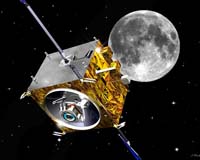
Smart-1 had the same techonolgy as the Deep Space 1 probe here:
"SMART-1 is the vanguard" of future space missions, said the craft's operations manager, Octavio Camino-Ramos. "Almost everything on board was innovative. It was a mission to test technology, the science was an extra plus."

A revolutionary ion thruster engine has propelled the cube, which measured just one metre across and weighed in at a paltry 350 kilos (770 pounds), since it was launched in September 2003.

The engine type has only been used once before -- with the US craft Deep Space 1, launched in 1998 to rendezvous with an asteroid and then a comet.

Ion engines are fuelled by xenon gas. The gas atoms are charged by electric guns powered by solar panels and are then expelled from the rear of the spacecraft, delivering a tiny thrust, visible as a ghostly blue glow.

Compared with the blast, roar and smoke of chemical rockets, ion engines seem almost laughably puny.

But chemical engines burn out after a couple of minutes, whereas an ion engine can push on gently for months or even years, for so long as the Sun shines and the small supply of propellant lasts.

Friday, September 01, 2006

Save Pluto!

I was at the World Science Fiction Convention during the Demise of Pluto as one of our outermost planets. Even the WSFC meetings debated the demotion of Pluto. I Love parlementray procedures! Just like PTSA!


Pluto is no longer a planet, but not without a struggle. After tumultuous discussions at the general assembly of the International Astronomical Union in Prague, Czech Republic, several hundred astronomers have agreed for the first time on a definition of a planet.

Three attempts at a definition were needed, and the discussion was sometimes heated, but there was widespread support among astronomers for the final result.

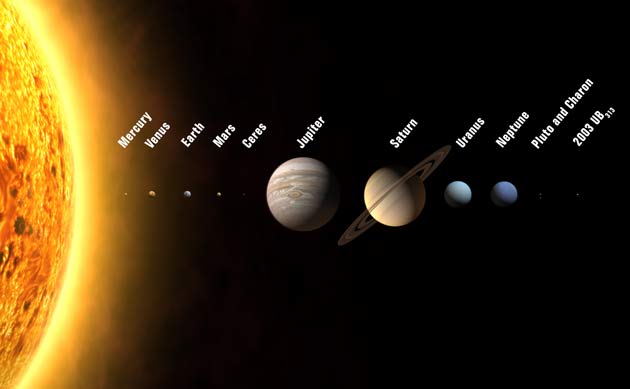
According to the new definition, a planet is a celestial body that (a) is in orbit around the sun, (b) has enough mass to be nearly round and (c) dominates its orbit. The astronomers were trying to define only what "planet" means in our own solar system, without considering planets around other stars.

The new resolution also defines a class of "dwarf planets" that meet the first two criteria above, but not the last. This class includes Pluto as well as a slightly larger object known as 2003 UB313 that was discovered in 2005, and probably several other icy bodies in the Kuiper Belt beyond Neptune. It also includes Ceres, the biggest of the rocky asteroids circling the sun between the orbits of Mars and Jupiter.


And will the New Horizon's mission(here) be demoted to a dwarf planet?
Poor New Horizons. When it launched in January 2006 it was with all the prestige of the first spacecraft to study Pluto, the last unvisited planet in the solar system.

That changed seven months later, when astronomers decided that Pluto was not a planet. For the time being, New Horizons is at least the first mission to a dwarf planet -- the new class of objects into which scientists dumped Pluto.

But that doesn't mean it will be the first spacecraft to visit a dwarf planet. Under the new definition (it's still unclear), Ceres may be upgraded from asteroid to dwarf planet, and if NASA's Dawn mission launches as planned next summer, it will arrive at Ceres in February 2015, five months before New Horizons gets to Pluto.

In the meantime, New Horizons' mission remains the same: to unlock one of the solar system's last, great secrets. The spacecraft will cross the orbits of all the planets from Earth to Neptune and fly by Pluto and Charon in July 2015.


Update: A Simi Valley Assemblyman has proposed legislation here:
Frustrated over the Legislature's inability to pass legislation to create an independent redistricting commission or make other political reforms, Richman on Thursday penned a resolution asking the Assembly to condemn the International Astronomical Union for its decision to strip Pluto of its planetary status.


"The downgrading of Pluto reduces the number of planets available for legislative leaders to hide redistricting legislation and other inconvenient political reform measures," the resolution says in part. "The California Legislature, in the closing days of the 2005-06 session, has been considering few matters important to the future of California, and the status of Pluto takes precedence."

In a few short hours, Richman was able to round up 53 co-authors — 26 Republicans and 27 Democrats.

The resolution notes the matter is of particular concern to California, since the slighted former planet shares the name "of California's most famous animated dog."

It also notes that the action constitutes "an unfunded mandate" on public schools since it "renders millions of textbooks ¿ obsolete."

In an e-mail to associates, Richman notes, "Sadly, there is probably a much better chance that the Assembly will vote on HR36 than independent redistricting."

What have we learned since Viking?

From MarsDaily here:
First, there's the unsung hero - the Mars Global Surveyor, the mission no one's ever heard about. It did a fantastic job. Its orbital laser altimeter gave us a sense of the elevation everywhere on Mars. It basically gave us the globe we have today and the sense of what we're doing. It also had a thermal emission spectrometer on it, with which we identified a possible water-laden mineral of hematite. That then became the fundamental piece of information from which we made the decision to land at Meridiani with one of the two Mars Exploration Rovers, and that of course is where we found the outcrop and the first initial sense that there had been water there for a long period of time. So all these things are tied together.

Pathfinder, from a scientific history point of view, did not add much, but that's not important. Pathfinder re-engaged the public. Following that, there was an Odyssey mission that took gamma ray spectrometry and determined with its neutron detector that there was water pretty close to the surface in lots of places, and then we had the most recent mission, the Mars Exploration Rovers.

There's one mission that in the United States has not received as much play as it should have. If you spend any time in Europe, you know how jubilant they are about the successes of Mars Express. Mars Express has been in orbit for a couple of years, and it has made some fundamental discoveries. I'm not going to enter the debate about whether or not methane has been found. They announced that they found methane and other people have announced that they didn't, but nevertheless it is at least an interesting scientific puzzle that needs to be worked out.

What I am the most surprised and delighted by are the observations made by the OMEGA spectrometer, which has identified not only the sulfates, of the hematite variety and many different kinds, but also what are called phyllosilicates, or clay minerals which, the geologists tell me, means there had to be standing water for extended periods of time. So the Mars Express observations have set up a new picture of the evolution of the planet. Once again we have a new Mars that has emerged.

Think about it. A new Mars emerged in '71, with the Mariner observations. A new Mars emerged with Viking. Another one with Mars Global Surveyor. Another one with MER. Now still another one with Mars Express.

We are so lucky. This is only going to happen to us. Five hundred years from now, maybe someone will be finding something new about Mars, but it'll be some rare, isolated discovery. What is happening in our lifetime is the emergence of another world. It has given us the ability to think about what we are, and who we are, and where we are going in a way unlike we've ever been able to do before.

Did life start on Mars? If not, why not? If so, was it knocked off of Mars and carried to the Earth, and perhaps formed the beginnings of life on Earth? These are wonderful puzzles, and as the days pass, we're learning more and more about how to answer them."

STS-115 launch date set Sept. 6th

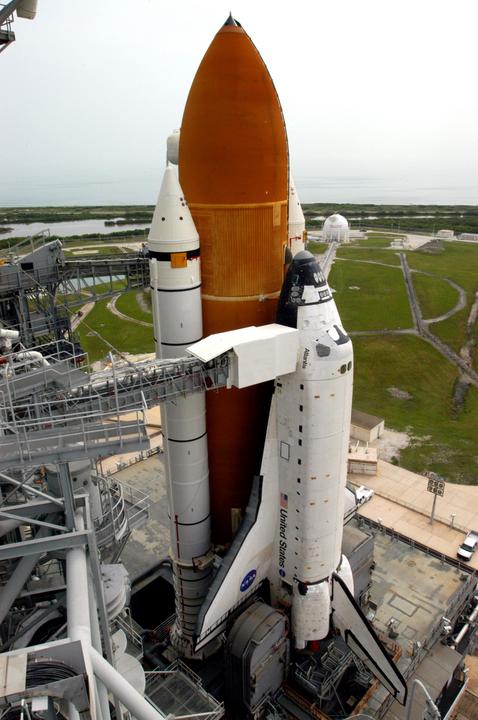
As launch preparations resumed at NASA's Kennedy Space Center's Launch Pad 39B on Thursday, mission managers set Sept. 6 as the new date for the launch of Atlantis on Mission STS-115 to the International Space Station. Liftoff time would be 12:29 p.m. EDT.

No damage to facilities or flight hardware is reported at the Kennedy Space Center following the exit of Ernesto from Florida. As the tropical depression passed through the area on Wednesday, the peak wind recorded on Launch Pad 39B, where Space Shuttle Atlantis stands, was measured at 44 miles per hour at 4:45 p.m. EDT. The shuttle was surrounded by the rotating service structure as NASA decided to protect it in place when weather forecasts improved.

On Tuesday, mission managers halted a rollback of the space shuttle to the protection of the Vehicle Assembly Building as the projected path of the tropical storm skirted further west than first expected, allowing a sufficient decrease in winds to permit the shuttle to ride out the storm at the pad.

Thursday, August 31, 2006

The Ozone layer is recovering

From NASA news:
A new study using NASA and National Oceanic and Atmospheric
Administration (NOAA) data finds consistent evidence that Earth's
ozone layer is on the mend.

A team led by Eun-Su Yang of the Georgia Institute of Technology,
Atlanta, analyzed 25 years of independent ozone observations at
different altitudes in Earth's stratosphere, which lies between six
and 31 miles above the surface. The observations were gathered from
balloons, ground-based instruments, NASA and NOAA satellites.

The stratosphere is Earth's second lowest atmospheric layer. It
contains approximately 90 percent of all atmospheric ozone. The
researchers concluded the Earth's protective ozone layer outside of
the polar regions stopped thinning around 1997. Ozone in these areas
declined steadily from 1979 to 1997.

The abundance of human-produced ozone-destroying gases such as
chlorofluorocarbons peaked at about the same time (1993 in the lowest
layer of the atmosphere, 1997 in the stratosphere). Such substances
were phased out after the 1987 international Montreal Protocol was
enacted.


The Montreal Protocol makes sence with a little bit of change. It does not restrict growth like the Kyoto Protocol accord does.

Tuesday, August 29, 2006

Shuttle going back to the PAD!


Boy, can they change their mind or what? I just hope the Hurricane stays far, far away!

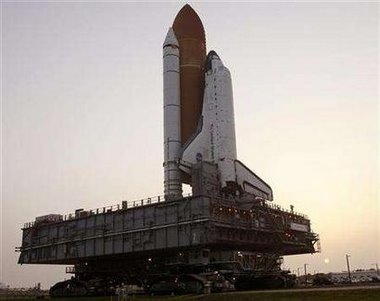
NASA Mission Managers have decided to return Atlantis to Launch Pad 39B today. The space shuttle is expected to be back in place by about 8 p.m. EDT. The decision came as Tropical Storm Ernesto was predicted to skirt further west than first expected, allowing a sufficient decrease in winds to permit the shuttle to ride out the storm at the pad. Launch Director Mike Leinbach and the team made the determination at 2:40 p.m. EDT. Atlantis had begun its trek to the Vehicle Assembly Building, atop the crawler-transporter, at 10:04 a.m. this morning.


Let's hope for no more lightning strikes!

Shuttle will be moved into Hangar


From NASA:
NASA DECIDES TO MOVE SHUTTLE ATLANTIS OFF LAUNCH PAD

NASA has decided to roll the Space Shuttle Atlantis off its launch pad
and back inside the protection of the Vehicle Assembly Building at
the Kennedy Space Center, Fla. The roll back is targeted to start at
approximately 10:05 a.m. EDT Tuesday.

The decision was made due to Tropical Storm Ernesto's track. Ernesto
is expected to bring high winds as it passes Kennedy.

A new launch date is not yet scheduled for Atlantis' flight, STS-115,
to the International Space Station. NASA and the Russian Federal
Space Agency continue to discuss the timing of Atlantis' mission and
the Soyuz spacecraft, which will send the next crew to the station in
September. Factors to be considered are the lighting constraints for
the shuttle launch and Soyuz landing and the timing for docking and
undocking the spacecraft with the station. NASA is also investigating
additional launch windows later in the fall.

The STS-115 crew will return to NASA's Johnson Space Center, Houston.
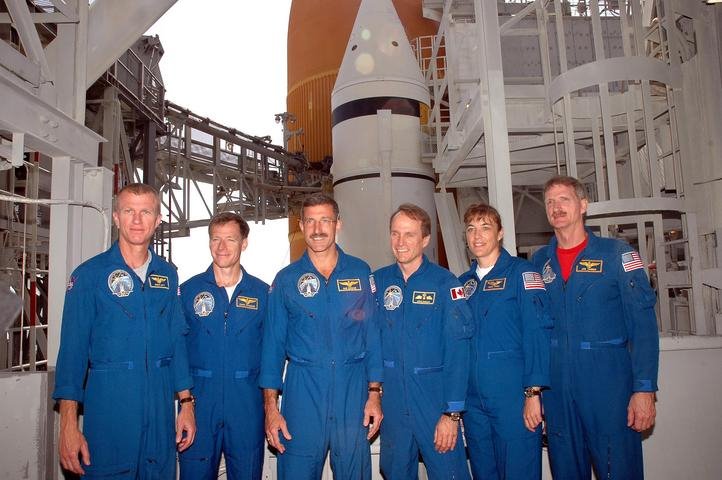
Commander Brent Jett, Pilot Chris Ferguson, and mission specialists
Joe Tanner, Dan Burbank, Heide Stefanyshyn-Piper and Canadian
astronaut Steve MacLean will continue training as they await a new
target launch date.


This means Atlantis will probably miss the September 7th deadline for a Launch. It takes eight days for a turn-around from Hangar to pad. With the Soyuz docking later in September the Shuttle can't be there at the same time. Also, with the new launch laws in effect, if there is not enough light to photograph the shuttle launch then we only have 3 launch windows this year to Launch Atlantis. I think they should wave the sunlight rule for this. We got to get the ISS built. I'm confident that the foam on the fuel tank is now stable. They can photo the shuttle out in space with the camera arm. The good thing is after Friday's lightning strike, the techs can give Atlantis a good checkup while in the hangar.

Monday, August 28, 2006

500 Million Dollar COTS Progarm

“I’ve said many times that I think — obviously by the fact that I’m gambling a half-billion dollars here — commercial space has a pretty strong supporter in me as NASA administrator,” Griffin said in a recent interview. “If it doesn’t work, I’ve frankly made the wrong bet … with a good amount of money that we could have used for other purposes if the entrepreneurial sector is, in fact, not able to step up.”

That $500 million wager has been placed on two very different firms that both have the same goal: building a vehicle that will meet NASA’s need for a new way to deliver supplies to the international space station after the space shuttle fleet is retired in 2010.

The two winners of the COTS demonstration contracts NASA awarded Aug. 18 — Space Exploration Technologies Corp. (SpaceX) and Rocketplane Kistler — both intend to develop new kerosene-fueled rockets to launch their proposed crew and cargo modules on confidence-building test flights before shooting for the international space station.

Both SpaceX and Rocketplane Kistler have a considerable amount of hardware already on hand — more, in fact, than any of the four other COTS finalists the pair beat out for the awards.

Both companies intend to combine the money they receive from NASA — SpaceX is getting $278 million and Rocketplane Kistler $207 million — with additional private investment. Both companies also plan to berth their cargo modules to the international space station with the aid of the outpost’s giant robot arm.


From Space.com here.

Wednesday, August 23, 2006

Golf balls in space etc

I'll be heading off for the World con in Anaheim today. Just a few space articles I've checked out today.
Here is the Golf ball promo for a company in Canada. The Russian Commander on the ISS will test out a gold golf ball in space in November. I just hope as it becomes space junk that it avoids any Space Shuttles in the near future...

Another story is one of the ISS crew was not up to date on the NASA memo telling them to wait until friday to mention the name ORION. Opps!

Tuesday, August 22, 2006

Sea Launch success


Yesterday Sea Launch successfully launched a South Korean comm satellite.
South Korea's first dual-use commercial and military communications satellite is now in space after a successful blastoff from a floating platform in the central Pacific Ocean.The 22nd mission for Sea Launch's Zenit 3SL rocket began with a fiery liftoff from the Odyssey launch platform at 0327 GMT Tuesday (11:27 p.m. EDT Monday). Positioned along the Equator at 154 degrees West longitude, the former Norwegian oil-drilling rig was in a prime location for the three-stage rocket to receive a boost from Earth's faster rotation at such low latitudes.

It took just over an hour for the launcher to release the Koreasat 5 satellite in the targeted oval-shaped orbit stretching from a low point of about 1,800 miles to a high point of around 22,300 miles. Its inclination was zero degrees.

A few minutes after spacecraft separation, controllers in the Sea Launch command ship received word that an Italian ground station had heard the first radio signals from Koreasat 5, proving the 9,806-pound satellite was in good health following the harrowing ride to orbit.

Friday, August 18, 2006

Bolt Swap out


Atlantis will get the correct bolts put in this weekend in preparation for the launch next Sunday.
CAPE CANAVERAL, Florida (AP) -- NASA managers decided Friday to change out two bolts they fear may not be secure enough in attaching an important communications antenna to space shuttle Atlantis' payload bay.

The swap-out will take place over the weekend while Atlantis is on the launch pad in preparation for an August 27 liftoff. Technicians will have to build scaffolding on top of a platform six stories off the ground to reach the bolts.

The two days of work likely will wrap up Sunday but won't affect the launch schedule or the start of the countdown on Thursday, unless there is a problem, said NASA spokesman Kyle Herring.

Wednesday, August 16, 2006

Shuttle crew group picture (STS 115)

Shuttle ready to go Aug 27


"We have set the launch date again for the 27th (of August)," Bill Gerstenmaier, the NASA associate administrator for space operations, said in a televised news conference from the
Kennedy Space Center in Florida. "We are ready to go for that."

NASA officials voted unanimously to go ahead with the launch after a two-day flight readiness review, Gerstenmaier said. The shuttle has an August 27-September 13 launch window.

......
A technical issue also arose during the readiness review, as officials discussed a design flaw in bolts attaching an antenna to the orbiter, said shuttle program manager Wayne Hale. NASA will likely have to replace the bolts, he said.

God Speed Atlantis!

Shuttle Alantis has a bolt problem


Among the many items to be discussed during the meeting is whether engineers need to replace a set of four bolts connecting Atlantis’ primary data and video antenna to the upper right side of the orbiter’s payload bay.

“I know they’re going to present it and we’re going to lay out a plan on what the work would take,” said NASA spokesperson Bruce Buckingham, of the agency’s Kennedy Space Center (KSC) where the meeting is underway, adding that it’s still far from final whether additional work will be required at the shuttle’s launch pad.

The four bolts latching Atlantis’ antenna dish in place are shorter than those stipulated in engineering specifications, but have flown on all 26 of the shuttle’s spaceflights. Engineers have expressed some concern that the bolts could shake loose during launch, which could send the antenna plunging down the length of Atlantis’ 60-foot (18-meter) payload bay and cause serious damage to the orbiter.

“If we did decide to go do the work, it could in all likelihood not affect our launch date,” Buckingham said.

Atlantis is slated to launch from KSC’s Pad 39B site no earlier than 4:30 p.m. EDT (1030 GMT) on Aug. 27 to begin an 11-day mission to the International Space Station (ISS).

Its STS-115 mission, commanded by veteran shuttle astronaut Brent Jett, will deliver a new solar array and pair of truss segments to the orbital laboratory.

But first Atlantis must pass muster before teams of safety engineers and top shuttle officials during a standard pre-launch meeting known as the Flight Readiness Review

HT Space.com

Pluto's Planet Definition or we'll have 53 more in the solar system


The IAU will be voting next week on the definition of what a planet is (here).
The tally of planets in our solar system would jump instantly to a dozen under a highly controversial new definition proposed by the International Astronomical Union (IAU).

Pluto and Charon would become pluton's along with Mark Brown's discovery 2003UB313.
That would make Caltech researcher Mike Brown, who found 2003 UB313, formally the discoverer of the 12th planet. But he thinks it's a lousy idea.

"It's flattering to be considered discoverer of the 12th planet," Brown said in a telephone interview. He applauded the committee's efforts but said the overall proposal is "a complete mess." By his count, the definition means there are already 53 known planets in our solar system with countless more to be discovered.

Brown and other another expert said the proposal, to be put forth Wednesday at the IAU General Assembly meeting in Prague, is not logical. For example, Brown said, it does not make sense to consider Ceres and Charon planets and not call our Moon (which is bigger than both) a planet.


Here is the definition:
The definition, which basically says round objects orbiting stars will be called planets, is simple at first glance:

"A planet is a celestial body that (a) has sufficient mass for its self-gravity to overcome rigid body forces so that it assumes a hydrostatic equilibrium (nearly round) shape, and (b) is in orbit around a star, and is neither a star nor a satellite of a planet."


Text of the proposal is here.

USAF commander for Space Defense

HUNTSVILLE, Alabama (Reuters) - The Air Force's new top commander for space predicted on Tuesday future attacks on U.S. satellites and called for greatly expanded tracking and identification of payloads launched by other countries.

Currently, U.S. efforts are focused on determining if an overseas launch is a ballistic missile or designed to put an object in orbit, then cataloging it over a period that can take weeks, said Air Force Gen. Kevin Chilton, who heads the Air Force Space Command at Peterson Air Force Base, Colorado.

"I say those days are over," he told an annual conference here on the fledgling, multibillion-dollar U.S. anti-missile shield. "If it's a space launch, we can't afford to relax."

"We need to know what the intent of that launch is," he said, including whether an object could jam or otherwise harm satellites or spread micro-satellites that could do so.

Chilton said his goal was to learn all this in the object's first orbit of the Earth so the United States could take unspecified actions "before an adversary can cripple us."

The increased "situational awareness" he had in mind could be achieved largely through improved computer work that would present information in easy-to-understand displays, he said.

Foes would be foolish not to be thinking of how to deny the United States the advantages of space, on which it relies heavily for military and commercial purposes, said Chilton, who took over the space command a month and a half ago.

HT Drudge

Tuesday, August 15, 2006

More Star Trek Posters


HT to Star Trek Inspirational Posters here.

Parts from Old Apollo Rockets

While engineers are trying to get the Ares 1 designed they are going to Apollo exhibits to see how the Apollo program did it. They are even getting old NASA engineers to help the new guys and gals with the Ares project.
Snoddy, a manager at NASA's Marshall Space Flight Center, has been removing valves and other parts from Apollo exhibits as he oversees construction of the upper-stage engine on the new moon rocket, dubbed Ares 1. Some of the pieces and accompanying documentation are not available anywhere but museums, he said.

The move makes sense: The new engine Snoddy is working on, a J-2X, is an updated version of the J-2 engine that powered the third stage of the 363-foot (109-meter) Saturn V rocket during Apollo.

LA Con IV


Next week my family and I will be attending the World Science fiction Convention at Anaheim convention Center. There will be some internet access and I hope to blog there about the Space Science panels. There will be Many displays on Science Fiction, Robots, Lunar Rover, Mars Rover, etc. Lots of panels, Art Show, masquerade etc. The main function I will be at is the Babel Diplomatic Conference/40th Star Trek Celebration wearing my ST uniform (ST II/VI movies) and my girls will be TNG. Kathryn will be Dr. Crusher and Megan will be a female Worf (or Alexandra). My Husband will be Scotty, Black Vest from (ST II/VI).


Star Trek Posters


Hat Tip to Star Trek Inspirational Posters here.

Friday, August 11, 2006

Count down test a success


Atlantis' astronauts strapped into the space shuttle Thursday for a practice launch countdown more than two weeks before they are scheduled to blast off on a mission to resume construction of the international space station.

The six crew members, dressed in their orange spacesuits, waved to photographers as they walked out of crew quarters at the Kennedy Space Center and boarded a van that took them to the launch pad. The launch window opens August 27.

The practice went smoothly with the countdown clock stopping at 4 seconds, said NASA spokesman Bruce Buckingham.

Thursday, August 10, 2006

NASA Display at DCS

NASA will have a display at the Discovery Science Center on August 20 - 22. From Larry Evans, President of the Orange County Space Society:
The exhibit is called the "Vision for Space Exploration" and
will highlight the new NASA mission of sending people back to the Moon and
onward to Mars. The exhibit is housed in a large trailer that is traveling
cross-country over the next several months. During the three days in Orange
County, the exhibit will be parked at the Discovery Science Center (DSC) in
Santa Ana.


--Description of Exhibit:

The first section of the trailer features a gaming section with Moon and
Mars globes. Visitors are surrounded by stars and planets. Holographic video
screens create floating images, allowing visitors' hand motions to control
and create bases for human life on the planets. The second section of the
trailer has a hexagon-shaped, three-dimensional theater featuring a
five-screen presentation on the Vision for Space Exploration. The Dome's
interior becomes a seamless floor-to-wall-to-ceiling window for a journey to
other-worldly destinations. Explorers see themselves in space to fully
experience environments in other parts of our Solar System, giving travelers
the illusion of stepping on the surfaces of Earth, the Moon and Mars.

Visitors will also have a chance to actually touch a real moonrock brought
back by Apollo astronauts. This is one of only three lunar samples able to
be touched by the public anywhere in the world. At the end of the
experience, people will have the opportunity to get a free photo of
themselves standing on either the Moon or Mars!

Wednesday, August 09, 2006

Van Allen has died.


IOWA CITY, Iowa (AP) -- Physicist James A. Van Allen, a leader in space exploration who discovered the radiation belts surrounding the Earth that now bear his name, died Wednesday. He was 91.
....
Explorer 1, which weighed just 31 pounds, was launched January 31, 1958, during an emotional time just after the Sputnik launches by the Soviet Union created new Cold War fears. The instruments that Van Allen developed for the mission were tiny Geiger counters to measure radiation.

Near the 35th anniversary of the launch, Van Allen recalled in an Associated Press interview how scientists waited tensely for confirmation the satellite was in orbit.

When the signal finally came, "it was exhilarating. ... That was the big break, knowing it had made it around the Earth, that it was actually in orbit."

The success of the flight created nationwide celebration. Equally exciting for the scientists was the discovery of the radiation belts, a discovery that happened slowly over the next weeks and months as they pieced together data coming from the satellite.

"We had discovered a whole new phenomenon which had not been known or predicted before," Van Allen said. "We were really on top of the world, professionally speaking." Later in 1958, another scientist proposed naming the belts for Van Allen.


Read the whole thing.


Related posts:

Flame Trench

StarBaseOC: 48 years of Space Exploration

Sunday, August 06, 2006

Mars Hoax again!

From Space Weather daily update:
MARS HOAX: A bogus email is going around the Internet. It claims that Mars will be historically close to Earth on August 27, 2006--so close that Mars will look as large as the full Moon. This is not true. Here are the facts: On August 27th, Mars will be on the other side of the solar system, about 385 million kilometers from Earth. The red planet will look tiny and dim, nothing like a full Moon.

The "Mars Hoax" email first appeared in 2003. On August 27th of that year, Mars really did come historically close to Earth. But the email's claim that Mars would rival the Moon was grossly exaggerated. Every August since 2003, the email has staged a revival. It's as wrong now as it was then.


I'm sure we're going to get many calls about this on Coast2CoastAM. (LOL!)

SOHO and Saturn


From Space Weather a SOHO picture with the image of Saturn here:

The SOHO site with live updated pictures here:

From Dr. SOHO's FAQ on what is SOHO:
What is SOHO and how can society benefit from its science?

SOHO stands for Solar and Heliospheric Observatory and is a satellite that studies the Sun 24 hours a day, 365 days a year without interruptions. The spacecraft has 12 scientific instruments collecting information about the Sun ranging from activity in the Sun's corona to vibrations deep in the Sun's interior.

Because the Sun is the only star close enough to have real and dramatic effects on our life here on Earth, we certainly expect and hope that improving our observations and our understanding of this beautiful, awesome object will in the course of time bring about beneficial applications. While it's never possible to tell where the quest for knowledge will lead, at this time the area where we have the greatest expectation of useful fallout is in the "space weather" arena.

"Space Weather" may sound abstruse, but it's a concept that is growing in importance as mankind pushes further and further against the limits within which we live. When a farmer had only an acre or two to worry about, a look out the window was a good enough weather forecast for the day's plowing. When he has thousands of acres to plow, seed, and fertilize, he may find it necessary to plan on a much broader scale in order to avoid disaster; thus, we need weather satellites and global forecasting systems for tropospheric weather. Similarly, when communication and electrical grids connected only local communities, the worst threat might have been a lighting strike on a local utility pole. But today, our electrical power grids span entire continents, and our communication lines reach across hemispheres, linked by synchronous-altitude satellites. It's not too early to be thinking about the effects on these extended systems, of vast clouds of atomic particles and magnetic fields thrown out by the Sun on an almost daily basis.

Saturday, August 05, 2006

Hurricane Prediction downsized

From USA Today:
Thursday, hurricane researcher William Gray at Colorado State University said the season won't be as bad as he had predicted. Gray and his forecast team reduced the number of expected hurricanes from nine to seven and said a monster storm like Katrina is unlikely.

In May, government forecasters predicted 13 to 16 tropical storms, eight to 10 of which could grow into hurricanes, during the six-month Atlantic hurricane season that started June 1. The hurricane center will update its forecast Tuesday.

Conditions were favorable for hurricane development much earlier last year than is typical, and they persisted, producing a record number of storms. Those conditions — warmer sea-surface temperatures and the absence of high-altitude, west-to-east wind shear that breaks up storms as they're forming — weren't repeated this June and July.

“All of the ingredients that were in place last year simply weren't this year,” Feltgen said. “Now winds are lightening up, sea surfaces are warming, and all the conditions are becoming quite favorable for activity to really take off like it's supposed to this time of year.”

Friday, July 28, 2006

Charles E. Brady, Jr. (Captain, USN) , RIP


Just saw this on Drudgereport here:

I remember his flight very well. It was the "international" flight on Columbia STS-78 June 20 to July 7, 1996 here:

Brady was celebrated for his many accomplishments. His space flight 10 years ago remains the longest such mission to date. Brady and six other astronauts orbited the earth 271 times and broke the shuttle endurance record by eight hours.

That mission included studies sponsored by 10 nations and five space agencies, and the crew included a Frenchman, a Canadian, a Spaniard and an Italian. Brady was one of three mission specialists who conducted a number of experiments -- mostly on themselves -- in the orbiter's Life and Microgravity Spacelab.


He took his own life. Sorry to hear about his loss. My thoughts and prayers go out to his family. Brady's NASA BIO here.

Wednesday, July 26, 2006

Japan to N. Korea: We will be watching you!


From AstroExpo.com:

Tokyo, July. 19 : Japan will launch a third spy satellite in September to monitor North Korean activity, a news report said on Wednesday.

Japan's space agency, JAXA, will launch the country's third spy satellite using an H-2A rocket on Sept. 10, Kyodo News agency said, quoting unidentified government officials.

JAXA plans to launch a fourth by the end of the year, according to Kyodo. Japan first launched two spy satellites in March 2003.

The four satellites will enable Japan to survey any point in the world and will be used especially to monitor North Korea, the report said.

Officials at JAXA could not be reached for comment late Wednesday.

Alantis Rolled out


Shuttle Alantis has been rolled out of the Hangar and into the VAB at Kenndey. Alantis has not been flown since 2002. Launch is Aug. 28 with a window until Sept. 7. There might be a conflict with a Soyuz mission to the ISS in the middle of September. Work to be done on the ISS is installation of the Port 3/4 truss segment with its two large solar arrays on the station.

Saturday, July 22, 2006

Project Orion

Here are some posts about the new project Orion:

Slasdot Via Space.Com
NASA intends to use the moniker Orion as both the title for its next generation manned craft, the Crew Exploration Vehicle (CEV), and as the project’s name. This approach is modeled after the 1960's program when Apollo Command Modules launched astronauts under Project Apollo.

Under Project Orion, NASA would launch crews of four astronauts aboard Orion capsules, first to Earth orbit and the International Space Station and then later to the Moon.


The Name Orion is not offical but NASA got some approval here:
Yet a publicly-accessible federal trademark search shows that NASA was granted the use of Orion on July 14, 2006 for use with "command modules" and "crew capsules", as well as crew and cargo launch vehicles.

Sources close to the agency confirmed to collectSPACE that the name Orion was in the final stages of approval.

Earlier documents obtained in January by collectSPACE used the names Antares and Artemis as 'notional' titles for the CEV. Orion will soon officially replace those other names for internal and external use, though when NASA will announce Orion is not yet known.


BlogsOfWar has placed his Misc. posts in Offtopic were the space articles will be. (For those who want to avoid articles that are war realted.)
Orion and NASA's Return to the Moon.

Great Blog, I read all of his posts to get tech, war and space all in one place!

Friday, July 21, 2006

Alantis moving out of Hangar


Monday, July 24, Atlantis is scheduled to be moved out of its hangar
at NASA's Kennedy Space Center, Fla. The first motion is expected at
6 a.m. EDT. Media must arrive at Kennedy's News Center by 5 a.m. to
attend the event.

The move from the Orbiter Processing Facility to the Vehicle Assembly
Building is referred to as a "rollover." Inside the assembly
building, Atlantis will be attached to its external fuel tank and
twin solid rocket boosters.

Atlantis' launch window begins Aug. 28. During its 11-day mission to
the International Space Station, the STS-115 crew of six astronauts
will install the Port 3/4 truss segment with its two large solar
arrays.

Crew members are:
  • Commander Brent Jett
    A veteran of three space missions, Jett will lead the crew of STS-115, the shuttle's 19th mission to the space station.
  • Pilot Chris Ferguson
    Ferguson will make his first journey into space as the pilot of the STS-115 shuttle mission.
  • Mission Specialist Joe Tanner
    With five spacewalks to his credit, STS-115 Mission Specialist Tanner will be making his fourth spaceflight.
  • Mission Specialist Dan Burbank
    Assigned as a mission specialist for STS-115, Burbank previously flew on STS-106.
  • Mission Specialist Steve MacLean
    On his second spaceflight, Canadian Space Agency Astronaut MacLean will visit the space station as an STS-115 mission specialist.
  • Mission Specialist Heidemarie Stefanyshyn-Piper
    A member of the 1996 astronaut class, Stefanyshyn-Piper is assigned to STS-115 as a mission specialist.

Thursday, July 20, 2006

37 years ago...


US test Minuteman III at VAFB

Via Drudgereport:
VANDENBERG AIR FORCE BASE, Calif. (AP) -- The Air Force successfully launched an unarmed intercontinental ballistic missile early Thursday.

The Minuteman III dummy warheads were fired at 3:14 a.m. and traveled about 4,200 miles before hitting a water target in the Marshall Islands.

The launch was delayed by a day because of a power outage at a radar facility that handles flights in and out of Southern California. The purpose is to test the defense system's reliability and accuracy.

Earlier this month, North Korea shook up the world by firing several missiles into the Sea of Japan, including a failed long-range missile.


The North Korean launch raised questions about the readiness of the U.S. missile defense system, which includes interceptors housed in underground silos in California and Alaska.


I heard on Sean Hannity and Drudge that the July 4th launch of missles in No. Korea were witnessed by Iranian operatives. The Axis of Evil I say.
One or more Iranians witnessed North Korea's recent missile tests, deepening U.S. concerns about growing ties between two countries with troubling nuclear capabilities, a top U.S. official said on Thursday.

Asked at a U.S. Senate hearing about reports that Iranians witnessed the July 4 tests, Assistant Secretary of State Chris Hill, the chief U.S. negotiator with Pyongyang, replied: "Yes, that is my understanding" and it is "absolutely correct" that the relationship is worrisome.


And the Patriot is being readied in Japan in anticipation of No. Korea's launching more missles.
Japan and the U.S. on Thursday announced a plan to deploy advanced Patriot interceptor missiles at American bases on southern Okinawa island, and a top government spokesman called for more pressure on North Korea to stop its missile tests.

The U.S. government will have Patriot Advanced Capability-3 missiles operational by the end of the year and post 600 more troops on Okinawa, the Foreign Ministry said. Officials on the island 1,000 miles southwest of Tokyo questioned the need for the missiles.

Japan stressed the deployment would be purely for defense purposes.

"In view of the development, deployment and proliferation of ballistic missiles in the region, and the clear and present threats such as the recent missile launches by North Korea ... Japan will continue to do its utmost to build its ballistic missile defense capabilities in close cooperation with the U.S.," the statement said.

Monday, July 17, 2006

Discovery is Home!

Discovery is home! Now What? Well for starters there will be 15 more flights until 2010 when the fleet will be retired. So we have 4 years to go and average 3 to 4 shuttle flights a year. Then the CEV will be readied by 2014. That means we will have about 3 years of non-manned flights by NASA. (2011-2014) My hope is private enterprise will take up the low-earth actives, which will let NASA to do the exploring of MOON and MARS.

I also hope the ISS will be more utilized as a stepping-stone to the Moon and Mars and beyond. Developing and using the space elevator technology will help in transporting crews and supplies without the need of a rocket to get to zero g orbit. Oh the possibilities are endless. I'll keep my fingers crossed!

From AP via PJ Media here:

Griffin noted that NASA faces 16 more shuttle flights to complete the space station and, hopefully, repair the popular Hubble Space Telescope. A decision is expected by fall on whether to send a shuttle to Hubble one final time, to extend the observatory's life.

NASA is up against a hard 2010 deadline for completing the space station. That's when the three remaining shuttles will be retired to make way for a new spaceship capable of carrying astronauts to the moon and eventually on to Mars.

"We don't have any slack. We have just enough shuttle flights left to do the job so we can't afford to mess up," Griffin said. "The team performed superbly systemwide (with Discovery) and what we have to do is exactly that same thing again from now until the end of 2010."

Complicating matters is that NASA faces a series of tremendously difficult assembly flights, beginning with Atlantis' upcoming mission to deliver and install a massive beam and set of solar wings. NASA is aiming for a liftoff as early as Aug. 27.

Shuttle program manager Wayne Hale said he wants just as much intense scrutiny _ and differing opinions among engineers _ for the next flight and all the ones after that.

A few weeks before Discovery's liftoff, NASA's chief engineer and top safety officer argued for putting off the mission until more design changes could be made to one area of the fuel tank. Hale was all for going ahead. Griffin cast the final, decisive vote.

After landing, Lindsey said he trusted that launch decision and noted it was an outgrowth of the management culture lessons learned from Columbia. The successful conclusion of the mission is more of a beginning to space station assembly and exploration, he said, than an end to the post-Columbia recovery era.

"I don't think we want to ever put Columbia behind us," Lindsey said.


I'll Blog the next launch (Atlantis) at WorldCon in Anaheim on Aug 27th.

Blogging the Landing

--3:25 AM PDT
Well I'm awake on the westcoast and laptop warmed up. Weather looks good at KSC. I have NASA TV on and it's almost sunrise on the landing strip. I'm checking Flame Trench and Nasa landing blog. All looks go so far. The doors are closed on Shuttle Discovery. All switches are being thrown to landing postions. The training aircraft at KSC are up checking the weather. Deorbit starts around 7 AM with 8:14 AM landing at KSC. (time Central).

--4:05 AM PDT
The NASA landing blog is up and running at Landing Blog here. And the Flame Trench Via Florida Today.

--4:08 AM PDT
One hour to de-orbit burn. The Astronauts are drinking the sports drinks to give their bodies fuild. Weather might be in question due to some thunder storms but out of the 30 mile area so far.

--4:50 AM PDT
All Systems a go, just waiting on the weather. De-orbit in about 15 minutes. Over at Flame Trench photos of the landing site show overcast skies. Dosen't look so good on the weather for de-orbit. Update soon.

--4:55 AM PDt
OK for De-Orbit. Weather is within limits.

--5:08 AM PDT
Astronauts are strapped in and ready to de-orbit. Landing at 6:14 AM PDT.
Discovery has fired its Orbital Maneuvering System engines to slow the vehicle down so that it will drop out of orbit and begin the high-speed freefall back to Earth. The three-minute engine burn sets Discovery on an irreversible course for home.

They's comming home no backin' out now! Godspeed Discovery!

--5:12 AM PDT
De-orbit burn takes about 3 Minutes. Discovery is over the Indian Ocean off the coast of Sumatra.

--5:15 AM PDT
De-Orbit Burn is done. Recovery team is driving to the landing pad.

--5:26 AM PDT
They should be feeling the heat as the friction is building up on reentry. The propellants on board are being let go.

--5:28 AM PDT
Mission control gives last landing condtions to Commander Lindsey.

--5:33 AM PDT
40 Minutes to touch down. Will be landing on runway 33.

--5:36 AM PDT
Five minutes to interface. 63 hundred miles to runway. 3 APU's are good to go too.

--5:41 AM PDT
1 minute to entry interface. 54 hundred miles to runway.

--5:43 AM PDT
Interface now and 30 minutes to touchdown.
Discovery is currently at an altitude of 108 statute miles and 6,300 miles from the runway. Today will be the 62nd landing of the shuttle at Kennedy Space Center.


--5:46 AM PDT
They are definatly feeling the atmoshpere now. I bet their bodies will start to feel the heavyness and the g's on their faces.

--5:48 AM PDT
Comming to the coast of Central America. APU's still good.
Discovery is now 4,600 miles to the runway, traveling at approximately mach 24.8.

Looks like they are switching to landing srips from 33 to 15 because of weather conditons.

--5:33 AM PDT
The course change whould mean instead of a right turn to approach it would be a left turn to approach. This is because of a small thunder cloud is building up on approach to 33.

--6:00 AM PDT
It will be 15 landing strip and 15 Minutes to touchdown at KSC. And they will be turning left on approach.

--6:03 AM PDT
Heading to Florida over the Gulf of Mexico.

--6:05 AM PDT
Just entering the Florida coast and 9 minutes to touchdown.

--6:06 AM PDT
21 Miles and Mach 4.5 now. In a few minutes the pilots camera will be active.

--6:08 AM PDT
Loose switch on Air data probe.

--6:09 AM PDT
5 Minutes to landing.
Discovery's current speed is Mach 6.2 (4,650 mph), 25 miles in altitude and 214 miles from the runway. Discovery is approaching Florida's southwestern coast. Nine minutes until touchdown.


Camera is ready and looking good. Discovery at Mach one now.
6:11 AM PDT
Booms are heard. Now at 3 Minutes to touchdown. 500 mph. On target.

6:13 AM PDT
420 MPH now. Fast approach and line up to runway now. Chase plane pics now.

6:14 AM PDT Runway in sight all good. Approach is good.

6:15 AM Here we are! Bird has landed. The Chute is out. Looking good! Great job you guys!
6:16 AM All stop at KSC. Just waiting to de-plane the bird. The exhaust fumes have to disapate before exit.

6:20 AM PDT
The Leeky APU was not a problem on landing.

Sunday, July 16, 2006

Now for the Spacewalkers


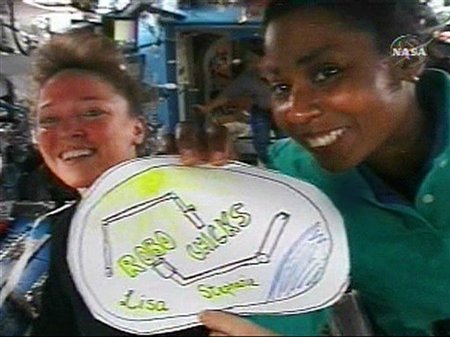
Robo Chicks in action


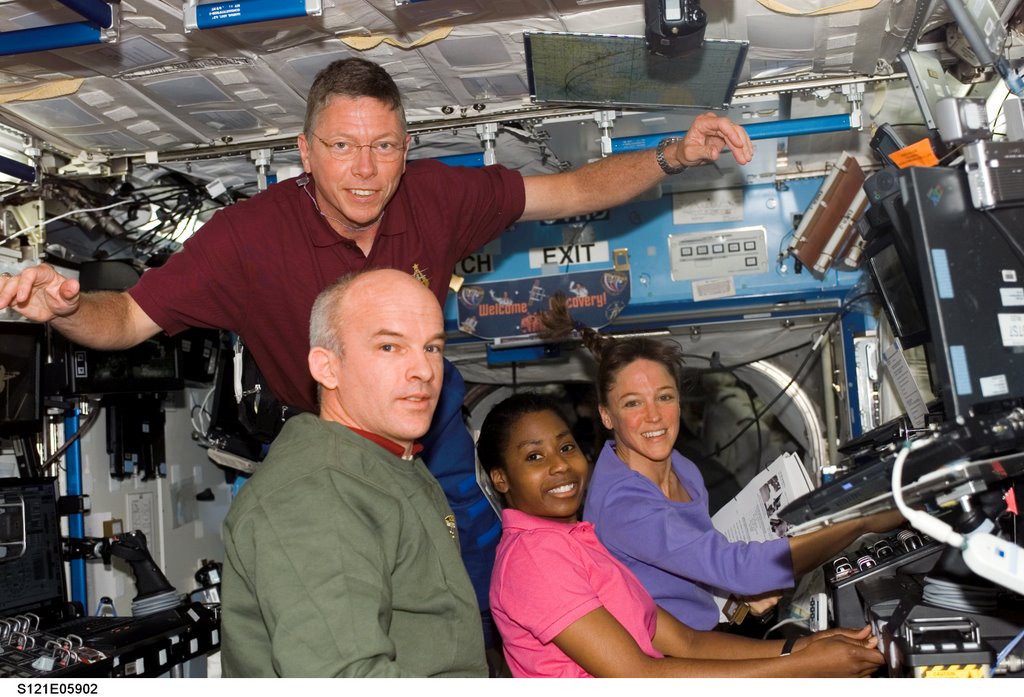
My girls did watch parts of the spacewalks. Some were boring to them, but they loved it when they showed the "Robo Chicks" in action. It was something to do with the pony tails (in parallel) and working on the robotic arms. They want a hair style like that on earth! Go Lisa and Stephanie!

Shuttle Landing Monday

I've been in the middle of the summer activites with the girls. Blogging has been light because of the distractions. I plan to live blog the Discovery Landing on Monday, July 17. Here is NASA's release of today July 16:
The six STS-121 astronauts are preparing for landing. Today's activities include stowage of items, engine tests and system checkouts.

Landing is scheduled for 9:14 a.m. EDT Monday at Kennedy Space Center, Fla. The deorbit burn is set for 8:07 a.m. A second landing opportunity for Monday would see the deorbit burn at 9:43 a.m. for a landing at 10:50 a.m. Weather forecasts call for a chance of showers at the landing site.

Crew members will take a break from their work to talk with media with CNN, CBS, ABC, NBC and the Fox News Channel at 11:53 a.m.

Discovery’s landing will mark the end of a successful mission for the STS-121 astronauts. They delivered supplies, equipment and a new Expedition 13 crew member to the International Space Station. During three spacewalks, they performed maintenance on the station’s mobile transporter and tested orbiter heat shield techniques.

Thursday, July 13, 2006

Testing our missle defense


Our system's are working after a test in New Mexico on Wednesday, here via Drudgereport.
When the target missile was destroyed, sending a brilliant white, mushroom-like cloud into the dark sky, the crowd began to applaud and cheer wildly.

" We smashed it," several people cheered as the rainbow colored contrail gave way to the cotton ball cloud of destruction above.

Eckles said contrails and explosions from previous tests have been seen as far away as Phoenix and Tucson. On Wednesday, Phoenix residents again were treated to a colorful contrail pattern over the Arizona skies, while closer-to-home reports were received from Lordsburg, Silver City and Doña Ana County from early risers who observed the same display.

"All evidence is that it was totally destroyed," Driessnack said of the target missile during an interview after the test was complete. "We knew from the last test, 60 days ago, that it was working as it should."

He said the test indicates THAAD could be ready for emergency deployment "as soon as a year from now."


Just in time when North Korea is shooting off duds. Iran's a threat we have to deal with also. A good defense to protect North American lifes. Thanks to Ronald Reagan who went though on SDI. WE really need it now!

Links to stories:

Space War story on THADD here.

Also in the news Northrop-Grumman has Skyguard Laser Defense system out of Redondo Beach, CA (Former TRW) here.

Sunday, July 09, 2006

China gets a slapping for aiding Iran

HT from Strategy page here.

The United States has ordered sanctions on two Chinese missile technology companies. The Chinese are accused of providing missile technology to Iran. One of the Chinese companies, China Great Wall Industry Corporation ("Great Wall" for short) has long been accused of aiding the North Korean missile effort. Great Wall is owned by the Chinese government, but is run for profit, and its managers are under orders to make money, or lose their jobs. Great Wall earns most of its profits by putting foreign satellites into orbit. Great Wall does this more cheaply than anyone else, and has had 24 successful launches for foreign customers so far. The two Chinese companies are major suppliers of missile technology to the Chinese armed forces, but the export business is where they rack up their biggest profits. The American sanctions block the Chinese firms from using any American banks in their dealings.

Friday, July 07, 2006

The Shuttle debate

The Orange County Register (here) had an editorial on NASA getting rid of the shuttle right now and privatizing the fleet.
The best approach now would be to scuttle all three shuttles, or privatize the fleet. The problem isn't just safety, but economics, said Ed Hudgins, an adjunct scholar at the Cato Institute and editor of "Space: The Free Market Frontier." He said each shuttle launch now costs $500 million to $1 billion.

"From a scientific view, very little is gained" from a shuttle flight, Mr. Hudgins said. The shuttle also provides services for the International Space Station, which in the 1980s was projected to cost $8 billion, but whose real cost now is expected to be $50 billion to $100 billion. "Again, the space station is doing very little science," Mr. Hudgins said.

I wonder if the private sector will be geared up to go. If we privatize will the space station be completed? A good argument for private enterprise, but my belief is private enterprise will not have the government red tape to go through.
In sum, half of NASA's $7 billion yearly budget goes to human space exploration – the shuttle and space station – money that could go to better uses, such as unmanned space exploration.
I still think "manned" or the PC "Human" exploration is important to the US. If we give up the shuttle and private enterprise does not ramp up then were will we be? Is the US going to let China or Russia take over space exploration for six years waiting for the CEV to be build?

Granted I favor private enterprise getting into space. But space exploration's history has had some hurtles to face. Will privatizing the shuttle help or hinder the USA space program stay the front runner in space exploration? My option is to complete the shuttle flights within NASA and retire it in six years. But I also favor private companies getting into the space exploration business. They will eventually take over the low orbit activities while NASA explores the outer regions.

Tuesday, July 04, 2006

Back from the Parade! Happy 4th of July!

I'm back from the parade and ready for Launch! It was great to see so many people in Fullerton enjoy the 4th of July.

--11:07 AM PDT
Looks like they plan a T -31 sec hold for monitoring Liquid oxygen inlet tank temp.

--11:10 AM PDT
Weather looks great! No Anvils this time. All green.
T -9 Mins. and holding. We have about 15 mins. left in the hold.

--11:17 AM PDT
All polled and ready for count down.

--11:20 AM PDT
Weather a go, no techincal problems. 5 mins left in hold.

--11:25 AM PDT
Final Go's Polled! Ready to Go!!!!!!!!!!!!!!
A great day to launch and celebrate America's 230th Birthday!
"I can't think of a better place to be on the Fourth of July," Commander Steve Lindsey responded from within the orbiter. He said that the crew is ready to give Florida an up close and personal look at the rockets' red glare.


--11:29 AM PDT T-9 and counting!!!!!!!

--11:31 AM PDT T-7 White Room retracting and pre-start precedures.

--11:33 AM PDT T-4:30 and counting.

--11:35 AM PDT T-4 mins. Readness test of rocket engines.

--11:36 AM PDT T-3 Mins. and Vent hood is retacted.

--11:38 AM PDT Blast off! Bird looks good!

--11:40 AM PDT Go with thothle up!

--11:42 AM PDT Solids go by by.

-11:46 AM PDT Roll over.

--11:48 AM PDT Liquid tank detached. Main engine cut off.

Shuttle a go Go!


I have a 4th of July parade to go to. My daughter's troop will be marching in it. I might just get home in time for the launch. So live blogging won't happen today.

The foam issue has been looked at and was agreed it could go ahead and launch.
Carnegie Mellon University engineering and risk analysis professor Paul Fischbeck, who had been worried earlier in the day by the falling chunk of foam, said NASA's rationale in going ahead made sense and he is slightly more comfortable with a launch try Tuesday.

Fischbeck, who has consulted with NASA on the shuttle's delicate heat protection system, wondered why foam had broken off on the launch pad. "It's something you might want to understand before you launch," he said.

The patch of foam fell off an area that covers an expandable bracket holding a liquid oxygen feed line against the huge external tank. NASA engineers believe ice built up in that area from condensation caused by rain Sunday.

The tank expanded when the super-cold fuel was drained after Sunday's launch was canceled because of the weather. The ice that formed "pinched" some of that foam, causing the quarter-inch-wide crack and the piece of foam to drop off, officials said.

The size of the fallen foam was less than half the size of one that could cause damage, NASA officials said.

NASA managers decided to go ahead with the launch attempt because of three criteria: They are confident enough foam still is on the bracket to prevent a large piece of ice from forming; that the area of foam where the piece dropped was still intact; and they don't believe the area will be exposed to extreme heat during ascent.

Inspectors spotted the crack in the foam insulation during an overnight check of the shuttle. NASA had scrubbed launch plans Saturday and Sunday because of weather problems.

The forecast for a Tuesday liftoff was better than previous days, with just a 40 percent chance that storm clouds would prevent liftoff.


Live Blogging sites:
NASA Shuttle Launch
Flame Trench
***Update****
A backup Circuit Breaker to the controls of primary heaters on the segment joints on both solid rocket boosters is acting up. A crew is going to replace the 100 amp backup breaker. Ice patrols are out inspecting.

Monday, July 03, 2006

Cracks found on External tank

I don't think they will launch anytime soon:
During a routine inspection overnight after the draining of the tank, a crack was discovered in the foam near a bracket on the external fuel tank that holds the liquid oxygen feedline in place. The Mission Management Team is meeting to discuss this and to determine what, if any, impact this will have on our launch date.


Next update at 12:00 noon EDT Briefing. NASA TV here.

Update: Spaceflight Now has the picture of the cracked foam piece found today here.

New Mexico Space Port

UP Aerospace (Space Daily) will launch a payload on Aug. 14 (My Dad's 70th Birthday!):
UP Aerospace announced Friday that it has set Aug. 14 as the date of its first commercial space launch from New Mexico's spaceport facility. The company's SpaceLoft XL vehicle will carry more than 50 payloads and experiments from sponsors in the United States and Europe.

"Our 20-foot-tall, single-stage, 800-pound SpaceLoft XL solid-fuel rocket will accelerate to five times the speed of sound - nearly 3,400 miles per hour - in just 13.5 seconds," said Jerry Larson, UP Aerospace president and chief technology officer. "It will reach the international definition of space, 62 miles or 100 kilometers, in just a minute and a half, and a achieve a flight apogee of about 70 miles shortly thereafter."

"The mission includes support from White Sands Missile Range, located just to the east of the Spaceport," Larson said. "Our SpaceLoft XL rocket includes a C-Band transponder that will be tracked by the radars at White Sands, providing the highest quality data possible for use in licensing the Spaceport with the FAA."

The payloads will include contributions from the University of Colorado at Boulder, Brown University (co-developed with AeroAstro,), the University of Hartford, Central Connecticut State University and New Mexico State University, the company said in a news release.

SpaceLoft XL provides a total of 110-pound payload capacity and 10,500 cubic inches of payload volume. The rocket can accommodate payloads up to 10 inches in diameter and 7 feet long and can lift them to an altitude of 140 miles (225 kilometers) with a wide range of micro-gravity options.

The launch will be "just the first of multiple commercial space launches that we will be conducing. Another significant space launch is in October, concurrent with this year's X PRIZE CUP event," said Eric Knight, chief executive officer of UP Aerospace

"In addition to the university payloads, we will also be flying into space over 40 experiments created by high school students from across America," Knight said. "To open the space-access door to students at this level, we've partnered with the Connecticut Center for Advanced Technology and the National Aerospace Leadership Initiative. These organizations have established LaunchQuest, a novel program that lets youngsters conduct their own space-flight research."

Close encounters

Via Drudge(here)
BELFAST, Ireland, July 2 (UPI) -- An asteroid with the power to wipe out a small country will miss the Earth tomorrow, the Sunday Telegraph reported.

Asteroid 2004 XP14 is nearly half a mile wide and was discovered in December 2004. It is in the "Apollo" class of asteroids, which are those that cross orbits with Earth.

Initial speculation by scientists predicted the possibility of impact with Earth later this century, but that conclusion has been ruled out, the newspaper said.

When the asteroid passes Earth, it will be some 268,624 miles away, just slightly further away than the average distance of the Moon from Earth, the report said. A telescope will be required to view the asteroid, which will pass at 5:25 a.m. UK time.

Saturday, July 01, 2006

Blogging the Launch

**Update** Welcome Blog Of War readers! I'll try to live blog as much as I can today. I have Church at 10:30 AM. But will be home by 11:45 AM PDT (2:45 PM EDT) to cover the launch. (Unless I want to be a bad girl and skip church....)

Sunday, July 2, 2006

--10:17 AM PDT
It's a Scrub again!!!!!!!!!!!!!!!!!!!!!!!!!!!!!!!!!!!!!!!!!!!!!!!!!!!
I'm going to church. I'll blog again on the next day.

--10:12 AM PDT Weather is Red. They all crew are seated and ready. I'm going to Church to pray for clear sailing! Be back before (hopefully) launch time.
--9:47 AM PDT
Com checks and final seating.
VP Dick Cheney will not be at KSC to view the launch today. (HT Flame Trench)
--9:42 AM PDT
Still getting all crew members hooked up and strapped in. I just finished my shower and getting ready for church. (I want to pray for good weather and good blast-off).
Weather is still red, with Anvil's in the area.
--9:00 AM PDT
They rode up the 195 feet in the elevator and now are in the whiteroom. The Commander is being seated right now.

--8:38 AM PDT
Astronauts are on the Van to drive out to 39 B. They'll be at the pad in about 25 minutes.
--7:52 AM PDT
The Astronauts are suiting up in in the Operations and Checkout Facility.

--7:45 AM PDT
Thunder storms in the area, weather will be a problem today. 5 No-go Weather criterias so far. T Minus 3 Hours and Holding.


From NASA press release:
The next launch attempt for Discovery's STS-121 mission to the International Space Station is set for Sunday, July 2, at 3:26 p.m. EDT. Commentary on NASA Television will begin with fueling of the shuttle's external tank at 5 a.m. followed by full coverage at 9:30 a.m.

The forecast for Sunday shows a 60 percent probability of weather prohibiting launch.

The Weather will be a little bit better then yesterdays. Let's hope the anvil clouds stay away!

NASA TV link here.


************************************************************************************
Saturday, July 1, 2006
--12:42 PM PDT
It's a Scrub!!!!!!!!!!!!!!!!!!!!!!!!!!!!!!!!!!!!!!!!!!!!!!!!!!! Tomorrow they will try again. 3:26 PM EDT. Will Dick Cheney come back tomorrow?
--12:36 PM PDT
No-go still due to anvil. Now condtions at landing at KSC looks bad too, becoming overcast. Two minutes till T-9 but will hold at 9 min. Weather!
--12:27 PM PDT
Anvil clouds within 20 miles of launch pad. Still no go, does not look good.
--12:22 PM PDT
The set time for launch is 3:48 and 41 sec. EST(Launch window is till 3:58 EST)
--12 Noon PDT
Houston update-all go except the weather is still no-go. T-9 min. and holding. Close out crew is wraping up at the launch pad.
--11:43 AM PDT
The thruster heater will not be a problem by flight control.
--11:38 AM PDT
The VP has landed in Air Force 2. T-Minus 20 and holding.
--11:32 AM PDT
Weather is still no-go with the anvil clouds.(The Ground Launch Sequencer (GLS) mainline activation has been completed.) GLS computer is up to monintor 1000 activites that effect the shuttle and launch.
--11:08 am PDT
Stand-by to pressurize the hatch.
--10:57 AM PDT
Flame Trench says Weather is no go, anvil clouds.
--10:55 AM PDT
All Loud and Clear, Houston!
--10:54 AM PDT
Air to Air checks
--10:52 AM PDT
Onboard Com checks are done, now air to ground checks to go.
--10:32 AM PDT
The Flame Trench is also live blogging here by Florida Today. All the crew is seated. Weather looks "green."
--10:16 AM PDT
Last crew woman is being seated.
--10:05 AM PDT
Lightning reported in the area of Pad 39B. T-38 is up to check the weather. It's a red now, but weather is always changing. The launch window will be watched closely.
--10 AM PDT
Com Check!
--9:22 AM PDT
They are being seated into the vehicle. Commamder goes first.
--9:19 AM PDT
They are at the Pad! Climbing out of the van and to the elevator. Its a 195 foot ride!
--9:15 AM PDT
No other issues than weather and the thuster heater. Seems like a non-issue at this time.
--9:10 AM PDT
Van is driving to PAD 39 B. The tents are set up for big wigs. VP Dick Cheney is here to watch the launch.
--9:00 AM PDT
The shuttle astronauts are in the van, driving out to Pad 39B!
--8:45 AM PDT
The shuttle astronauts are getting dressed and ready. They will make their way out of the crew quarters shortly.
T - 3:00 hours and Counting!

--7:25 AM PST
I'll be convering the launch as much as I can today. Here is the NASA Blog(HERE) page. As of the first post today (10 am EST, 7 am PST) the only problem they are working on is a heater problem:
The only possible issue in work is the examination by officials of a heater problem with one of the vernier engine thrusters onboard Discovery. There is still plenty of time left in the countdown for them to discuss how this will be handled.

We'll have to stay tuned to see how this will be worked around or fixed. The weather is at 40% so we'll keep an eye on that too!
Rep. Calvert Blasts the LAT

I was helping out at Summer Day Camp and missed the LAT editorial about dumping the shuttle program now and have NASA not be active in space for 6 years. (While other nations are busy working in space!)
Instead of risking another tragic or humiliating setback Saturday, NASA should abandon the shuttle and focus on more productive missions.

The shuttle was intended as a reusable spacecraft that would require only routine maintenance between missions. But NASA has been working on the foam problem for more than three years. It's becoming increasingly clear that the issue with the shuttle isn't age but a design flaw.

In fairness, the officials who advised against Saturday's launch — the agency's chief engineer and its chief safety officer — say there isn't much risk that the shuttle's crew could die. If debris punctures Discovery's skin, its astronauts can abandon the craft for the International Space Station; the shuttle would burn up in the atmosphere without a soul on board.


Rep. Calvert (HT NASA Watch) replies here:
NASA is still working on the foam problem, but the problem is much more understood now and there are safeguards in place to ensure that shedding foam will not endanger the crew. Discovery's flight is a test flight to see how the foam fixes developed so far will work. But more importantly, it is a test of NASA's organizational culture. All indications are that the safety culture of NASA is working well thus far throughout the pre-launch process. Two senior members of the Final Flight Readiness Review did not recommend a launch at this time. Their concerns were given due consideration by the Administrator when he made his decision to proceed with the launch. Unlike with Columbia's mission, the process was transparent and consultative throughout. The Administrator has received the entire spectrum of NASA opinion about the launch. He has taken this information, weighed the risks, and made a decision that he believes is the best one for America's Space Program. That's what we pay him for.

The Shuttle is far from a perfect system. The decision to retire it in 2010 is based on a combination of the Shuttle's age and design, the need to complete the International Space Station (ISS), and the necessity of transitioning the NASA workforce and facilities to support the new Crew Exploration Vehicle (CEV). The longer we delay completing Discovery's test flight the less time remains to fly the remaining missions.

But until the CEV is available sometime after 2012, the Shuttle is the only system the U.S. has to send people into space. Even if the Shuttle was retired tomorrow, the CEV will not be ready much sooner. Americans should not be not comfortable with allowing six or more years to pass with only China and Russia having a human space flight capability.

Human space flight is an inherently risky business. Administrator Griffin, the crew of Discovery, and the men and women of NASA understand that fact. If Discovery's test flight fails to safely complete its mission, the Shuttle era will be over. If it succeeds, America's manned space program will be able to conduct a rational transition to the next generation space vehicle. Let's give NASA the chance to succeed.

I believe NASA will surpass the problems. They really did a fine job a year ago with testing repair options. The Media were all over the grounding when foam was caught flighing off the tank during launch. Here is a post on Gene Kranz's NYT op-ed (8/3/2005) about it here.
There are many nations that wish to surpass us in space. Does the "quit now" crowd really believe that abandoning the shuttle and International Space Station is the way to keep America the pre-eminent space-faring nation? Do they really believe that a new spacecraft will come without an engineering challenge or a human toll? The path the naysayers suggest is so out of touch with the American character of perseverance, hard work and discovery that they don't even realize the danger in which they are putting future astronauts - not to mention our nation.

I'm with Gene on this one. Space is America's "crown jewel." We are a Space-Faring nation. Why give it up and wait while other's surpass us?