Sunday, August 06, 2006

SOHO and Saturn


From Space Weather a SOHO picture with the image of Saturn here:

The SOHO site with live updated pictures here:

From Dr. SOHO's FAQ on what is SOHO:
What is SOHO and how can society benefit from its science?

SOHO stands for Solar and Heliospheric Observatory and is a satellite that studies the Sun 24 hours a day, 365 days a year without interruptions. The spacecraft has 12 scientific instruments collecting information about the Sun ranging from activity in the Sun's corona to vibrations deep in the Sun's interior.

Because the Sun is the only star close enough to have real and dramatic effects on our life here on Earth, we certainly expect and hope that improving our observations and our understanding of this beautiful, awesome object will in the course of time bring about beneficial applications. While it's never possible to tell where the quest for knowledge will lead, at this time the area where we have the greatest expectation of useful fallout is in the "space weather" arena.

"Space Weather" may sound abstruse, but it's a concept that is growing in importance as mankind pushes further and further against the limits within which we live. When a farmer had only an acre or two to worry about, a look out the window was a good enough weather forecast for the day's plowing. When he has thousands of acres to plow, seed, and fertilize, he may find it necessary to plan on a much broader scale in order to avoid disaster; thus, we need weather satellites and global forecasting systems for tropospheric weather. Similarly, when communication and electrical grids connected only local communities, the worst threat might have been a lighting strike on a local utility pole. But today, our electrical power grids span entire continents, and our communication lines reach across hemispheres, linked by synchronous-altitude satellites. It's not too early to be thinking about the effects on these extended systems, of vast clouds of atomic particles and magnetic fields thrown out by the Sun on an almost daily basis.

Saturday, August 05, 2006

Hurricane Prediction downsized

From USA Today:
Thursday, hurricane researcher William Gray at Colorado State University said the season won't be as bad as he had predicted. Gray and his forecast team reduced the number of expected hurricanes from nine to seven and said a monster storm like Katrina is unlikely.

In May, government forecasters predicted 13 to 16 tropical storms, eight to 10 of which could grow into hurricanes, during the six-month Atlantic hurricane season that started June 1. The hurricane center will update its forecast Tuesday.

Conditions were favorable for hurricane development much earlier last year than is typical, and they persisted, producing a record number of storms. Those conditions — warmer sea-surface temperatures and the absence of high-altitude, west-to-east wind shear that breaks up storms as they're forming — weren't repeated this June and July.

“All of the ingredients that were in place last year simply weren't this year,” Feltgen said. “Now winds are lightening up, sea surfaces are warming, and all the conditions are becoming quite favorable for activity to really take off like it's supposed to this time of year.”

Friday, July 28, 2006

Charles E. Brady, Jr. (Captain, USN) , RIP


Just saw this on Drudgereport here:

I remember his flight very well. It was the "international" flight on Columbia STS-78 June 20 to July 7, 1996 here:

Brady was celebrated for his many accomplishments. His space flight 10 years ago remains the longest such mission to date. Brady and six other astronauts orbited the earth 271 times and broke the shuttle endurance record by eight hours.

That mission included studies sponsored by 10 nations and five space agencies, and the crew included a Frenchman, a Canadian, a Spaniard and an Italian. Brady was one of three mission specialists who conducted a number of experiments -- mostly on themselves -- in the orbiter's Life and Microgravity Spacelab.


He took his own life. Sorry to hear about his loss. My thoughts and prayers go out to his family. Brady's NASA BIO here.

Wednesday, July 26, 2006

Japan to N. Korea: We will be watching you!


From AstroExpo.com:

Tokyo, July. 19 : Japan will launch a third spy satellite in September to monitor North Korean activity, a news report said on Wednesday.

Japan's space agency, JAXA, will launch the country's third spy satellite using an H-2A rocket on Sept. 10, Kyodo News agency said, quoting unidentified government officials.

JAXA plans to launch a fourth by the end of the year, according to Kyodo. Japan first launched two spy satellites in March 2003.

The four satellites will enable Japan to survey any point in the world and will be used especially to monitor North Korea, the report said.

Officials at JAXA could not be reached for comment late Wednesday.

Alantis Rolled out


Shuttle Alantis has been rolled out of the Hangar and into the VAB at Kenndey. Alantis has not been flown since 2002. Launch is Aug. 28 with a window until Sept. 7. There might be a conflict with a Soyuz mission to the ISS in the middle of September. Work to be done on the ISS is installation of the Port 3/4 truss segment with its two large solar arrays on the station.

Saturday, July 22, 2006

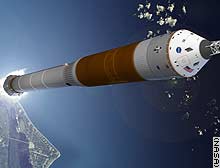
Project Orion

Here are some posts about the new project Orion:

Slasdot Via Space.Com
NASA intends to use the moniker Orion as both the title for its next generation manned craft, the Crew Exploration Vehicle (CEV), and as the project’s name. This approach is modeled after the 1960's program when Apollo Command Modules launched astronauts under Project Apollo.

Under Project Orion, NASA would launch crews of four astronauts aboard Orion capsules, first to Earth orbit and the International Space Station and then later to the Moon.


The Name Orion is not offical but NASA got some approval here:
Yet a publicly-accessible federal trademark search shows that NASA was granted the use of Orion on July 14, 2006 for use with "command modules" and "crew capsules", as well as crew and cargo launch vehicles.

Sources close to the agency confirmed to collectSPACE that the name Orion was in the final stages of approval.

Earlier documents obtained in January by collectSPACE used the names Antares and Artemis as 'notional' titles for the CEV. Orion will soon officially replace those other names for internal and external use, though when NASA will announce Orion is not yet known.


BlogsOfWar has placed his Misc. posts in Offtopic were the space articles will be. (For those who want to avoid articles that are war realted.)
Orion and NASA's Return to the Moon.

Great Blog, I read all of his posts to get tech, war and space all in one place!

Friday, July 21, 2006

Alantis moving out of Hangar


Monday, July 24, Atlantis is scheduled to be moved out of its hangar
at NASA's Kennedy Space Center, Fla. The first motion is expected at
6 a.m. EDT. Media must arrive at Kennedy's News Center by 5 a.m. to
attend the event.

The move from the Orbiter Processing Facility to the Vehicle Assembly
Building is referred to as a "rollover." Inside the assembly
building, Atlantis will be attached to its external fuel tank and
twin solid rocket boosters.

Atlantis' launch window begins Aug. 28. During its 11-day mission to
the International Space Station, the STS-115 crew of six astronauts
will install the Port 3/4 truss segment with its two large solar
arrays.

Crew members are:
  • Commander Brent Jett
    A veteran of three space missions, Jett will lead the crew of STS-115, the shuttle's 19th mission to the space station.
  • Pilot Chris Ferguson
    Ferguson will make his first journey into space as the pilot of the STS-115 shuttle mission.
  • Mission Specialist Joe Tanner
    With five spacewalks to his credit, STS-115 Mission Specialist Tanner will be making his fourth spaceflight.
  • Mission Specialist Dan Burbank
    Assigned as a mission specialist for STS-115, Burbank previously flew on STS-106.
  • Mission Specialist Steve MacLean
    On his second spaceflight, Canadian Space Agency Astronaut MacLean will visit the space station as an STS-115 mission specialist.
  • Mission Specialist Heidemarie Stefanyshyn-Piper
    A member of the 1996 astronaut class, Stefanyshyn-Piper is assigned to STS-115 as a mission specialist.

Thursday, July 20, 2006

37 years ago...


US test Minuteman III at VAFB

Via Drudgereport:
VANDENBERG AIR FORCE BASE, Calif. (AP) -- The Air Force successfully launched an unarmed intercontinental ballistic missile early Thursday.

The Minuteman III dummy warheads were fired at 3:14 a.m. and traveled about 4,200 miles before hitting a water target in the Marshall Islands.

The launch was delayed by a day because of a power outage at a radar facility that handles flights in and out of Southern California. The purpose is to test the defense system's reliability and accuracy.

Earlier this month, North Korea shook up the world by firing several missiles into the Sea of Japan, including a failed long-range missile.


The North Korean launch raised questions about the readiness of the U.S. missile defense system, which includes interceptors housed in underground silos in California and Alaska.


I heard on Sean Hannity and Drudge that the July 4th launch of missles in No. Korea were witnessed by Iranian operatives. The Axis of Evil I say.
One or more Iranians witnessed North Korea's recent missile tests, deepening U.S. concerns about growing ties between two countries with troubling nuclear capabilities, a top U.S. official said on Thursday.

Asked at a U.S. Senate hearing about reports that Iranians witnessed the July 4 tests, Assistant Secretary of State Chris Hill, the chief U.S. negotiator with Pyongyang, replied: "Yes, that is my understanding" and it is "absolutely correct" that the relationship is worrisome.


And the Patriot is being readied in Japan in anticipation of No. Korea's launching more missles.
Japan and the U.S. on Thursday announced a plan to deploy advanced Patriot interceptor missiles at American bases on southern Okinawa island, and a top government spokesman called for more pressure on North Korea to stop its missile tests.

The U.S. government will have Patriot Advanced Capability-3 missiles operational by the end of the year and post 600 more troops on Okinawa, the Foreign Ministry said. Officials on the island 1,000 miles southwest of Tokyo questioned the need for the missiles.

Japan stressed the deployment would be purely for defense purposes.

"In view of the development, deployment and proliferation of ballistic missiles in the region, and the clear and present threats such as the recent missile launches by North Korea ... Japan will continue to do its utmost to build its ballistic missile defense capabilities in close cooperation with the U.S.," the statement said.

Monday, July 17, 2006

Discovery is Home!

Discovery is home! Now What? Well for starters there will be 15 more flights until 2010 when the fleet will be retired. So we have 4 years to go and average 3 to 4 shuttle flights a year. Then the CEV will be readied by 2014. That means we will have about 3 years of non-manned flights by NASA. (2011-2014) My hope is private enterprise will take up the low-earth actives, which will let NASA to do the exploring of MOON and MARS.

I also hope the ISS will be more utilized as a stepping-stone to the Moon and Mars and beyond. Developing and using the space elevator technology will help in transporting crews and supplies without the need of a rocket to get to zero g orbit. Oh the possibilities are endless. I'll keep my fingers crossed!

From AP via PJ Media here:

Griffin noted that NASA faces 16 more shuttle flights to complete the space station and, hopefully, repair the popular Hubble Space Telescope. A decision is expected by fall on whether to send a shuttle to Hubble one final time, to extend the observatory's life.

NASA is up against a hard 2010 deadline for completing the space station. That's when the three remaining shuttles will be retired to make way for a new spaceship capable of carrying astronauts to the moon and eventually on to Mars.

"We don't have any slack. We have just enough shuttle flights left to do the job so we can't afford to mess up," Griffin said. "The team performed superbly systemwide (with Discovery) and what we have to do is exactly that same thing again from now until the end of 2010."

Complicating matters is that NASA faces a series of tremendously difficult assembly flights, beginning with Atlantis' upcoming mission to deliver and install a massive beam and set of solar wings. NASA is aiming for a liftoff as early as Aug. 27.

Shuttle program manager Wayne Hale said he wants just as much intense scrutiny _ and differing opinions among engineers _ for the next flight and all the ones after that.

A few weeks before Discovery's liftoff, NASA's chief engineer and top safety officer argued for putting off the mission until more design changes could be made to one area of the fuel tank. Hale was all for going ahead. Griffin cast the final, decisive vote.

After landing, Lindsey said he trusted that launch decision and noted it was an outgrowth of the management culture lessons learned from Columbia. The successful conclusion of the mission is more of a beginning to space station assembly and exploration, he said, than an end to the post-Columbia recovery era.

"I don't think we want to ever put Columbia behind us," Lindsey said.


I'll Blog the next launch (Atlantis) at WorldCon in Anaheim on Aug 27th.

Blogging the Landing

--3:25 AM PDT
Well I'm awake on the westcoast and laptop warmed up. Weather looks good at KSC. I have NASA TV on and it's almost sunrise on the landing strip. I'm checking Flame Trench and Nasa landing blog. All looks go so far. The doors are closed on Shuttle Discovery. All switches are being thrown to landing postions. The training aircraft at KSC are up checking the weather. Deorbit starts around 7 AM with 8:14 AM landing at KSC. (time Central).

--4:05 AM PDT
The NASA landing blog is up and running at Landing Blog here. And the Flame Trench Via Florida Today.

--4:08 AM PDT
One hour to de-orbit burn. The Astronauts are drinking the sports drinks to give their bodies fuild. Weather might be in question due to some thunder storms but out of the 30 mile area so far.

--4:50 AM PDT
All Systems a go, just waiting on the weather. De-orbit in about 15 minutes. Over at Flame Trench photos of the landing site show overcast skies. Dosen't look so good on the weather for de-orbit. Update soon.

--4:55 AM PDt
OK for De-Orbit. Weather is within limits.

--5:08 AM PDT
Astronauts are strapped in and ready to de-orbit. Landing at 6:14 AM PDT.
Discovery has fired its Orbital Maneuvering System engines to slow the vehicle down so that it will drop out of orbit and begin the high-speed freefall back to Earth. The three-minute engine burn sets Discovery on an irreversible course for home.

They's comming home no backin' out now! Godspeed Discovery!

--5:12 AM PDT
De-orbit burn takes about 3 Minutes. Discovery is over the Indian Ocean off the coast of Sumatra.

--5:15 AM PDT
De-Orbit Burn is done. Recovery team is driving to the landing pad.

--5:26 AM PDT
They should be feeling the heat as the friction is building up on reentry. The propellants on board are being let go.

--5:28 AM PDT
Mission control gives last landing condtions to Commander Lindsey.

--5:33 AM PDT
40 Minutes to touch down. Will be landing on runway 33.

--5:36 AM PDT
Five minutes to interface. 63 hundred miles to runway. 3 APU's are good to go too.

--5:41 AM PDT
1 minute to entry interface. 54 hundred miles to runway.

--5:43 AM PDT
Interface now and 30 minutes to touchdown.
Discovery is currently at an altitude of 108 statute miles and 6,300 miles from the runway. Today will be the 62nd landing of the shuttle at Kennedy Space Center.


--5:46 AM PDT
They are definatly feeling the atmoshpere now. I bet their bodies will start to feel the heavyness and the g's on their faces.

--5:48 AM PDT
Comming to the coast of Central America. APU's still good.
Discovery is now 4,600 miles to the runway, traveling at approximately mach 24.8.

Looks like they are switching to landing srips from 33 to 15 because of weather conditons.

--5:33 AM PDT
The course change whould mean instead of a right turn to approach it would be a left turn to approach. This is because of a small thunder cloud is building up on approach to 33.

--6:00 AM PDT
It will be 15 landing strip and 15 Minutes to touchdown at KSC. And they will be turning left on approach.

--6:03 AM PDT
Heading to Florida over the Gulf of Mexico.

--6:05 AM PDT
Just entering the Florida coast and 9 minutes to touchdown.

--6:06 AM PDT
21 Miles and Mach 4.5 now. In a few minutes the pilots camera will be active.

--6:08 AM PDT
Loose switch on Air data probe.

--6:09 AM PDT
5 Minutes to landing.
Discovery's current speed is Mach 6.2 (4,650 mph), 25 miles in altitude and 214 miles from the runway. Discovery is approaching Florida's southwestern coast. Nine minutes until touchdown.


Camera is ready and looking good. Discovery at Mach one now.
6:11 AM PDT
Booms are heard. Now at 3 Minutes to touchdown. 500 mph. On target.

6:13 AM PDT
420 MPH now. Fast approach and line up to runway now. Chase plane pics now.

6:14 AM PDT Runway in sight all good. Approach is good.

6:15 AM Here we are! Bird has landed. The Chute is out. Looking good! Great job you guys!
6:16 AM All stop at KSC. Just waiting to de-plane the bird. The exhaust fumes have to disapate before exit.

6:20 AM PDT
The Leeky APU was not a problem on landing.

Sunday, July 16, 2006

Now for the Spacewalkers


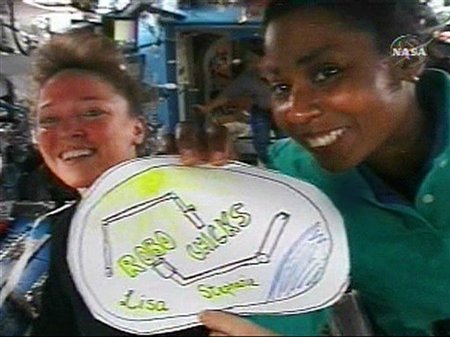
Robo Chicks in action


My girls did watch parts of the spacewalks. Some were boring to them, but they loved it when they showed the "Robo Chicks" in action. It was something to do with the pony tails (in parallel) and working on the robotic arms. They want a hair style like that on earth! Go Lisa and Stephanie!

Shuttle Landing Monday

I've been in the middle of the summer activites with the girls. Blogging has been light because of the distractions. I plan to live blog the Discovery Landing on Monday, July 17. Here is NASA's release of today July 16:
The six STS-121 astronauts are preparing for landing. Today's activities include stowage of items, engine tests and system checkouts.

Landing is scheduled for 9:14 a.m. EDT Monday at Kennedy Space Center, Fla. The deorbit burn is set for 8:07 a.m. A second landing opportunity for Monday would see the deorbit burn at 9:43 a.m. for a landing at 10:50 a.m. Weather forecasts call for a chance of showers at the landing site.

Crew members will take a break from their work to talk with media with CNN, CBS, ABC, NBC and the Fox News Channel at 11:53 a.m.

Discovery’s landing will mark the end of a successful mission for the STS-121 astronauts. They delivered supplies, equipment and a new Expedition 13 crew member to the International Space Station. During three spacewalks, they performed maintenance on the station’s mobile transporter and tested orbiter heat shield techniques.

Thursday, July 13, 2006

Testing our missle defense


Our system's are working after a test in New Mexico on Wednesday, here via Drudgereport.
When the target missile was destroyed, sending a brilliant white, mushroom-like cloud into the dark sky, the crowd began to applaud and cheer wildly.

" We smashed it," several people cheered as the rainbow colored contrail gave way to the cotton ball cloud of destruction above.

Eckles said contrails and explosions from previous tests have been seen as far away as Phoenix and Tucson. On Wednesday, Phoenix residents again were treated to a colorful contrail pattern over the Arizona skies, while closer-to-home reports were received from Lordsburg, Silver City and Doña Ana County from early risers who observed the same display.

"All evidence is that it was totally destroyed," Driessnack said of the target missile during an interview after the test was complete. "We knew from the last test, 60 days ago, that it was working as it should."

He said the test indicates THAAD could be ready for emergency deployment "as soon as a year from now."


Just in time when North Korea is shooting off duds. Iran's a threat we have to deal with also. A good defense to protect North American lifes. Thanks to Ronald Reagan who went though on SDI. WE really need it now!

Links to stories:

Space War story on THADD here.

Also in the news Northrop-Grumman has Skyguard Laser Defense system out of Redondo Beach, CA (Former TRW) here.

Sunday, July 09, 2006

China gets a slapping for aiding Iran

HT from Strategy page here.

The United States has ordered sanctions on two Chinese missile technology companies. The Chinese are accused of providing missile technology to Iran. One of the Chinese companies, China Great Wall Industry Corporation ("Great Wall" for short) has long been accused of aiding the North Korean missile effort. Great Wall is owned by the Chinese government, but is run for profit, and its managers are under orders to make money, or lose their jobs. Great Wall earns most of its profits by putting foreign satellites into orbit. Great Wall does this more cheaply than anyone else, and has had 24 successful launches for foreign customers so far. The two Chinese companies are major suppliers of missile technology to the Chinese armed forces, but the export business is where they rack up their biggest profits. The American sanctions block the Chinese firms from using any American banks in their dealings.

Friday, July 07, 2006

The Shuttle debate

The Orange County Register (here) had an editorial on NASA getting rid of the shuttle right now and privatizing the fleet.
The best approach now would be to scuttle all three shuttles, or privatize the fleet. The problem isn't just safety, but economics, said Ed Hudgins, an adjunct scholar at the Cato Institute and editor of "Space: The Free Market Frontier." He said each shuttle launch now costs $500 million to $1 billion.

"From a scientific view, very little is gained" from a shuttle flight, Mr. Hudgins said. The shuttle also provides services for the International Space Station, which in the 1980s was projected to cost $8 billion, but whose real cost now is expected to be $50 billion to $100 billion. "Again, the space station is doing very little science," Mr. Hudgins said.

I wonder if the private sector will be geared up to go. If we privatize will the space station be completed? A good argument for private enterprise, but my belief is private enterprise will not have the government red tape to go through.
In sum, half of NASA's $7 billion yearly budget goes to human space exploration – the shuttle and space station – money that could go to better uses, such as unmanned space exploration.
I still think "manned" or the PC "Human" exploration is important to the US. If we give up the shuttle and private enterprise does not ramp up then were will we be? Is the US going to let China or Russia take over space exploration for six years waiting for the CEV to be build?

Granted I favor private enterprise getting into space. But space exploration's history has had some hurtles to face. Will privatizing the shuttle help or hinder the USA space program stay the front runner in space exploration? My option is to complete the shuttle flights within NASA and retire it in six years. But I also favor private companies getting into the space exploration business. They will eventually take over the low orbit activities while NASA explores the outer regions.

Tuesday, July 04, 2006

Back from the Parade! Happy 4th of July!

I'm back from the parade and ready for Launch! It was great to see so many people in Fullerton enjoy the 4th of July.

--11:07 AM PDT
Looks like they plan a T -31 sec hold for monitoring Liquid oxygen inlet tank temp.

--11:10 AM PDT
Weather looks great! No Anvils this time. All green.
T -9 Mins. and holding. We have about 15 mins. left in the hold.

--11:17 AM PDT
All polled and ready for count down.

--11:20 AM PDT
Weather a go, no techincal problems. 5 mins left in hold.

--11:25 AM PDT
Final Go's Polled! Ready to Go!!!!!!!!!!!!!!
A great day to launch and celebrate America's 230th Birthday!
"I can't think of a better place to be on the Fourth of July," Commander Steve Lindsey responded from within the orbiter. He said that the crew is ready to give Florida an up close and personal look at the rockets' red glare.


--11:29 AM PDT T-9 and counting!!!!!!!

--11:31 AM PDT T-7 White Room retracting and pre-start precedures.

--11:33 AM PDT T-4:30 and counting.

--11:35 AM PDT T-4 mins. Readness test of rocket engines.

--11:36 AM PDT T-3 Mins. and Vent hood is retacted.

--11:38 AM PDT Blast off! Bird looks good!

--11:40 AM PDT Go with thothle up!

--11:42 AM PDT Solids go by by.

-11:46 AM PDT Roll over.

--11:48 AM PDT Liquid tank detached. Main engine cut off.

Shuttle a go Go!


I have a 4th of July parade to go to. My daughter's troop will be marching in it. I might just get home in time for the launch. So live blogging won't happen today.

The foam issue has been looked at and was agreed it could go ahead and launch.
Carnegie Mellon University engineering and risk analysis professor Paul Fischbeck, who had been worried earlier in the day by the falling chunk of foam, said NASA's rationale in going ahead made sense and he is slightly more comfortable with a launch try Tuesday.

Fischbeck, who has consulted with NASA on the shuttle's delicate heat protection system, wondered why foam had broken off on the launch pad. "It's something you might want to understand before you launch," he said.

The patch of foam fell off an area that covers an expandable bracket holding a liquid oxygen feed line against the huge external tank. NASA engineers believe ice built up in that area from condensation caused by rain Sunday.

The tank expanded when the super-cold fuel was drained after Sunday's launch was canceled because of the weather. The ice that formed "pinched" some of that foam, causing the quarter-inch-wide crack and the piece of foam to drop off, officials said.

The size of the fallen foam was less than half the size of one that could cause damage, NASA officials said.

NASA managers decided to go ahead with the launch attempt because of three criteria: They are confident enough foam still is on the bracket to prevent a large piece of ice from forming; that the area of foam where the piece dropped was still intact; and they don't believe the area will be exposed to extreme heat during ascent.

Inspectors spotted the crack in the foam insulation during an overnight check of the shuttle. NASA had scrubbed launch plans Saturday and Sunday because of weather problems.

The forecast for a Tuesday liftoff was better than previous days, with just a 40 percent chance that storm clouds would prevent liftoff.


Live Blogging sites:
NASA Shuttle Launch
Flame Trench
***Update****
A backup Circuit Breaker to the controls of primary heaters on the segment joints on both solid rocket boosters is acting up. A crew is going to replace the 100 amp backup breaker. Ice patrols are out inspecting.

Monday, July 03, 2006

Cracks found on External tank

I don't think they will launch anytime soon:
During a routine inspection overnight after the draining of the tank, a crack was discovered in the foam near a bracket on the external fuel tank that holds the liquid oxygen feedline in place. The Mission Management Team is meeting to discuss this and to determine what, if any, impact this will have on our launch date.


Next update at 12:00 noon EDT Briefing. NASA TV here.

Update: Spaceflight Now has the picture of the cracked foam piece found today here.

New Mexico Space Port

UP Aerospace (Space Daily) will launch a payload on Aug. 14 (My Dad's 70th Birthday!):
UP Aerospace announced Friday that it has set Aug. 14 as the date of its first commercial space launch from New Mexico's spaceport facility. The company's SpaceLoft XL vehicle will carry more than 50 payloads and experiments from sponsors in the United States and Europe.

"Our 20-foot-tall, single-stage, 800-pound SpaceLoft XL solid-fuel rocket will accelerate to five times the speed of sound - nearly 3,400 miles per hour - in just 13.5 seconds," said Jerry Larson, UP Aerospace president and chief technology officer. "It will reach the international definition of space, 62 miles or 100 kilometers, in just a minute and a half, and a achieve a flight apogee of about 70 miles shortly thereafter."

"The mission includes support from White Sands Missile Range, located just to the east of the Spaceport," Larson said. "Our SpaceLoft XL rocket includes a C-Band transponder that will be tracked by the radars at White Sands, providing the highest quality data possible for use in licensing the Spaceport with the FAA."

The payloads will include contributions from the University of Colorado at Boulder, Brown University (co-developed with AeroAstro,), the University of Hartford, Central Connecticut State University and New Mexico State University, the company said in a news release.

SpaceLoft XL provides a total of 110-pound payload capacity and 10,500 cubic inches of payload volume. The rocket can accommodate payloads up to 10 inches in diameter and 7 feet long and can lift them to an altitude of 140 miles (225 kilometers) with a wide range of micro-gravity options.

The launch will be "just the first of multiple commercial space launches that we will be conducing. Another significant space launch is in October, concurrent with this year's X PRIZE CUP event," said Eric Knight, chief executive officer of UP Aerospace

"In addition to the university payloads, we will also be flying into space over 40 experiments created by high school students from across America," Knight said. "To open the space-access door to students at this level, we've partnered with the Connecticut Center for Advanced Technology and the National Aerospace Leadership Initiative. These organizations have established LaunchQuest, a novel program that lets youngsters conduct their own space-flight research."

Close encounters

Via Drudge(here)
BELFAST, Ireland, July 2 (UPI) -- An asteroid with the power to wipe out a small country will miss the Earth tomorrow, the Sunday Telegraph reported.

Asteroid 2004 XP14 is nearly half a mile wide and was discovered in December 2004. It is in the "Apollo" class of asteroids, which are those that cross orbits with Earth.

Initial speculation by scientists predicted the possibility of impact with Earth later this century, but that conclusion has been ruled out, the newspaper said.

When the asteroid passes Earth, it will be some 268,624 miles away, just slightly further away than the average distance of the Moon from Earth, the report said. A telescope will be required to view the asteroid, which will pass at 5:25 a.m. UK time.

Saturday, July 01, 2006

Blogging the Launch

**Update** Welcome Blog Of War readers! I'll try to live blog as much as I can today. I have Church at 10:30 AM. But will be home by 11:45 AM PDT (2:45 PM EDT) to cover the launch. (Unless I want to be a bad girl and skip church....)

Sunday, July 2, 2006

--10:17 AM PDT
It's a Scrub again!!!!!!!!!!!!!!!!!!!!!!!!!!!!!!!!!!!!!!!!!!!!!!!!!!!
I'm going to church. I'll blog again on the next day.

--10:12 AM PDT Weather is Red. They all crew are seated and ready. I'm going to Church to pray for clear sailing! Be back before (hopefully) launch time.
--9:47 AM PDT
Com checks and final seating.
VP Dick Cheney will not be at KSC to view the launch today. (HT Flame Trench)
--9:42 AM PDT
Still getting all crew members hooked up and strapped in. I just finished my shower and getting ready for church. (I want to pray for good weather and good blast-off).
Weather is still red, with Anvil's in the area.
--9:00 AM PDT
They rode up the 195 feet in the elevator and now are in the whiteroom. The Commander is being seated right now.

--8:38 AM PDT
Astronauts are on the Van to drive out to 39 B. They'll be at the pad in about 25 minutes.
--7:52 AM PDT
The Astronauts are suiting up in in the Operations and Checkout Facility.

--7:45 AM PDT
Thunder storms in the area, weather will be a problem today. 5 No-go Weather criterias so far. T Minus 3 Hours and Holding.


From NASA press release:
The next launch attempt for Discovery's STS-121 mission to the International Space Station is set for Sunday, July 2, at 3:26 p.m. EDT. Commentary on NASA Television will begin with fueling of the shuttle's external tank at 5 a.m. followed by full coverage at 9:30 a.m.

The forecast for Sunday shows a 60 percent probability of weather prohibiting launch.

The Weather will be a little bit better then yesterdays. Let's hope the anvil clouds stay away!

NASA TV link here.


************************************************************************************
Saturday, July 1, 2006
--12:42 PM PDT
It's a Scrub!!!!!!!!!!!!!!!!!!!!!!!!!!!!!!!!!!!!!!!!!!!!!!!!!!! Tomorrow they will try again. 3:26 PM EDT. Will Dick Cheney come back tomorrow?
--12:36 PM PDT
No-go still due to anvil. Now condtions at landing at KSC looks bad too, becoming overcast. Two minutes till T-9 but will hold at 9 min. Weather!
--12:27 PM PDT
Anvil clouds within 20 miles of launch pad. Still no go, does not look good.
--12:22 PM PDT
The set time for launch is 3:48 and 41 sec. EST(Launch window is till 3:58 EST)
--12 Noon PDT
Houston update-all go except the weather is still no-go. T-9 min. and holding. Close out crew is wraping up at the launch pad.
--11:43 AM PDT
The thruster heater will not be a problem by flight control.
--11:38 AM PDT
The VP has landed in Air Force 2. T-Minus 20 and holding.
--11:32 AM PDT
Weather is still no-go with the anvil clouds.(The Ground Launch Sequencer (GLS) mainline activation has been completed.) GLS computer is up to monintor 1000 activites that effect the shuttle and launch.
--11:08 am PDT
Stand-by to pressurize the hatch.
--10:57 AM PDT
Flame Trench says Weather is no go, anvil clouds.
--10:55 AM PDT
All Loud and Clear, Houston!
--10:54 AM PDT
Air to Air checks
--10:52 AM PDT
Onboard Com checks are done, now air to ground checks to go.
--10:32 AM PDT
The Flame Trench is also live blogging here by Florida Today. All the crew is seated. Weather looks "green."
--10:16 AM PDT
Last crew woman is being seated.
--10:05 AM PDT
Lightning reported in the area of Pad 39B. T-38 is up to check the weather. It's a red now, but weather is always changing. The launch window will be watched closely.
--10 AM PDT
Com Check!
--9:22 AM PDT
They are being seated into the vehicle. Commamder goes first.
--9:19 AM PDT
They are at the Pad! Climbing out of the van and to the elevator. Its a 195 foot ride!
--9:15 AM PDT
No other issues than weather and the thuster heater. Seems like a non-issue at this time.
--9:10 AM PDT
Van is driving to PAD 39 B. The tents are set up for big wigs. VP Dick Cheney is here to watch the launch.
--9:00 AM PDT
The shuttle astronauts are in the van, driving out to Pad 39B!
--8:45 AM PDT
The shuttle astronauts are getting dressed and ready. They will make their way out of the crew quarters shortly.
T - 3:00 hours and Counting!

--7:25 AM PST
I'll be convering the launch as much as I can today. Here is the NASA Blog(HERE) page. As of the first post today (10 am EST, 7 am PST) the only problem they are working on is a heater problem:
The only possible issue in work is the examination by officials of a heater problem with one of the vernier engine thrusters onboard Discovery. There is still plenty of time left in the countdown for them to discuss how this will be handled.

We'll have to stay tuned to see how this will be worked around or fixed. The weather is at 40% so we'll keep an eye on that too!

Rep. Calvert Blasts the LAT

I was helping out at Summer Day Camp and missed the LAT editorial about dumping the shuttle program now and have NASA not be active in space for 6 years. (While other nations are busy working in space!)
Instead of risking another tragic or humiliating setback Saturday, NASA should abandon the shuttle and focus on more productive missions.

The shuttle was intended as a reusable spacecraft that would require only routine maintenance between missions. But NASA has been working on the foam problem for more than three years. It's becoming increasingly clear that the issue with the shuttle isn't age but a design flaw.

In fairness, the officials who advised against Saturday's launch — the agency's chief engineer and its chief safety officer — say there isn't much risk that the shuttle's crew could die. If debris punctures Discovery's skin, its astronauts can abandon the craft for the International Space Station; the shuttle would burn up in the atmosphere without a soul on board.


Rep. Calvert (HT NASA Watch) replies here:
NASA is still working on the foam problem, but the problem is much more understood now and there are safeguards in place to ensure that shedding foam will not endanger the crew. Discovery's flight is a test flight to see how the foam fixes developed so far will work. But more importantly, it is a test of NASA's organizational culture. All indications are that the safety culture of NASA is working well thus far throughout the pre-launch process. Two senior members of the Final Flight Readiness Review did not recommend a launch at this time. Their concerns were given due consideration by the Administrator when he made his decision to proceed with the launch. Unlike with Columbia's mission, the process was transparent and consultative throughout. The Administrator has received the entire spectrum of NASA opinion about the launch. He has taken this information, weighed the risks, and made a decision that he believes is the best one for America's Space Program. That's what we pay him for.

The Shuttle is far from a perfect system. The decision to retire it in 2010 is based on a combination of the Shuttle's age and design, the need to complete the International Space Station (ISS), and the necessity of transitioning the NASA workforce and facilities to support the new Crew Exploration Vehicle (CEV). The longer we delay completing Discovery's test flight the less time remains to fly the remaining missions.

But until the CEV is available sometime after 2012, the Shuttle is the only system the U.S. has to send people into space. Even if the Shuttle was retired tomorrow, the CEV will not be ready much sooner. Americans should not be not comfortable with allowing six or more years to pass with only China and Russia having a human space flight capability.

Human space flight is an inherently risky business. Administrator Griffin, the crew of Discovery, and the men and women of NASA understand that fact. If Discovery's test flight fails to safely complete its mission, the Shuttle era will be over. If it succeeds, America's manned space program will be able to conduct a rational transition to the next generation space vehicle. Let's give NASA the chance to succeed.

I believe NASA will surpass the problems. They really did a fine job a year ago with testing repair options. The Media were all over the grounding when foam was caught flighing off the tank during launch. Here is a post on Gene Kranz's NYT op-ed (8/3/2005) about it here.
There are many nations that wish to surpass us in space. Does the "quit now" crowd really believe that abandoning the shuttle and International Space Station is the way to keep America the pre-eminent space-faring nation? Do they really believe that a new spacecraft will come without an engineering challenge or a human toll? The path the naysayers suggest is so out of touch with the American character of perseverance, hard work and discovery that they don't even realize the danger in which they are putting future astronauts - not to mention our nation.

I'm with Gene on this one. Space is America's "crown jewel." We are a Space-Faring nation. Why give it up and wait while other's surpass us?

Friday, June 30, 2006

30 years ago on MARS


Viking I historic landing will be 30 years on July 4th. (1976 is when I graduated from High School also). My father was working for John H. Ransom Labs in Camarillo, CA at the time. His company worked on some of the optical parts in Viking's camera. The prisms they manufactured gave Viking a 360 degree picture of the Martian landscape. A great mission and look at what we can do 30 years later. Viking could not move but had a robot arm. Spirit and Opportunity are still working after two years on Mars. They were suppose to last about 6 months. Here's a site with Viking images.

One day to go!
The shuttle will blast off tomorrow weather perminting. Here is the NASA count down clock.

(HT from Instapundant) By Rand Simberg at NRO here:

What those who criticize Dr. Griffin’s decision to move forward with the launch are implicitly saying is that the astronauts’ lives, and the vehicle, aren’t worth the mission, and that they have, in fact, infinite value relative to it. Every month that we delay the return to flight costs hundreds of millions of taxpayer dollars, with an army of shuttle technicians sitting around, their skills getting rusty (which brings its own risks). Moreover, no matter how much more time and money is spent in trying to reduce the risk, “safe” will always be a relative, not an absolute term. If completing the station, if finishing this particular mission, is worth anything, it’s worth doing sooner, rather than later, so we can sooner free up the resources for more adventurous activities that are (or at least should be) perceived as being worth the risk of life. Paul Dietz, a frequent commenter to my blog, has noted that if we really wanted to indicate national seriousness about opening up the space frontier, we would, starting right now, with great fanfare, set up a dedicated national cemetery for those who would be expected to lose their lives in that long-term endeavor, and provide it with lots of acreage.

Tuesday, June 27, 2006

Shuttle Crew arrives

Shuttle Launch Countdown starts on Wednesday

From NASA:
MEDIA ADVISORY: M06-106

NASA Space Shuttle Discovery's Launch Countdown Begins June 28

NASA will begin the countdown for the launch of Space Shuttle Discovery at 5 p.m. EDT June 28. The countdown includes nearly 28 hours of built-in hold time leading to a scheduled launch at about 3:49 p.m. on July 1. The launch window extends for nearly five minutes. The launch team at NASA's Kennedy Space Center, Fla., will conduct the countdown from the newly renovated Firing Room 4 of the Launch Control Center.

This mission is designated STS-121. It is the 115th shuttle flight and the 18th U.S. flight to the International Space Station. Discovery's mission is scheduled to last about 12 days and end with 10:45 a.m. landing at Kennedy on July 13. The crew will test new equipment and procedures to improve shuttle safety, as well as deliver supplies and make repairs to the International Space Station.

COUNTDOWN MILESTONES (TIMES SUBJECT TO CHANGE)

Launch-3 Days (Wednesday, June 28): Countdown begins at the T-43 hour mark (5 p.m.)

Launch-2 Days (Thursday, June 29)
Remove mid-deck and flight-deck platforms (1 a.m.);
Complete preparation to load power reactant storage and distribution system (4 a.m.)
Activate and test navigational systems (6 a.m.);
Flight deck preliminary inspections complete (9 a.m.)
Enter first built-in hold at T-27 hours for duration of 4 hours (9 a.m.); Clear launch pad of all non-essential personnel; Perform test of the vehicle's pyrotechnic initiator controllers
Resume countdown (1 p.m.) Begin operations to load cryogenic reactants into Discovery's fuel cell storage tanks (2:30 p.m.)
Enter 4-hour built-in hold at T-19 hours (9 p.m.); Demate orbiter mid-body umbilical unit (9:30 p.m.) Resume orbiter and ground support equipment closeouts

Launch-1 Day (Friday, June 30)
Resume countdown (1 a.m.); Final preparations of shuttle's three main engines for main propellant tanking and flight (1 a.m.); Begin filling pad sound suppression system water tank (2 a.m.); Pad sound suppression system water tank filling complete (5 a.m.); Close out the tail service masts on the mobile launcher platform

Enter planned hold at T-11 hours for 13 hours, 53 minutes (9 a.m.);
Begin star tracker functional checks (9:50 a.m.); Activate orbiter's inertial measurement units; Activate the orbiter's communications systems; Install film in numerous cameras on the launch pad (10:55 a.m.); Flight crew equipment late stow (2:50 p.m.); Move Rotating Service Structure (RSS) to the park position (6:30 p.m.); Perform ascent switch list; Fuel cell flow-through purge complete Resume countdown at T-11 hours (10:53 p.m.)

Launch Day (Saturday, July 1)
Activate the orbiter's fuel cells (12:02 a.m.); Clear the blast danger area of all non-essential personnel; Switch Discovery's purge air to gaseous nitrogen (12:53 a.m.)
Enter planned 2-hour built-in hold at the T-6 hour mark (3:53 a.m.); Launch team verifies no violations of launch commit criteria prior to cryogenic loading of the external tank; Clear pad of all personnel
Resume countdown (5:53 a.m.); Chill down of propellant transfer lines (5:53 a.m.); Begin loading the external tank with about 500,000 gallons of cryogenic propellants (about 6:03 a.m.); Complete filling the external tank with its flight load of liquid hydrogen and liquid oxygen propellants (about 8:53 a.m.); Final Inspection Team proceed to launch pad
Enter planned 3-hour built-in hold at T-3 hours (8:53 a.m.); Perform inertial measurement unit preflight calibration; Align Merritt Island Launch Area (MILA) tracking antennas; Perform open loop test with Eastern Range
Resume countdown at T-3 hours (11:53 a.m.); Crew departs Operations and Checkout Building for the pad (11:58 a.m.); Complete closeout preparations in the white room
Check cockpit switch configurations; Flight crew begins entry into the orbiter (about 12:28 p.m.); Astronauts perform air-to-ground voice checks with Launch and Mission Control. Begin to close Discovery's crew hatch (about 1:38 p.m.); Begin Eastern Range final network open loop command checks; Perform hatch seal and cabin leak checks; Complete white room closeout; Closeout crew moves to fallback area; Primary ascent guidance data is transferred to the backup flight system
Enter planned 10-minute hold at T-20 minutes (2:33 p.m.); NASA test director conducts final launch team briefings; Complete inertial measurement unit preflight alignments
Resume countdown at T-20 minutes (2:43 p.m.); Transition the orbiter's onboard computers to launch configuration; Start fuel cell thermal conditioning; Close orbiter cabin vent valves; Transition backup flight system to launch configuration
Enter estimated 40-minute hold at T-9 minutes (2:54 p.m.); Launch director, mission management team and NASA test director conduct final polls for go/no go to launch
Resume countdown at T-9 minutes (about 3:40 p.m.); Start automatic ground launch sequencer; Retract orbiter crew access arm (T-7:30); Start mission recorders (T-6:15)
Start Auxiliary Power Units (T-5:00); Arm SRB and ET range safety safe and arm devices (T-5:00); Start liquid oxygen drainback (T-4:55); Start orbiter aerosurface profile test (T-3:55); Start main engine gimbal profile test (T-3:30); Pressurize liquid oxygen tank (T-2:55);
Begin retraction of the gaseous oxygen vent arm (T-2:55); Fuel cells to internal reactants
(T-2:35); Pressurize liquid hydrogen tank (T-1:57); Deactivate bi-pod heaters (T-1:52); Deactivate SRB joint heaters (T-0:60 seconds); Orbiter transfers from ground to internal power (T-0:50 seconds); Ground Launch Sequencer go for auto sequence start (T-0:31 seconds); SRB gimbal profile (T-0:21 seconds); Ignition of three space shuttle main engines (T-6.6 seconds); SRB ignition and liftoff (T-0)

STS-121 CREW & LAUNCH DAY ACTIVITIES
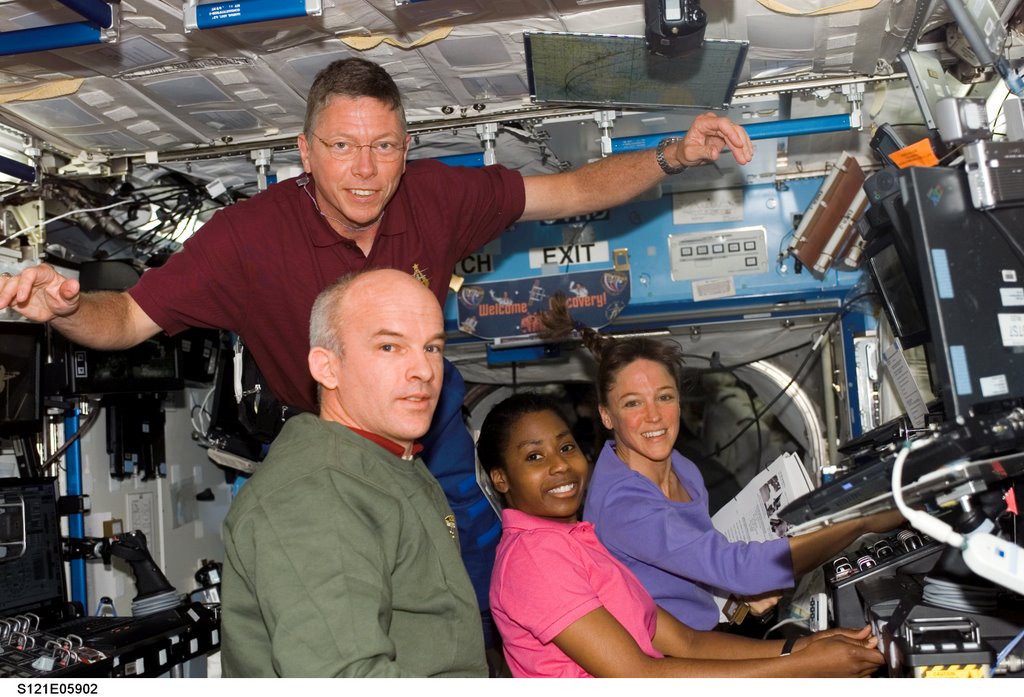
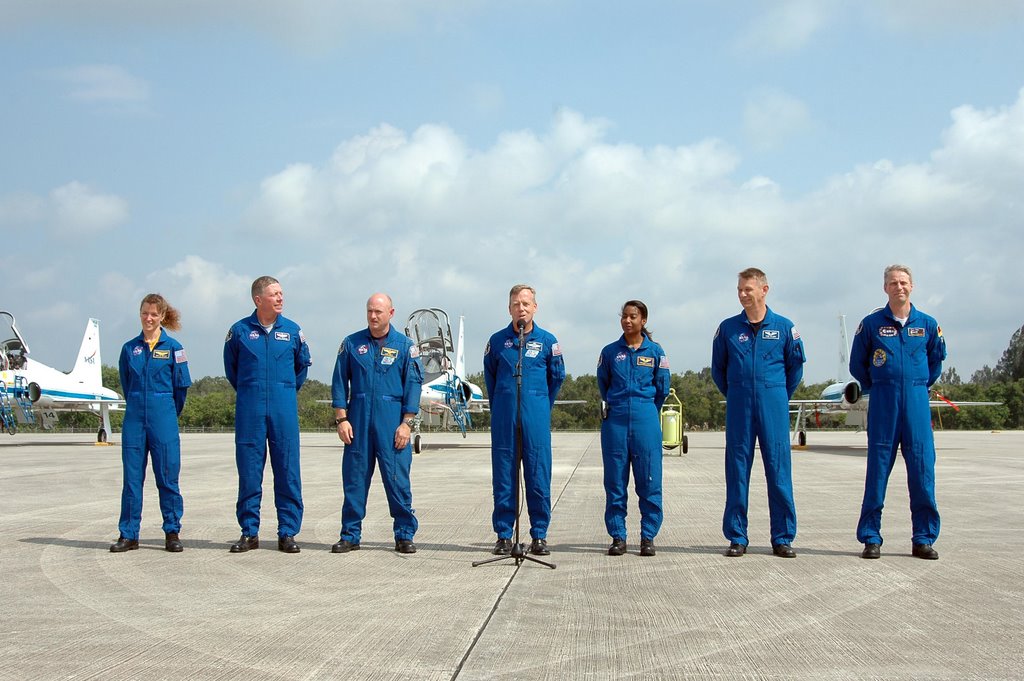
Commander Steve Lindsey; Pilot Mark Kelly; mission specialists Michael Fossum, Lisa Nowak, Stephanie Wilson, Piers Sellers and Thomas Reiter of the European Space Agency

# 5:15 a.m. Crew wakes up
# 10:10 a.m. Breakfast
# 10:48 a.m. Weather briefing for STS-121 commander and two crew members
# 11:30 a.m. Astronauts put on flight suits
# 11:58 a.m. Depart for launch pad
# 12:28 p.m. Arrive at white room and begin to enter Discovery
# 1:43 p.m. Close crew hatch
# 3:49 p.m. Launch

Friday, June 23, 2006

Pluto's New Moons Nix and Hydra


The two small moons found last year have been named Nix and Hydra by the (here) IAU.
In mythology, Nix is the goddess of darkness and night, befitting a satellite orbiting distant Pluto, the god of the underworld. Nix is also the mother of Charon, relevant to the giant impact believed to have created Pluto's three satellites, indicating Charon was borne of the material from which Nix formed. Hydra is the terrifying monster with the body of a serpent and nine heads, befitting the outermost moon of Pluto, the ninth planet in the solar system.


The Moons were discovered by the Hubble Telescope and a team of researchers from Southwest Research Institute, the Johns Hopkins University Applied Physics Laboratory in Laurel, Md and the Lowell Observatory in Flagstaff, Ariz.

Tuesday, June 20, 2006

Update on North Korean Missile

Here's the Reuters story on our US missile program.
The United States has moved its ground-based interceptor missile defense system from test mode to operational amid concerns over an expected North Korean missile launch, a U.S. defense official said on Tuesday.

"It's good to be ready," the official said


I hope to God it is so! Good to hear we are ready.
Japan is nervous. They are building a missile defense system using Aegis.

Japan plans to equip half a dozen, or more, of its Aegis warships with the SM-3, to provide protection from North Korean, or Chinese, ballistic missiles. The SM-3 missile has been one of the bright spots in the American anti-missile effort. Japan has also agreed to contribute a billion dollars to the three billion dollar development work being done on the SM-3. The U.S. has already stationed Aegis SM-3 equipped ships off the coast of Korea, to provide protection against North Korean missiles.

It's good Japan has bought the Aegis Anti-Missle system. Hopefully they will use it if The North does strike.
"If North Korea test-launches a missile, naturally Japan and the United States will take stern measures," said Chief Cabinet Secretary Shinzo Abe, the government spokesman, suggesting the possibility of economic sanctions.

Japanese officials are exchanging information "around the clock" on a possible launch of the Taepodong-2, which has a range of 3,500 to 6,000 kilometers (2,200 to 3,750 miles), said defense chief Fukushiro Nukaga in Tokyo.


It appears that China does not want North Korea to test the "waters" to see what Japan and the US will do.
But South Korean officials and analysts say North Korea will not actually fire the missile because it is sure to trigger strong punitive measures from the international community, which could threaten the economic survival of the communist regime already suffering from U.S.-led financial sanctions over its nuclear program and financial illegalities.
China opposes the prospective missile launch as it could be used by Japan to step up its efforts toward its missile defenses and stronger security ties with the United States.

"The North's missile threat seems aimed at gaining leverage as its nuclear card is losing effectiveness. With the missile card in hand, the Kim Jong Il regime seeks to have direct talks with the United States," said Koh Yu-hwan, a North Korea specialist at Dongguk University in Seoul.

"If North Korea fires the missile, it is aimed at tightening its grip on the people. This indicates a crack in the North's social control system and serious conflicts among power elite," he said.

According to intelligence sources, the North's state control has been weakened since its economic reform measures in 2002, which brought about negative fallout, including tremendous inflation.

**Update Captian Ed on the TCS article on "Star Wars" here.

A Brief History--On Earth?

I heard about this by Steven Hawking last week. I do believe he is right about survival of the Human species by colonizing space.
"It is important for the human race to spread out into space for the survival of the species," Hawking said. "Life on Earth is at the ever-increasing risk of being wiped out by a disaster, such as sudden global warming, nuclear war, a genetically engineered virus or other dangers we have not yet thought of."


However, I don't think global warming will get us. The risk from a Nuke being released by a Terrorist group is greater. Colonizing space is good insurance for Human survival. Space is the Place!

Monday, June 19, 2006

Ready for a test?

Will the US use the missle defense system if North Korea launches?

A two-stage Taepodong-2 missile could hit parts of the United States, while a three-stage Taepodong-2 could range all of North America, the head of the Defense Intelligence Agency told the US Senate in February 2005.

Previous unclassified Defense Department estimates date back to 1997, when a report put the Taepodong-2 missile's range at between 4,000 and 6,000 kilometers (2,500-3,750 miles) , and the Taepodong-1 at 1,500 km (940 miles).

The United States has been working feverishly, with mixed success, to field missile defenses capable of countering a limited missile attack by North Korea.

A North Korean launch would mark the first real test of the US system, which currently consists of an array of tracking and targeting radars and at least 11 interceptor missiles in silos in Alaska and California.

US Aegis warships have been modified for missile defense missions. Several are stationed in the western Pacific.

Their Spy-1 radars are capable of tracking missile launches. The US Missile Defense Agency also has been testing capabilities of warships to shoot down short and medium range missiles with interceptor missiles.

Last November, a US Navy cruiser intercepted a mock warhead after it separated from a medium-range missile in a test pover the Pacific.


Bill Gertz says the US might test the Missle system out here.

Wednesday, June 14, 2006

Shuttle Crew gets ready


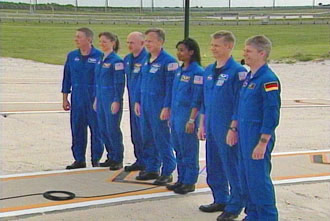
Image above: STS121-S-002 (5 April 2006) -- These seven astronauts take a break from training to pose for the STS-121 crew portrait. From the left are astronauts Stephanie D. Wilson, Michael E. Fossum, both mission specialists; Steven W. Lindsey, commander; Piers J. Sellers, mission specialist; Mark E. Kelly, pilot; European Space Agency astronaut Thomas Reiter of Germany; and Lisa M. Nowak, both mission specialists. Image credit: NASA

Monday, June 12, 2006

First storm of the season


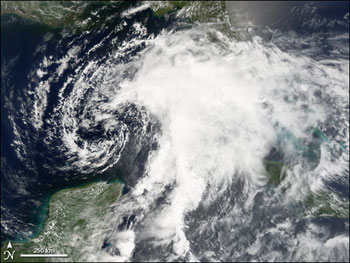
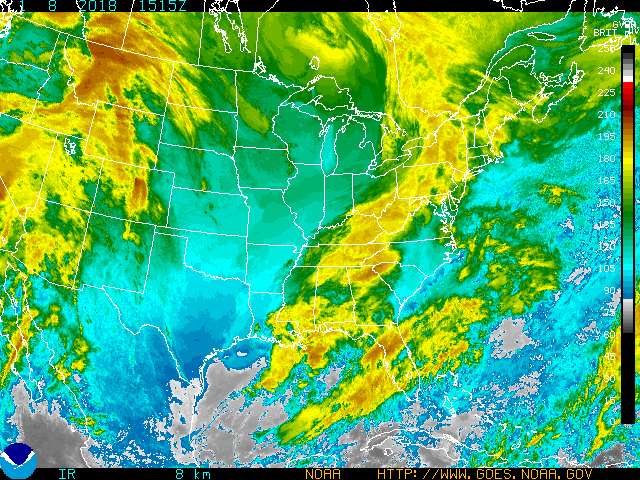
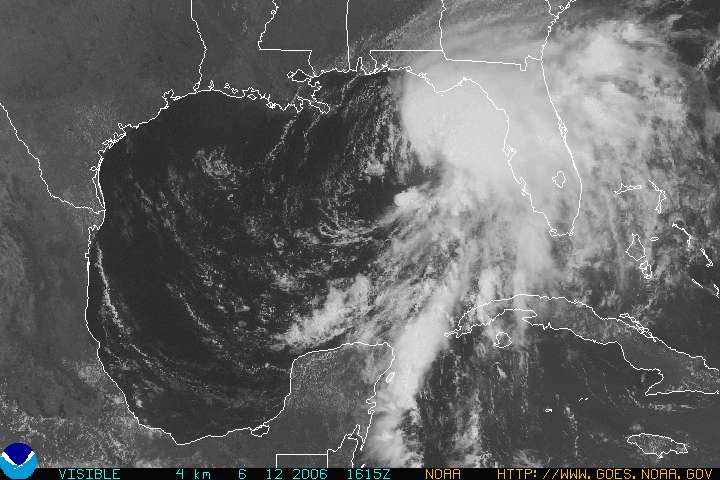
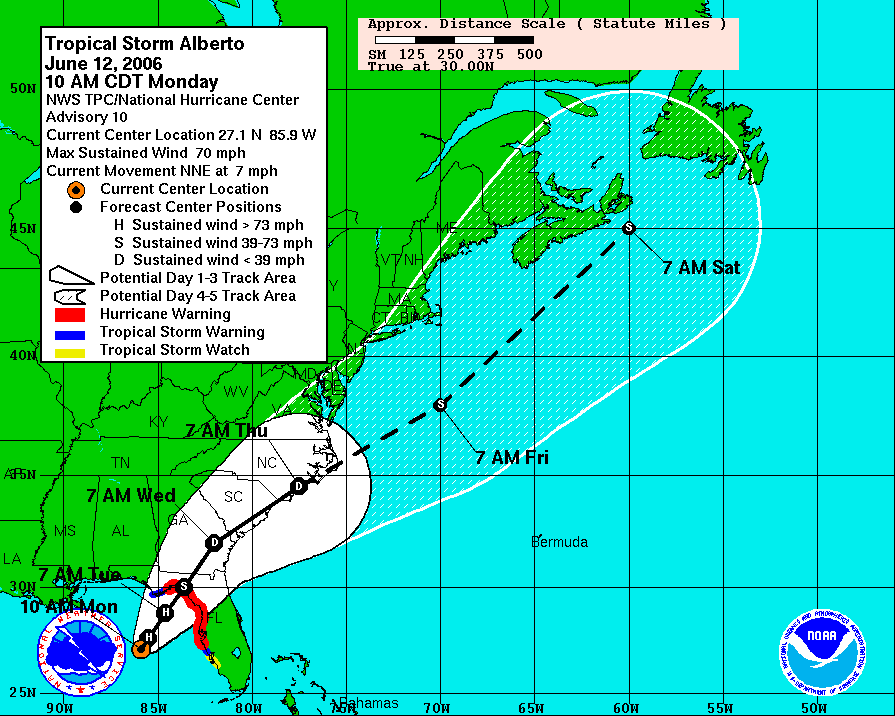
Alberto is a Stage 1 Hurricane now. Here's the GOES image.

National Hurricane Center site here.


The NASA Hurricane site is here.

Wednesday, June 07, 2006

Cloudsat images


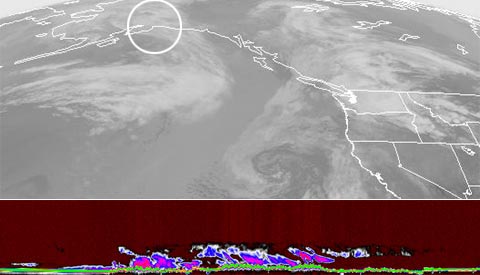
The first images from Cloudsat are in. They show the 3-D aspects of clouds instead of the flat satellite pictures shown on the weather channel.
"We're seeing the atmosphere as we've never seen it before," said Deborah Vane, CloudSat deputy principal investigator at NASA's Jet Propulsion Laboratory, Pasadena, Calif. "We're no longer looking at clouds like images on a flat piece of paper, but instead we're peering into the clouds and seeing their layered complexity."

The first-ever millimeter wavelength radar, CloudSat's Cloud-Profiling Radar is more than 1,000 times more sensitive than typical weather radar. It can observe clouds and precipitation in a way never before possible, distinguishing between cloud particles and precipitation. Its measurements are expected to offer new insights into how fresh water is created from water vapor and how much of this water falls to the surface as rain and snow.

CloudSat was launched April 28 from Vandenberg Air Force Base, Calif., along with NASA's Cloud-Aerosol Lidar and Infrared Pathfinder Satellite Observations satellite. Both satellites will orbit 705 kilometers (438 miles) above Earth aboard NASA's "A-Train" constellation of five Earth Observing System satellites. The A-Train satellites will work together to provide new insights into the global distribution and evolution of clouds to improve weather forecasting and climate prediction.

CloudSat is managed by JPL, which developed the radar instrument with hardware contributions from the Canadian Space Agency. Colorado State University provides scientific leadership and science data processing and distribution. Ball Aerospace and Technologies Corp., Boulder, Colo., designed and built the spacecraft. The U.S. Air Force and U.S. Department of Energy contributed resources. U.S. and international universities and research centers support the mission science team.

The flat image is on top (circled) while the bottom image is the 3-D of the same cloud formation here.

Monday, June 05, 2006

Space Race

The National Geographic Channel has a great 2 part series on the Space Race between USSR and USA. Here is the interactive site on NGC. Its on tonight. Here's the time listings.

From Denver Post on William Gray

I've been telling people for some time this guy William Gray has (OVER) 50 years of climate data on Hurricanes. He said the record doesn't lie and the global warming freaks have it wrong. HT to Drudge (and RUSH talked about it too) on this Denver Post here.
"Let's just say a crowd of baby boomers and yuppies have hijacked this thing," Gray says. "It's about politics. Very few people have experience with some real data. I think that there is so much general lack of knowledge on this. I've been at this over 50 years down in the trenches working, thinking and teaching."

Gray acknowledges that we've had some warming the past 30 years. "I don't question that," he explains. "And humans might have caused a very slight amount of this warming. Very slight. But this warming trend is not going to keep on going. My belief is that three, four years from now, the globe will start to cool again, as it did from the middle '40s to the middle '70s."

Both Gray and Pielke say there are many younger scientists who voice their concerns about global warming hysteria privately but would never jeopardize their careers by speaking up.

"Plenty of young people tell me they don't believe it," he says. "But they won't touch this at all. If they're smart, they'll say: 'I'm going to let this run its course.' It's a sort of mild McCarthyism. I just believe in telling the truth the best I can. I was

I love it! Just when ALGORE's movie comes out.

Thursday, June 01, 2006

Hurricane forcast for 2006

USA today has Max Mayfield and his prediction for the 2006 Hurricane season.
Mayfield, who has barnstormed hurricane country for weeks to preach the gospel of readiness, sees trouble in a recent poll of coastal residents in 12 Atlantic and Gulf states. The survey of 1,100 people by Mason-Dixon Polling & Research found that more than half don't feel vulnerable to hurricanes, and three in five have no family disaster plan.

The poll, released in mid-May by the National Hurricane Survival Initiative, a public-private partnership that includes the hurricane center, also found that more than two-thirds of the respondents have no hurricane survival kit. And half erroneously believe that masking tape makes windows shatterproof in a storm. Thirteen percent say they wouldn't evacuate, even if ordered to leave.


I wonder what if the ratio is the same for California residents prepaired to face Earthquakes?


Another site to check out is William Gray's Colorado State here.

Droids on the ISS


Saw this on Free Republic:
Six years ago, MIT engineering Professor David Miller showed the movie Star Wars to his students on their first day of class. There's a scene Miller is particularly fond of, the one where Luke Skywalker spars with a floating battle droid. Miller stood up and pointed: "I want you to build me some of those."

So they did. With support from the Department of Defense and NASA, Miller's undergraduates built five working droids. And now, one of them is onboard the International Space Station (ISS).


How cool is that? The article goes on why small satellites are needed and how difficult it is to gather them together to work on moving other vehicles in space. (Ever been in a crowd of people?)
Tiny satellites are a hot new idea in space exploration: Instead of launching one big, heavy satellite to do a job, why not launch lots of little ones? They can orbit Earth in tandem, each doing their own small part of the overall mission. If a solar flare zaps one satellite—no problem. The rest can close ranks and carry on. Launch costs are reduced, too, because tiny satellites can hitch a ride inside larger payloads, getting to space almost free of charge.

But there's a problem: Flying in formation is trickier than it sounds. Ask a crowd of people to line up single file, and they'll be able to figure it out and do it rather easily. Getting a group of orbiting satellites to do the same thing, it turns out, is extremely hard.

Shuttle Launch a go (so far)

Here's theNYT article on the Shuttle launch upcoming in July.
Although there is still a risk of dangerous foam debris, NASA officials cleared the space shuttle's external fuel tank on Wednesday for launching of the Discovery in July, after a year on the ground.

Shuttle program officials, meeting at the Kennedy Space Center in Florida, said enough modifications had been made on the tank since the last shuttle flight to give them confidence that the foam risk was minor.

N. Wayne Hale Jr., manager of the shuttle program, said at a news conference that foam debris from different areas on the fuel tank would continue to come off and pose some risk of damaging a shuttle. But he called the risk "acceptable" and said, "We have eliminated the largest hazards."

Repeating a note often sounded by NASA officials and astronauts, Mr. Hale said the shuttle would always be risky to fly.

Michael D. Leinbach, the shuttle launching director at Kennedy, said the Discovery should be ready to launch within a window lasting from July 1 through July 19. In the approach to that window, managers will have unusually long contingency time, almost two weeks, to deal with problems that might arise.

Mr. Leinbach also said the shuttle Atlantis was on schedule to roll out to its launching pad on July 25 in anticipation of a mission beginning Aug. 28 or shortly thereafter.


--Space is risky business to begin with.

From Space Today net here:
NASA managers concluded Wednesday that foam shedding from the space shuttle's external tank does not pose a significant risk to the shuttle orbiter, clearing the way for next month's launch of the shuttle Discovery. Officials concluded that while foam will fall off the tank during the launch, the hazards posed by large chunks of foam have been mitigated so that those risks are in line with other aspects of the shuttle system. That risk could be further decreased with on later missions if NASA decides to proceed with the removal of foam "ice/frost ramps" on the external tank that are particularly prone to shedding. The decision allows NASA to proceed with preparations for the launch next month of the shuttle Discovery on mission STS-121: the launch window for that flight runs from July 1-19. An official launch date will be set during a flight readiness review in mid-June.

From Florida Today:
"It's a risky vehicle to fly, and nobody should mistake that. There are a number of things that can cause bad outcomes on this vehicle," shuttle program manager Wayne Hale said.

But the chance of potentially catastrophic damage from foam debris "is consistent with the entire overall risk we fly with the space shuttle," he added.

Hale's comments came at the conclusion of a two-day review considered key to clearing Discovery for launch of NASA's second flight since the 2003 Columbia accident.

Wednesday, May 31, 2006

Protest at NOAA today

I heard about this protest this morning. (Now on Drudge here.)

Hundreds of concerned citizens and leaders from across the nation will join Hurricane Katrina survivors Wednesday to call for the resignation of the heads of the National Hurricane Center (NHC) and the National Oceanic and Atmospheric Administration (NOAA) at the NOAA Headquarters just outside of Washington, D.C. During an 11 a.m. demonstration, advocates will demand that NOAA stop covering up the growing scientific link between severe hurricanes and global warming while insisting on real solutions to the problem of global warming.

Oh My! Max Mayfield is a bad man! Why, He even called Mayor Nagen to warn him about Katrina! Now who would do that and not care about the masses. To blame the weather forecasters who are doing their jobs and claim it's global warming and they are the cause for it! (LOL! Just kidding!)

The protest is headed by the Climate Crisis Coalition and others here's the release. The CCC website is here.

Monday, May 29, 2006

Global Warming debate with ALGORE

I love to hear the debate on Global Warming. I'm a firm believer in the cycle of 11,000 to 12,000 years of the glacial ice age. The record proves we are going in cycles; the position of the Earth (relative to the sun) is what drives the cycle of warming and cooling. I don't think the advent of Mankind will do much damage to the climate. Granted we have cleaned up our act on pollution and could do better. It's just this pseudo-science the liberal left clings onto that does not make sense to me.
(From Drudge) The Non-Global warming side:
In one corner, subscribing to the theory that the Atlantic Basin is in a busy cycle that occurs naturally every 25 to 40 years, are Chris Landsea, science and operations officer at the National Hurricane Center in Miami, and William Gray and Phil Klotzbach of Colorado State University, who pioneered much of modern hurricane-prediction theory.
"There has been no change in the number and intensity of Category 4 or Category 5 hurricanes around the world in the last 15 years," Mr. Landsea said, in a telephone interview from Miami.

The Pro-Global Warming side:
On the other side are Kerry Emanuel of the Massachusetts Institute of Technology, one of the most respected hurricane scientists in the world, a team of meteorologists from Georgia Tech led by Peter Webster, an MIT-educated monsoon specialist, and Greg Holland, who earned his doctorate at Colorado State under Mr. Gray.
"You cannot blame any single storm or even a single season on global warming. ... Gore's statement in the movie is that we can expect more storms like Katrina in a greenhouse-warmed world. I would agree with this," said Judith Curry. She is chairwoman of Georgia Tech's School of Earth and Atmospheric Sciences, and is co-author, with Mr. Webster, Mr. Holland and H.R. Chang, of a paper titled "Changes in Tropical Cyclones," in the Sept. 16 issue of Science, a weekly publication of the American Association for the Advancement of Science.
The paper concluded that there has been an 80 percent increase in Category 4 and Category 5 hurricanes worldwide

Sunday, May 28, 2006

10th Planet

The tenth "planet" found last year will be determined by IAU in a paper due out in September 2006. The title is Definition of a Planet. (Is it a Planet or a Kelper body? Good question.) If they determine it not a Planet, will Pluto be a non-planet also?
Previous estimates by ground-based telescopes suggested the object known as 2003 UB313 was 30 percent bigger than Pluto.

But the latest measurement by the Hubble Space Telescope has a smaller margin of error and is probably a more accurate estimate, said lead researcher Michael Brown of the California Institute of Technology.

According to Hubble, UB313's diameter measures 1,490 miles, give or take 60 miles. Pluto is about 1,422 miles across.

Brown previously reported that UB313 could be up to 2,175 miles in diameter based on its brightness. He said he was surprised by Hubble's findings, which will be published in an upcoming issue of Astrophysical Journal.

The discovery of UB313, which Brown nicknamed Xena, after the syndicated-television warrior princess, reinvigorated the debate about what is considered a planet.

Some astronomers have questioned whether Pluto should keep its planetary status, while others say UB313 should be the 10th planet because it is bigger than Pluto.

(HT Fox news here.)

The website for 2003 UB313 is here.

Friday, May 26, 2006

GOES goes!


Sorry to have miss the launch. Had Kid patrol.

IT went off without a hitch. Right on time at 3:11 PM (PDT) last Weds.
GOES-N lifted off aboard a Boeing Delta IV rocket from Space Launch Complex 37 at Cape Canaveral Air Force Station, Fla. at 6:11 pm EDT. After GOES-N reaches its geosynchronous orbit of approximately 22,300 miles and a successful post-launch checkout is performed, the satellite will be placed in an on-orbit storage mode where it will be able to more rapidly replace a failure of any existing operational GOES.

Wednesday, May 24, 2006

More Discovery Pictures


GOES this afternoon

And a launch to watch out for:
BOEING, PART DEUX
The launch of the country's newest weather satellite -- GOES-N -- is scheduled to occur during a one hour window that opens at 6:11 a.m. EDT (3:11 a.m. PDT) (note: The OCRegister got the AM and PM mixed up) on Wednesday. Boeing-Huntington Beach will use its huge Delta IV booster to loft GOES-N from Cape Canaveral, Fla. You can watch the launch by clicking here shortly before lift-off.

GOES-N was supposed to go into orbit almost a year ago. The launch has been delayed by technical problems, a labor dispute and, most recently, bad weather at Cape Canaveral. When the satellite enters service, it'll provide data for weather forecasts, including the movement of hurricanes, and will monitor weather on the sun, which can affect conditions on Earth.

Here is the GOES site to watch the launch live at 3:11 p.m. PDT Weds. May 24th.

Launch of Shihab 3 in Iran

A siren from the DrudgeReport on Iran launching a rocket. From the Jerusalem Post here:
Iran conducted a test launch Tuesday night of the Shihab-3 intermediate-range ballistic missile, which is capable of reaching Israel and US targets in the region, Israel Radio reported. The test came hours before Prime Minister Ehud Olmert met with US President George W Bush in Washington to discuss the Iranian threat.

Military officials said it was not clear if this most recent test indicated an advance in the capabilities of the Shihab 3. They said the test was likely timed to coincide with the Washington summit and with comments made by Hizbullah leader Hassan Nasrallah during celebrations in Beirut marking the 6th anniversary of Israel's withdrawal from southern Lebanon.


From SpaceNews Daily here on the possible Missle sites in Europe:
Although Whitman would not say whether the move is aimed at Iran, Washington clearly views Tehran as the top US threat in the Middle East.

It comes amid a mounting confrontation with Iran over a uranium enrichment program that Washington believes is aimed at developing fissile material for nuclear weapons. Iran says its nuclear programs are for power generation.

Iran in April said it had tested a new generation medium-range missile featuring multiple warheads and radar-evading technology. Pentagon officials were skeptical of the claims.

A senior US defense official told AFP last year the European site could be very similar to the US site in Fort Greely, Alaska where half a dozen ground-based missiles are positioned to intercept potential long-range missile attacks from North Korea.

Tuesday, May 23, 2006

Discovery roll out


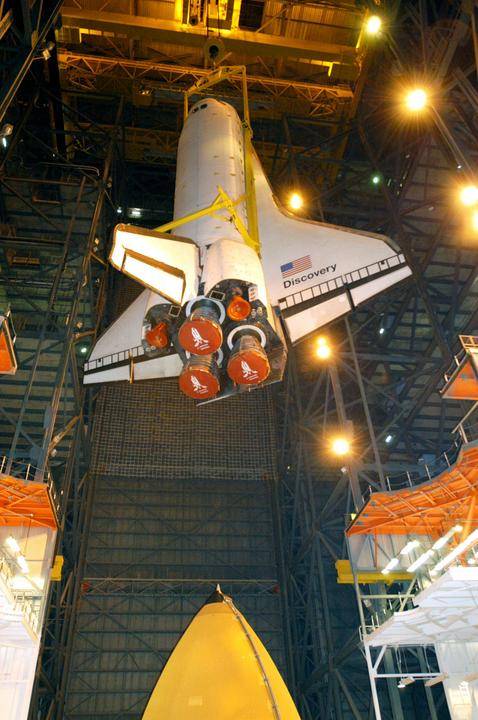
The roll out of Discovery happend on Friday, May 19. I'm just catchin' up.
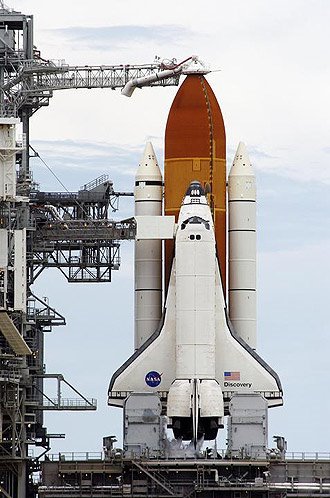
Space Shuttle Discovery's 4.2-mile journey from the Vehicle Assembly Building to Launch Pad 39B is complete! The move brings NASA one step closer to the STS-121 mission, targeted for launch no earlier than July 1.

Mounted on the Mobile Launcher Platform and carried by the mammoth crawler-transporter, Discovery emerged from the assembly building at 12:45 p.m. EDT. The "stack" rolled along at less than one mile an hour, and arrived at the launch pad early Friday evening.

This mission will continue the evaluation of flight safety procedures, including shuttle inspection and repair techniques. It also will deliver more supplies and cargo for future station expansion.

Steve Lindsey will command the mission, flying with pilot Mark Kelly, spacewalkers Mike Fossum and Piers Sellers and mission specialists Stephanie Wilson and Lisa Nowak. European Space Agency astronaut Thomas Reiter is also part of the crew and will remain on the station for several months. Reiter's arrival will give the station its first three-person crew since May 4, 2003.

Fail Safe for Minuteman III

Local space news from OC Resigter here.
FAIL SAFE
Boeing-Anaheim will build on its long history in defense, developing hardware that will allow controllers to destroy Minuteman III intercontinental ballistic missiles if they become a safety hazard during flight. The U.S. Air Force awarded Boeing-Anaheim $25.2 million to create the device, a wafer that also will improve the military's ability to track the missiles and gauge their accuracy.

The Minuteman is the land-based arm of the nation's nuclear arsenal. Nukes also can be fired by submarines and dropped by long-range bombers. The "M-3" has a range of more than 6,000 miles and can deliver multiple warheads. Unarmed Minuteman missiles are periodically launched on test flights from Vandenberg Air Force Base and produce contrails visible from Orange County.

Boeing-Anaheim has specialized in control-and-guidance systems for decades, and it developed the navigation systems for virtually all submarines in the modern American fleet.

OC Astronaut going to ISS

Michael Lopez-Alegria will be going to the ISS for a six month trip around the Earth! Yeah!
Veteran astronaut-spacewalker Michael Lopez-Alegria, who was raised in Mission Viejo, has been assigned to spend six months aboard the International Space Station, where he'll serve as mission commander, NASA says on its Web site.

Lopez-Alegria, 47, also will serve as science officer when he arrives at the space station aboard a Russian Soyuz spacecraft in September, NASA says.


Another OC resident will be on a Shuttle mission next year.
Caldwell, 36, will be part of a six-member crew that is expected to use shuttle Endeavour to carry a 3,900-pound section of space station framework that was built at Boeing-Huntington Beach. The shuttle also will transport supplies to the station, which is only half- finished.

NASA hasn't set a date for the flight, which will be Caldwell's first trip into space. But the mission is tentatively scheduled for June 2007 and could be historic. The crew also includes astronaut-educator Barbara Morgan, who was the backup for Christa McAuliffe, the teacher who died when shuttle Challenger exploded in 1986.

I'm glad that Barbara Morgan will be on the flight also.

The Vision in trouble?

Ht from Instapundit on this article in Popular Mechanics by Tom Jones:
If Administrator Mike Griffin is responsible for this hard-eyed approach top NASA’s future, he is to be commended. But the constant tinkering with launchers and the cost and schedule difficulties still to be grappled with in getting the new Crew Exploration Vehicle off the ground will only exacerbate Congressional suspicions that NASA, faced with painful budget choices, is trying to low-ball the costs for its exploration plans. The agency tried the same tactic 15 years ago with the Space Station, and suffered a huge loss in credibility with the administration, Congress and the public. NASA knows it must not squander the Vision opportunity, but can it avoid a repetition of its past missteps? If America hopes to fly astronauts again once the shuttle retires, the answer must be yes.

Thursday, May 11, 2006

Titan Video

"It was a very complicated process," said Erich Karkoschka, a senior staff scientist with the Lunar and Planetary Laboratory at the University of Arizona who integrated the Huygens images into mosaics and videos. Putting the images together "to build mosaics and make it without any seams ... that took quite a lot of time."

Huygens spent about 147 minutes descending through Titan's atmosphere. During that time, the probe's NASA-funded Descent Imager/Spectral Radiometer (DISR) photographed the moon's orangish atmosphere and mottled, gullied surface from three separate angles.

(Via CNN here.)

Video here via Space.com.

Wonderful view of Titan and the flight and landing of Huygens. Great job University of Arizona!

Wednesday, April 26, 2006

One Billion Dollars more


NASA Chief said at a hearing yesterday,
NASA Administrator Michael Griffin said that date is the earliest the new spaceship, or crew exploration vehicle, or CEV, could be developed no matter how much money the agency received.

Currently, the target date for building a new vehicle is 2014.

With his pitch to Congress, Griffin underscored a point he has made previously about completing the spaceship on a faster time frame.

Pressed by Sen. Bill Nelson, D-Florida, Griffin acknowledged an additional $1 billion could accelerate the program's completion.

Getting rid of the shuttle earlier than later whould save us from loss of life and vehicle. It will cost us more now, but in the long run we will save more if we abandon the shuttle now.