Like its predecessor in 2000, Eros B was launched from the Svobodny Cosmodrome in the Russian Far East later on Tuesday using a Russian Start-1 rocket.
It will orbit the Earth at a height of about 500 km (310 miles) and will circle the globe roughly every 95 minutes, ImageSat said.
The Eros satellites, which weigh under 350kg (770 lb), are among a number of small, lightweight satellites which Israel's space industry has perfected, Eckhaus said.
Because of the country's geographical location and small size, the space industry generally favors smaller payloads that can more easily be launched from Israeli territory.
"The fact that we are launching the satellite in Russia means that we can do so with the Earth's rotation and makes it more effective and gives it a longer life span," Eckhaus said.
Israel is only able to launch small satellites westwards over the Mediterranean Sea -- opposite to the Earth's rotation -- because it cannot risk rockets flying over its Arab neighbors to the east or debris falling on their territory.
Tuesday, April 25, 2006
Israel launches Spy Satellite over Iran
Israel launchs a spy satellite to keep an "eye" on Iran here.

Tuesday, March 28, 2006
Solar Eclipse
Some members of the Orange County Space Society are on a cruse ship viewing the Solar eclipse. Here is an interactive map on Space Weather.
Tourists and scientists were gathering at spots around the world for a solar show -- the first total eclipse in years, which will sweep northeast from Brazil to Mongolia, blotting out the sun across swathes of of the world's poorest lands.
Wednesday's eclipse will blot out the sun in highly populated areas, including west Africa, where governments scrambled to educate people about the dangers of looking at the eclipse without proper eye protection.
Sunday, March 26, 2006
Moon article in WaPo
This article from the Washington Post is positive on the Moon-Mars plan outlined by Bush's space exploration plan. The Moon is more of a harsh environment but if we don't have a base there the Chinese will. And it is a stepping stone to Mars. Also, the Helium-3 can be mined for resources. HT to Blogs for Bush here..
Not having to pay as dearly for mistakes is one key reason why the moon is an integral part of the Bush initiative. The other, as even scientists point out, is that if the United States does not return to the moon, others will.
"The new thing is China, and they've announced they're going to the moon. The Europeans want to go; the Russians want to go; and if we don't go, maybe they'll go with the Chinese," Mars Institute Chairman Pascal Lee said in an interview. "Could we bypass the moon and go to Mars while India and China are going to the moon? I don't think so."
Bush's 2004 "Vision for Space Exploration," by calling for a lunar return and a subsequent Mars mission, set goals, which, if achieved, would keep the United States in the forefront of space exploration for decades.
Saturday, March 25, 2006
The first space Chimp
My daughter's liked my Laika post on the Russian Space dog. I told them the US had sent up monkeys, rats and assorted animals. Enos the chimp was the first to orbit the earth in a Mecury capsule. Do you remember the Right Stuff. I believe it was John Glenn who complained it was a chimp that got to orbit first, not a human!
I could not find a picture of Enos, I did find one on Sam the Rheus Monkey here. Sam was sent up in a Little Joe-2 (LJ-2) spacecraft. The US NAVY recovered the little sucker after 3 minutes of weightlessness.

Another space chimp was Ham pictured here with his trainer (here).

Enos became the first chimp to orbit the earth on November 29, 1961, aboard a Mercury Atlas rocket. Although the mission plan originally called for three orbits, due to a malfunctioning thruster and other technical difficulties, flight controllers were forced to terminate Enos' flight after two orbits. Enos landed in the recovery area and was picked up 75 minutes after splashdown. He was found to be in good overall condition and both he and the Mercury spacecraft performed well. His mission concluded the testing for a human orbital flight, achieved by John Glenn on February 20, 1962. Enos died at Holloman Air Force Base of a non-space related case of dysentery 11 months after his flight.
I could not find a picture of Enos, I did find one on Sam the Rheus Monkey here. Sam was sent up in a Little Joe-2 (LJ-2) spacecraft. The US NAVY recovered the little sucker after 3 minutes of weightlessness.

Another space chimp was Ham pictured here with his trainer (here).

Buzz gets an Exploration Award
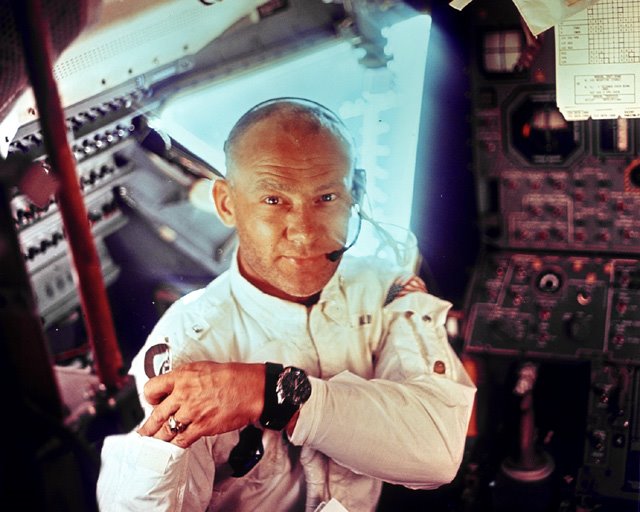
Buzz Aldren recieved the NASA's Ambassador of Exploration Award at the California Science Center in Los Angeles today here.
Aldrin is one of 38 recipients of the Ambassador of Exploration Award, all of whom were astronauts or other key individuals who participated in the Mercury, Gemini and Apollo programs. The award is a small sample of lunar material encased in Lucite and mounted for public display. The material is part of the 842 pounds of samples brought back to Earth during the six Apollo lunar expeditions from 1969 to 1972. Aldrin's award will be displayed in the Sketch Foundation Gallery: Air & Space Exhibits, California Science Center, 700 State Street, Los Angeles.
Friday, March 24, 2006
Falcon 1 lost power into one minute of flight
I'm sad to say the Falcon 1 flight failed today into one minute of flight. In the past, NASA too had failed launches. I recall the Vanguard TV-3 (Dec 6, 1957). It slightly went up a few feet and fell down and collapsed in a heap at the launch pad. At least Falcon got up there in the blue sky. Keep trying Elon! You'll have success.
Falcon 1 is a 70-foot-long, two-stage rocket powered by liquid oxygen and kerosene. Its first stage is designed to parachute into the ocean to be recovered and used again.
The Falcon 1 is intended to be the first in a family of low-cost rockets. SpaceX said that even before the first launch it already had eight contracts for launches through 2010 valued at nearly $200 million.
Saturday, March 18, 2006
Spirit wheel not working
One of the rovers wheel is stuck. The other five wheels are working though, dragging Spirit along up a crater slope. (HT KFWB/LATIMES here.
The right front wheel previously had an episode of balkiness but this week the motor that turns the wheel stopped working, the space agency's Jet Propulsion Laboratory said in a statement.
"It is not drawing any current at all," Jacob Matijevic, rover engineering team chief, said in the statement.
Spirit and its twin, Opportunity, landed on opposite sides of the Red Planet in January 2004 and have long outlasted missions originally planned to span 90 Martian days, which are a different length than Earth days.
Spirit's new wheel problem occurred this week during the rover's 779th Martian day.
Friday, March 17, 2006
Pentgon will weight in on Lockheed-Boeing Launch merge
Lockheed and Boeing, fierce rivals for rocket launches, agreed in May 2005 to create a 50-50 venture that would combine the production, engineering, test and launch operations for U.S. government use of Boeing Delta and Lockheed Atlas rockets, subject to government approval.
They said at the time the merger would save the government $100 million to $150 million annually and projected it would have closed by the end of last year.
"The concept of a ULA is something that we have looked at positively for a long time and there are a lot of details," Sega said. "We'll see what the respective teams have found with regard to assessment of those details."
Enceladus Mission ruled out?
The tantalizing Enceladus images were snapped by the Cassini spacecraft, an international project managed by NASA's Jet Propulsion Laboratory in Pasadena. Cassini plans at least one more pass by Enceladus, in 2008, which could reveal further details of the moon's potential to harbor life - though not the presence of life itself.
The space agency hasn't ruled out extending that mission, said Andrew Dantzler, director of NASA's solar system division. But any future mission to Enceladus would come after a Europa trip, he said.
``I believe all these great missions that we want to do, we will do,'' he said. ``We just have to space them out.''
(from KFWB.com/AP)
Griffin on Space leadership
NASA chief Griffin spoke at Florida's Space day (HT NASA Watch here.)
Space, he said, is the "new enterprise" of the 21st century and will determine the world powers of the future.
Griffin said the space industry provides 35,000 jobs in Florida and 1.4 million tourists visit the Kennedy Space Center annually. Space-related activities are in all of Florida's 67 counties and contribute more than $4.5 billion to the state's economy, according to Gov. Jeb Bush's office.
Bush has asked lawmakers this year to approve funding of $100 million to attract world-class researchers and $55 million to bolster the space industry.
Griffin was joined by Kennedy Space Center Director Jim Kennedy at Florida Space Day in the Capitol.
Laika, the Space Dog

What ever happened to Laika, the space dog of Sputnik II? The People's cube has the scoop here.
Enter Sputnik 2. The Soviet press boasted about the 250-pound object equipped with a cabin, providing all the necessary life support for a dog named Laika. Well, almost. The Soviets admitted soon after the launch that the spacecraft would not return, meaning that the animal was doomed from the start. Years after Sputnik 2 burned up in the atmosphere, conflicting scenarios of Laika's death were circulating in the West..
Recently, several Russian sources revealed that Laika survived in orbit for four days and then died when the cabin overheated. The design of the cabin was derived from the nose sections of experimental ballistic missiles that carried dogs into the upper atmosphere in short and relatively slow-speed flights, ending in a parachute landing. ~
Wednesday, March 15, 2006
Wow! Google Mars!
Google now has Mapping of Mars online here.
(CNN Tech news here)
The Martian maps were made from images taken by NASA's orbiting Mars Odyssey and Mars Global Surveyor.
Google Mars doesn't provide driving directions, but users can see the planet in three different formats: The Martian elevation map is color-coded by altitude; the visible-imagery map shows the surface in black-and-white pictures; the infrared map indicates temperature, with cooler areas dark and warmer areas bright.
Users can also zoom in on any of the three maps to view geographical features such as mountains, canyons, dunes and craters. The maps also pinpoint the locations of unmanned space probes that have landed on Mars.
The up-to-date maps even include the locations of the NASA rovers Spirit and Opportunity, which have been exploring opposite ends of the planet since 2004, said Phil Christensen, an Arizona State University planetary geologist who operates an infrared camera on the Mars Odyssey. Arizona State partnered with Google to create the maps.
(CNN Tech news here)
Monday, March 13, 2006
Stardust findings
The samples in the aerogel from Stardust have come back to earth and are being evaluated by the mission scientists. (from CNN here.)
Hundreds of microscopic specks of comet dust were collected and returned to Earth after the robotic Stardust spacecraft flew past the comet Wild 2 in 2004...
The specks of dust are described as glassy materials, crystals like olivine and various trace elements such as magnesium, peridot and sulfides...
The grains are pristine samples of material which scientists say is providing clues to the formation of the sun and nine planets....
About 150 scientists have been studying the dust since it arrived.
The samples were the first extraterrestrial material returned to Earth since a manned mission returned moon samples more than three decades ago.
When the comet dust particles were captured, they left tracks -- some shaped like carrots, others like turnips -- in the gel which was contained in a tennis racket-sized collector mitt.
Scientists spent hours using a computer-controlled needle to remove each particle.
Saturday, March 11, 2006
Mars Navigation

MRO navigation (here) is on course:
The spacecraft's Optical Navigation Camera was used in February and March 2006 to demonstrate the use of pictures from a small camera for calculating precise location of a Mars-bound spacecraft by comparing the observed positions of Mars' two moons to their predicted positions relative to background stars. While this technique was not necessary for the Mars Reconnaissance Orbiter's own navigation, the demonstration prepares the way for relying on it for navigating precise arrivals for future missions that land on Mars.
Friday, March 10, 2006
Remarks made by Sen. Kay Bailey Hutchison
From SpaceRef.comhere:
"The decision to base the new Crew Exploration Vehicle and launch systems heavily upon the well understood and proven systems is the right decision. It provides the key ingredients for successful development that avoids the time, cost and risk associated with inventing new technologies, as well as ensuring a smoother transition that makes the best use of existing skills, expertise, and vehicle processing capabilities."
"The current plan is to terminate space shuttle flights in 2010. Our legislation initially prohibited a gap between the end of shuttle flights and the start of CEV operations."
"In the end, we compromised with a statement of policy that the US should maintain an uninterrupted capability for human space flight, and required NASA to inform the Congress, at least a year before the last scheduled shuttle flight, if a gap appeared likely and what steps they would take to fill it."
"In my view, the options they might have at that point, if necessary, could include extending shuttle flights beyond 2010, utilizing crew launch capabilities that might be developed by the private sector, or establishing agreements for the use of international partner crew launch capabilities."
"The NASA Authorization Act endorses and encourages the private sector involvement in space station crew and cargo support, and I am pleased to see NASA moving forward in its efforts to help spur that development."
"The Congress should--and will--continue to take the steps necessary to encourage and enable those developments."
"I believe we have an exciting and bright future in space exploration. We are on a course that will bring important new knowledge, and inspire new generations of scientists and explorers in ways only space exploration can do."
"All of you will have a role to play in this national undertaking and I look forward to working with you in accomplishing the best future we can for space exploration and the enhancement of life for all of us--on the Earth and in the universe that awaits."
MRO closing in on MARS
Today is the day we all have been waiting for. The Mars Reconnaissance Orbiter or MRO will insert itself into MARS orbit. NASA says they have a history of 65 per cent chance of obtaining orbit while they have had a 80 per cent rate of landing on MARS. Good luck!
If all goes well here is the sequence of events to obtain orbit:
UPDATE: As of 2:16 PM PST MRO has achieved its burn and came out of occultation from Mars!
If all goes well here is the sequence of events to obtain orbit:
MRO will approach the southern pole of Mars and then fire its thrusters at 1:25 Pacific Standard Time Friday, March 10. After 21 minutes, MRO will go behind the planet and mission scientists will lose contact with the spacecraft for 30 minutes. Six minutes after this loss of contact, the rockets should stop firing automatically, having decreased the speed of the spacecraft by 18 percent.
The spacecraft should swing back around Mars and re-establish Earth contact at 2:16 pm PST. Mission scientists will need an additional 30 minutes to determine whether the spacecraft has been captured by Mars gravity.
UPDATE: As of 2:16 PM PST MRO has achieved its burn and came out of occultation from Mars!
Thursday, March 09, 2006
Closer to Mars!

The Mars Reconnaissance Orbiter zooms in on Mars and on Friday, March 10 MRO will insert into Mars orbit.
The sequence began Tuesday and will culminate with firing the craft's main thrusters for about 27 minutes on Friday -- a foot on the brakes to reduce velocity by about 20 percent as the spacecraft swings around Mars at about 5,000 meters per second (about 11,000 miles per hour). Mission controllers at NASA's Jet Propulsion Laboratory, Pasadena, Calif., and Lockheed Martin Space Systems, Denver, are monitoring the events closely.
"We have been preparing for years for the critical events the spacecraft must execute on Friday," said JPL's Jim Graf, project manager. "By all indications, we're in great shape to succeed, but Mars has taught us never to get overconfident. Two of the last four orbiters NASA sent to Mars did not survive final approach."
Times are Eastern:
Arrival at Mars
Mar. 10
Pre-arrival briefing: 12 p.m.
Orbit insertion coverage:
3:30 p.m. - 6 p.m.
Post-arrival briefing: 7:30 p.m.
Link for NASA Live Coverage here.
March Storm and Luddies!
I'm so behind on the March Storm in DC this week lead by ProSpace and other Space groups here. I've been reading MarsBlog about his coverage on the Anti-Nuke groups that don't want War or Nukes in space. The problem with that is we have to defend our assets. What if we can't protect our satellites? What would happen if all the cells phones stopped working or we could not report massive hurricanes coming at the Gulf coast? Duh! I believe in Peace with strength, as a Reagan conservative. (And I think Star Wars is a good idea). Space Hawks they call us. Well, I call it Survival of the Strongest. Protect the peaceful people who don't want to take over the world either by Communism or Islamic fanatics. I love America, the Declaration of Independence, the Constitution (as a Paper Document, not a Living one), the Founding Fathers (I don't care if they were bigoted slave owning White Males!) and our freedoms that I cherish. Defending Space will protect our way of life and the life’s of the Looney Liberal Luddies who complain the Space Hawks will take over and create a military BushHitlerNazi regime!
Big annoucement by NASA via Drudge
I haven't gotten all the facts yet, but possible water on Saturn's moon Enceladus here.
Local news station here at News 13 will have the annoucement at 2PM est. I'll include the NASA link when I find it.
False Alarm! It seems Ch. 13 read the press release wrong updated by Drudge and local6 here. Life has not been found, but water has been found. That's what I got out of it.
From the Flame Trench at Florida Todayhere:
More about the Cassini-Huygens discovery here at JPL site.
"As Cassini approached Saturn, we discovered the Saturnian system is filled with oxygen atoms. At the time we had no idea where the oxygen was coming from," said Candy Hansen, Cassini scientist at NASA's Jet Propulsion Laboratory (JPL) in Pasadena. "Now we know Enceladus is spewing out water molecules, which break down into oxygen and hydrogen."
Scientists still have many questions. Why is Enceladus so active? Are other sites on Enceladus active? Might this activity have been continuous enough over the moon's history for life to have had a chance to take hold in the moon's interior?
Local news station here at News 13 will have the annoucement at 2PM est. I'll include the NASA link when I find it.
False Alarm! It seems Ch. 13 read the press release wrong updated by Drudge and local6 here. Life has not been found, but water has been found. That's what I got out of it.
From the Flame Trench at Florida Todayhere:
There were erroneous reports online and elsewhere throughout the morning today that NASA was going to report finding life on another planet or somewhere else in the solar system. That is not the case.End quote. Ok, no life just Water.
That said, the finding could have profound implications about life in the solar system.
More about the Cassini-Huygens discovery here at JPL site.
Thursday, March 02, 2006
Not by Fire but by Ice Via Robert Felix
For years we've been told that receding glaciers are evidence of global warming.
Now we’re being told that advancing glaciers are evidence of global warming.
What a bunch of double talk.
Advancing glaciers are NOT evidence of global warming, advancing glaciers are an
indicator that we're headed into an ice age. Glaciers advance toward the sea because
increased snowfall makes them heavier at the top and pushes them out at the sides.
It's truly simple. Any geology 101 course will tell you that the concept of glacier
mass balance suggests that a glacier is influenced by two processes: accumulation
and ablation. If accumulation exceeds ablation the glacier surges forward. If ablation
exceeds accumulation the glacier retreats.
Shuttle Tank arrives to the Cape
The external fuel tank arrives in a barge to KSC here.
Flight date is May 10th.
Media day to see the Crew Exploration Vehicle (CEV) roll out is on March 7th here.
Flight date is May 10th.
Sixteen pieces of foam fell off Discovery's external tank from the flight last year here.
It's the first time the space agency has put a number on the pieces of foam that snapped off during liftoff last year in the first flight since the Columbia disaster.
Engineers had hoped to prevent any threatening loss of foam and were disappointed when it happened again.
Media day to see the Crew Exploration Vehicle (CEV) roll out is on March 7th here.
The tests are simulating airflow and temperature changes the CEV will have to experience in atmospheric flight, and they are among the first steps in the process to develop a new space-travel system to return humans to the Moon and support later missions to Mars.
Monday, February 27, 2006
MRO close to Mars orbit insertion
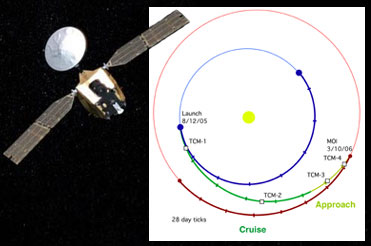
From a CNN article , Mars Reconnaissance Orbiter will insert into Mars orbit on March 10th.
"It's going to be difficult to get it into orbit," Doug McCuistion, who heads the NASA Mars Exploration Program, said at a briefing. "Mars is hard, Mars can be unpredictable, but we've got a good team here."
NASA has only a 65 percent success rate in getting space probes to orbit Mars, as opposed to a more than 80 percent success rate in managing to land spacecrafts on its surface, he said.
The tricky part is getting the orbiter to slow down enough to be captured by the planet's gravity.
"We're getting into the dangerous portion of the mission," said James Graf, the project's manager.
The JPL/NASA website for Mars Reconnaissance Orbiter here.
Saturday, February 25, 2006
Space X Launch update From Kwaj
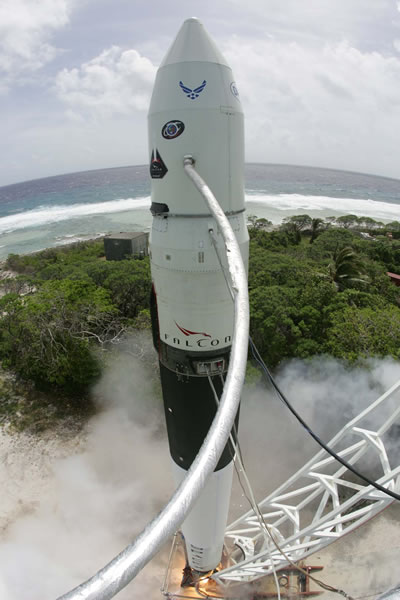
Just got an update from Elon and Space X on the Falcon I launch:
The tentative launch window for the maiden flight of Falcon 1 is March 20 through 25. The gating items are receiving a shipment of liquid oxygen (LOX) from Hawaii and switching out the 2nd stage tank. Obviously, long term operations on Kwaj will require that we install a state-of-the-art, high reliability LOX plant on island. In the meantime, we will get through first launch with LOX shipments from Hawaii and whatever output we can generate from the sad, old clunker of a LOX plant that we currently own.
We are also replacing the 2nd stage tank, following discovery of a small leak. Fortunately, a Falcon 2nd stage tank just barely fits through the door of a standard cargo airplane (no C-17 required), so the flight is relatively inexpensive and readily available. Fixing the leak in the tank being shipped back is not a huge task, but also not something easily done far away from the factory. Countdown procedures have been modified to prevent such leaks from developing in the future.
The static fire performed during the last countdown attempt was really helpful as a preflight systems checkout, so we will be doing one again three or four days before the next countdown (most likely March 17). In addition, we are doing another systems review with DARPA, AF and NASA in early March.
---Elon
Kwaj is part of the Marshall Islands Atolls. It is the site ofthe Army's The Reagan Test Site(RTS) which
"The Reagan Test Site encompasses approximately 750,000 square miles, although the total land area is only about 70 square miles."
"RTS is one of several tracking stations located around the globe that provides nearly continuous coverage of all manned space flight missions. Working in close cooperation with NASA, RTS has participated in numerous space experiments, providing ground radar and optical observation of experimental objects."

Friday, February 24, 2006
Pluto's Not Lonely anymore!
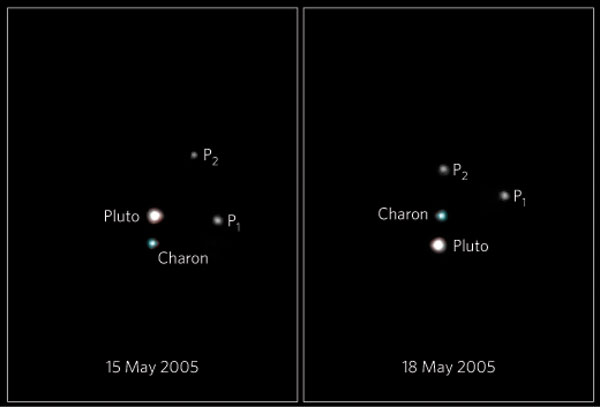
Yesterday in Nature here Scientists are using Hubble Space telescope to help guide New Horizons to Pluto and chart the two new moons and rings around the planet.
Those planning NASA's New Horizons mission, now en route first to a gravity assist from Jupiter in February 2007 and then its July 2015 appointment with Pluto, are now adding to their to-do list highly resolved imaging and spectroscopy of the newly discovered satellites. Refining these satellites' sizes and their orbital positions in nine years' time will also be a priority for observations to follow those currently being reported2. Both on its way in and out of the Pluto system, New Horizons' instruments will canvass the orbit plane for more satellites, rings and other telltale signs that might reveal the origin and evolution of this close-knit family. Pluto is a lonely place no more.
Wednesday, February 22, 2006
UAE and Space Ports
I saw this on Drudge over the weekend about the UAE wanting to build a spaceport in Singapore. Here's the space.com article:
Spaceport Shuffle
Deals are also in place to construct a $265 million spaceport at the Ras Al-Khaimah International Airport in Ras Al-Khaimah – the northernmost of seven emirates the United Arab Emirates (UAE) – with a $115 million facility to be built near Singapore’s Changi International Airport, Space Adventures officials said.
“After we initiate operations here, we look forward to expanding operations outside of the United Arab Emirates,” Sheikh Saud Bin Saqr Al Qasimi, crown prince of Ras Al-Khaimah, in a statement.
Anderson said Al Qasimi has been extremely supportive and invested $30 million into the spaceport project.
Space Adventures is also working with a consortium of investors in Singapore to develop Spaceport Singapore, a facility that will offer not only suborbital spaceflights, but also astronaut training, parabolic flights to simulate weightlessness, and other high-altitude attractions.
“With the proposed Spaceport Singapore, we now stand at the threshold of an unprecedented opportunity to launch into space practically from our own backyard,” said Lim Neo Chian, chief of the Singapore Tourism Board, in a statement.
The announcement of both spaceports does not rule out American spaceport in Space Adventures’ future, though several unrelated projects are already underway in the U.S.
“We’re still analyzing potential locations,” Anderson said. “We’d love to be opening a spaceport in the United States.”
Friday, February 17, 2006
Nasa climate scientist speaks!
I'm not so approving of gagging a scientist but I wonder how for sure we know that the last ice age (about 14,000 years ago) and the current glacial warming has the higher temperatures. The data we have is from tree rings and show the growth patterns. We did not have exact temperature readings 14,000 years ago. Our record of temperature readings are about 100 years old. I think we should analyze this data more. Yes we are in a climatic change. But we have so much more technical equipment to measure and record data. Here is Dr. Hansen's own words from the Independent online:
He goes on to detail the rapid break up of the ice shelves. He then states:
I agree this is very new. Our old models of ice shelves melting are way off.
Again, he is looking at the past climatic record. One, the last ice age was three degrees warmer than today, but the Sea levels are going to be higher (20MM previously to 25MM currently).
This new satellite data is a remarkable advance. We are seeing for the first time the detailed behavior of the ice streams that are draining the Greenland ice sheet. They show that Greenland seems to be losing at least 200 cubic kilometers of ice a year. It is different from even two years ago, when people still said the ice sheet was in balance.
He goes on to detail the rapid break up of the ice shelves. He then states:
Our understanding of what is going on is very new. Today's forecasts of sea-level rise use climate models of the ice sheets that say they can only disintegrate over a thousand years or more. But we can now see that the models are almost worthless. They treat the ice sheets like a single block of ice that will slowly melt. But what is happening is much more dynamic.
I agree this is very new. Our old models of ice shelves melting are way off.
How fast can this go? Right now, I think our best measure is what happened in the past. We know that, for instance, 14,000 years ago sea levels rose by 20m in 400 years - that is five meters in a century. This was towards the end of the last ice age, so there was more ice around. But, on the other hand, temperatures were not warming as fast as today.
How far can it go? The last time the world was three degrees warmer than today - which is what we expect later this century - sea levels were 25m higher. So that is what we can look forward to if we don't act soon. None of the current climate and ice models predict this. But I prefer the evidence from the Earth's history and my own eyes. I think sea-level rise is going to be the big issue soon, more even than warming itself.
Again, he is looking at the past climatic record. One, the last ice age was three degrees warmer than today, but the Sea levels are going to be higher (20MM previously to 25MM currently).
Thursday, February 16, 2006
Science Openness?
Griffin has since promised scientific openness and changes in public affairs policy. Sherwood Boehlert, the Republican chairman of the House Science Committee, said today that Congressional regulators will be watching the agency's internal inquiry into the matter and expects to see policy changed to prevent a repeat of recent incidents.
"I have high hopes NASA will end up being a model of how agencies can gaurantee scientific openness," Boehlert said in a statement praising Griffin for tackling the issue.
The top Democrat on the committee, Bart Gordon of Tennessee, also said he was heartened to hear that NASA was taking the specific case of global warming scientist James Hansen seriously.
However, Gordon said he is concerned that the Hansen incident is just one of many similar incidents throughout the federal government's science-related agencies. He said strict political control of science results "permeates this entire administration."
The members of the committee, in their opening statements, unanimously expressed concerns about NASA's intention to move $2 billion worth of science funding to pay for the 17 or so space shuttle
HT Florida Today
Links from Space Politics on the NASA hearings today here.
Tuesday, February 14, 2006
My Sci-Fi profile type
 | You scored as Nebuchadnezzar (The Matrix). You can change the world around you. You have a strong will and a high technical aptitude. Is it possible you are the one? Now if only Agent Smith would quit beating up your friends.
Your Ultimate Sci-Fi Profile II: which sci-fi crew would you best fit in? (pics) created with QuizFarm.com |
Friday, February 10, 2006
Where no Passengers have gone before
Transportation Secretary Norman Mineta says travelers could soon boldly go where no passengers have gone before -- into space.HT Drudge
A few years ago some mocked the idea of space tourism. As a child I read Robert E. Heinlein’s books. The "Past Though Tomorrow" series had stories on commercial and passenger travel in space. It is now a reality. As other forms of travel are "commercially" possible more and more travelers will go into space.
With the problems the shuttle is having with launch debris, we should focus on alternative ways of getting out of earths gravity. The space elevator is an excellent choice. We have to get out of the "rocket" mentality. Commercial space has to make the jump and take the lead. NASA and the government bureaucracy will not make that leap. Granted we still need rockets, but for passenger travel the elevator is more efficient and safer.
Thursday, February 09, 2006
Danes in Space

After all the hoopla on Denmark and publishing sensitive cartoons I wanted to promote the Danish National Space Program. They are working on the coatings of optics used in the NuStar space telescope. Description from the website:
The Danish National Space Center plays an important part in the mission by coating, calibrating and testing the optic for NuSTAR. This optic uses X-ray supermirrors which is based on depth graded multilayer structures capable of reflecting X-rays at energies up to 100 keV at reasonable graze angles.
From the NuStar NASA site:
By focusing X-rays at higher energy; up to 80 keV, NuSTAR will answer fundamental questions about the Universe: How are black holes distributed through the cosmos? How were the elements that compose our bodies and the Earth forged in the explosions of massive stars? What powers the most extreme active galaxies? Perhaps most exciting is the opportunity to fill a blank map with wonders we have not yet dreamed of: NuSTAR offers the opportunity to explore our Universe in an entirely new way.
Saturday, February 04, 2006
Ivan Ivanovich transmits no more!
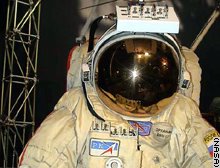
The ISS spacewalkers yesterday let loose SpaceSat-1. The Russian space suit was to transmit several messages to be received by ham radio operators around the world. Readings of suit temperature, battery power levels and time since leaving the ISS were to be reported to mission control. Alas, the suit malfunctioned right after deployment. Goodbye, Ivan Ivanovich!
"No more transmissions are being received by ham radio operators ... It may have ceased operating very shortly after its deployment," said NASA commentator Rob Navias, speculating its batteries became too cold.
Comet Tempel has Water
Comet Temple 1 was impacted back in July 2005 by Deep Impact. Data taken from the probe has three pockets of water along with lots of dust.
Tempel 1 has a surface area of roughly 45 square miles, or 1.2 billion square feet. The area taken up by the water ice, however, is only 300,000 square feet. The rest of the comet surface is dust.
"It's like a seven-acre skating rink of snowy dirt," said study co-author Peter Schultz of Brown University.
Friday, February 03, 2006
Shifting away from the Vision?
Q Scott, the President's moon/Mars mission, plan -- I mean, what's going to come of that? There's a lot of concern about the gap when the shuttle is retired and the new vehicle hasn't come into play yet.
DR. MARBURGER: There's lots of other science that's important, and there are lots of other initiatives in other agencies that are important for our country. This initiative focuses on things that we think have especially high leverage for future innovation. And that's what this is focused on. Space exploration is another issue, it's another important area for the country, but it's not part of this initiative.
Q Does this indicate any shifting of priorities away from that as a top priority?
DR. MARBURGER: No, there's no shift of priorities for the other areas.
HT Space Politics
Wednesday, February 01, 2006
48 years of Space Exploration

On Jan. 31 1958 the United States entered into the space race by the launch of the Explorer I. It had a Geiger counter that detected the radiation belt around the earth called the Van Allen Belt (named after James Van Allen who designed the experiment.) Sputnik was 184 pounds was larger then Explorer, which weighted 31 pounds. Explorer had more components than Sputnik, two radio transmitters and the cosmic ray instrument. On the other hand, Sputnik had two transmitters to broadcast on frequencies at 20 and 40 MHz. The whole world heard it on shortwave radio.
Here's an article about the a reject nose cone thought to be that from Explorer I. (HT OC Register)
Hail Columbia!

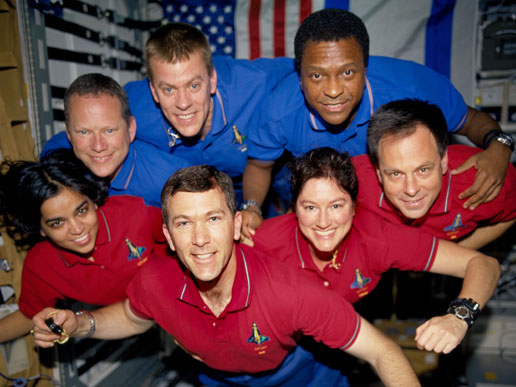 Top row, from left: David M. Brown, mission specialist; William C. McCool, pilot; and Michael P. Anderson, payload commander.
Bottom row, from left: Kalpana Chawla, mission specialist; Rick D. Husband, mission commander; Laurel B. Clark, mission specialist; and Ilan Ramon, payload specialist from the Israeli Space Agency.

The NASA Remberance page for Columiba is here and here.
The Space.Com Columbia Tragedy page is here
Chris Valentine's Video tribute here and the Columiba page here.

Tuesday, January 31, 2006
A little bit of moondust please.....

Apollo 12 astronaut Alan Bean displays a "thermos" for moondust--a.k.a. a Special Environmental Sample Container. (HT Science@NASA)
Monday, January 30, 2006
The 7 Challenger Myths
I like to read Obreg's columns. I never heard about the seven myths about Challenger disaster before. Here they are:
Oberg is right, we should all make sure the story is told right. We must correct the problems so disasters won't happen again. I hope they learned after Columbia. Replacing the Shuttle should have been sooner than after another tradgey.
1. Few people actually saw the Challenger tragedy unfold live on television.
2. The shuttle did not explode in the common definition of that word.
3. The flight, and the astronauts’ lives, did not end at that point, 73 seconds after launch.
4. The design of the booster, while possessing flaws subject to improvement, was neither especially dangerous if operated properly, nor the result of political interference.
5. Replacement of the original asbestos-bearing putty in the booster seals was unrelated to the failure.
6. There were pressures on the flight schedule, but none of any recognizable political origin.
7. Claims that the disaster was the unavoidable price to be paid for pioneering a new frontier were self-serving rationalizations on the part of those responsible for incompetent engineering management — the disaster should have been avoidable.
Oberg is right, we should all make sure the story is told right. We must correct the problems so disasters won't happen again. I hope they learned after Columbia. Replacing the Shuttle should have been sooner than after another tradgey.
Saturday, January 28, 2006
Challenger 20 years ago....
"Without risk, there's no discovery, there's no new knowledge, there's no bold adventure. The greatest risk is to take no risk."--June Scobee Rodgers Jan. 28, 2006
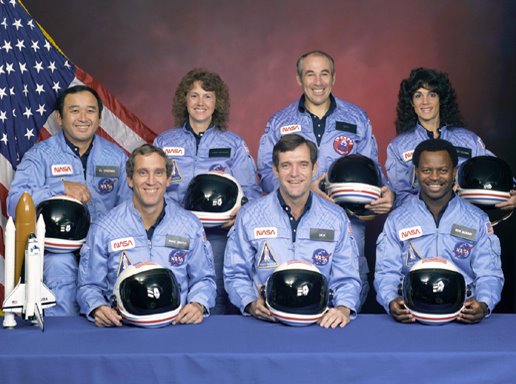
The night before the launch I was worried. Something told me this flight would not go. With the pictures of icicles hanging off Challenger and temperatures below freezing I was worried that the flight should not go. In the morning before take off I prayed. I turned on the radio to listen to the launch. The launch on the radio was only 60 seconds of live feed on CBS, and then went back to local news. I ran to the TV to turn on the launch on one of the Networks. Yes, it was still going up and still ok at that point. But 12 seconds later I saw the explosion. I felt so weak I had to sit down. I could not believe what had just happened. Challenger was gone; one of the solid rockets was still climbing. The big white cloud in the middle still there. Still no Challenger rising. I rushed to call my sister. Yes, she had seen it on TV too. Unenviable. On the west coast it was a little bit after 6 am. I was starting Ventura College that day spring semester. I was new to the campus and got lost. I eventually found my classroom and my teacher Mr. Pauley understood. We all confused that day.
Later that day I went to my Mom and Dads house for lunch. Mom was teaching Kindergarten at the time. Mom was a bit shaken up too. We all were. The nation was in mourning for our first teacher in space and her crew. We were all looking forward to Crista's lessons. Mom was excited about it, using Crista's journey into space to enrich her students. She had a traveling science cart and would go to some of the classrooms at her school to teach science.
I too was inspired and wrote many letters to the editors. Space exploration was too important to just give up because it was too risky. All the Astronauts and test pilots knew the risks. We can't just sit us humans. We must explore and reach out, Ad Astra--To the Stars! Space exploration is our own baby, even though the USSR beat us with the first manned mission. We caught up, and over took. NASA was our crowning achievement. We had it all and in 72 seconds with full throttle up Challenger reached the heavens, never looking back.
The most remembered speech that night was from President Ronald Reagan. It was to be the Presidents state of the Union speech, but canceled due to the tragedy. Instead, it was a consoling speech to a hurting nation.
....The crew of the space shuttle Challenger honored us by the manner in which they lived their lives. We will never forget them, nor the last time we saw them, this morning, as they prepared for their journey and waved good-bye and “slipped the surly bonds of earth” to “touch the face of God.”
The Challenger families have done well these 20 years. They have not let their loved ones memories fade. Space exploration is still going on. Our nation’s youth are still inspirited to explore the unknown realms of space. Thanks to the Challenger crew.
Amen. God bless the families and crew.
NASA Remberance page here.
Friday, January 27, 2006
Lieutenant Colonel Virgil Ivan "Gus" Grissom

Of the Orignial Mercury 7, I liked Gus the best. I was really young when Libery Bell was launched so I don't remember him. But when the Right Stuff came out I really admired his career and his antics in the beginning of our Manned Space program. When he was being tested to enter the Astronaut program the doctors were about to deny him because he suffered hayfever.
Without missing a beat, Grissom informed them that his allergies would not be a problem because "there won't be any ragweed pollen in space". Since no one could argue that point, they passed him on to the next series of tests.
The "Lemon" story really made me realize how the "can do" attitude at NASA was forming. Even though the spacecraft was falwed, they went ahead.
The arrival of Spacecraft 012 to the Cape only brought more problems. It soon became obvious that many designated engineering changes were incomplete. The environmental control unit leaked like a sieve and needed to be removed from the module. As a result, the launch schedule was delayed by several weeks. The Apollo simulator which was used for training purposes had its own set of problems and was not in any better shape than the actual spacecraft itself. According to Astronaut Walter Cunningham, "We knew that the spacecraft was, you know, in poor shape relative to what it ought to be. We felt like we could fly it, but let's face it, it just wasn't as good as it should have been for the job of flying the first manned Apollo mission." Nonetheless, the crew made do with what they had and by mid January of 1967, preparations were being made for the final preflight tests of Spacecraft 012.
On January 22, 1967, Grissom made a brief stop at home before returning to the Cape. A citrus tree grew in their backyard with lemons on it as big as grapefruits. Gus yanked the largest lemon he could find off of the tree. Betty had no idea what he was up to and asked what he planned to do with the lemon. " 'I'm going to hang it on that spacecraft,' Gus said grimly and kissed her goodbye." Betty knew that Gus would be unable to return home before the crew conducted the plugs out test on January 27, 1967. What she did not know was that January 22 would be "the last time he was here at the house".
(HT Gus Grissoms' Bio at NASA History by Mary C. Zornio)
Robotic Vs. Manned Space
With the grounding of the Shuttle and barely manned ISS the robots have taken over the exploring space these days. I've always felt that probes are an integral part to man's exploration of space. We use our technology to gather information. But one thing it doesn't do is let man actually experience the exploring. It’s like reading a book about the Grand Canyon instead of physically hiking down into the canyon itself. The probes explore and gather information, and answer some scientific questions. As our probes get more technically accurate at gathering information we come away with more questions than answers. Eventually man will explore the solar system and answer those questions. We can't let the probes do all of the exploring. Humankind needs the sensory experience itself.
Thursday, January 26, 2006
A day of Remembrance....
ADMINISTRATOR'S STATEMENT ON NASA'S DAY OF REMEMBRANCE
Update: Here is the website of NASA Remembers.
The following is a statement by NASA Administrator Michael Griffin on
NASA's Day of Remembrance. The Day or Remembrance honors those who
gave their lives for the cause of exploration and discovery. This
includes NASA employees, the astronauts who died in Apollo 1 and on
the Space Shuttles Challenger and Columbia.
" Today we pause to remember the loss of all of our employees,
including our Apollo 1, Challenger and Columbia astronauts, and to
honor their legacy. Nearly 50 years into the space age, spaceflight
remains the pinnacle of human challenge, an endeavor just barely
possible with today's technology. We at NASA are privileged to be in
the business of learning how to do it, to extend the frontier of the
possible, and, ultimately, to make space travel routine. It is an
enormously difficult enterprise. The losses we commemorate today are
a strong and poignant reminder of the sternness of the challenge."
Update: Here is the website of NASA Remembers.
Apollo One Crew

From left, Apollo 1 astronauts Virgil I. "Gus" Grissom, Edward White and Roger Chaffee pose in front of their Saturn 1 launch vehicle at Launch Complex 34 at the Kennedy Space Center.
Link to NASA Remembering Apollo one page here.
Link to NASA History page here were you can retrieve all the information on the mission and acident reports.
Apollo One 39 years later....

Launch Pad 34-A
HT Space.com
I remeber that Janurary day when my Mom told me about the Apollo One fire. I thought we would never get off the ground and land on the Moon. I was devistated at nine years old (same age as my KK)!
Astronauts Virgil I. "Gus" Grissom, Edward White and Roger Chaffee died during a blaze inside their Apollo capsule while conducting a countdown test on January 27, 1967 – three weeks before their scheduled liftoff from Kennedy Space Center.
A cumbersome hatch prevented technicians from rescuing the astronauts as the fire raged inside the Apollo 1 command module’s pure oxygen environment. Investigators later determined an electrical short was the fire's most likely cause. An extensive redesign of the Apollo spacecraft, with an emphasis on fireproof materials, was conducted in the wake of the tragedy. The first piloted Apollo mission, Apollo 7, took place in October 1968.
20 years ago this week
Twenty years ago this week, The Space Shuttle Challeger blew up. HT to Space.com for this article on a film on Christa McAuliffe:
Armed with gumption and bankrolled by credit cards, the pair started shooting a full-length documentary in 2001. It took five years, but they were buoyed by luck, the cooperation of McAuliffe's family and some help from the likes of Carly Simon and Susan Sarandon.
The result is a 75-minute film, Christa McAuliffe: Reach for the Stars, that was to be screened Tuesday night at Framingham State College, McAuliffe's alma mater.
“It brought her alive,'' said McAuliffe's mother, Grace Corrigan, who got an early viewing of the film. “It's was very well done.''
“What a wonderful celebration of her legacy,'' she said.
The showing commemorates Saturday's 20th anniversary of the Challenger explosion, which arrives on Saturday. More than that, it is the completion of a journey for Sotile and Godges, who started filming at Framingham State on the 15th anniversary of McAuliffe's death.
Iran to Test in March
Shameful Iran plans to test its nukes on my daughter's birthday.....
I pray we can disarm them soon.......
Hat tip to BlogsforBush and GOPBloggers.
We must move quickly to stop Iran from testing their weapons. Seriously.
Update on Iran: (HT From Captain's Quarters)
Tehran is planning a nuclear weapons test before the Iranian New Year on March 20, 2006 says a group opposed to the regime in Tehran.
I pray we can disarm them soon.......
The Foundation for Democracy citing sources in the U.S and Iran offered no further information.
The FDI quotes sources in Iran that the high command of the Revolutionary Guards Air Force have issued new orders to Shahab-3 missile units, ordering them to move mobile missile launchers every 24 hours in view of a potential pre-emptive strike by the U.S. or Israel. The order was issued Tuesday, Jan. 16.
Hat tip to BlogsforBush and GOPBloggers.
We must move quickly to stop Iran from testing their weapons. Seriously.
Update on Iran: (HT From Captain's Quarters)
Any parent whose child has a game station has to play this negotiation out at every bedtime. Until the parent finally takes the game away from the child, the negotiations never end until the game gets fully played out -- and in this case, that "game" would put nuclear weapons in the hands of radical Islamists with well-established links to terror groups. It's time for the grown-ups to take charge of the negotiations and start getting tough with the Iranians before that happens.
Saturday, January 21, 2006
Iran's Spy Satellite
With all the news about its Nuclear program Jerusalem Post now reports:
Iran is working with an Italian company to build a spy satellite, showing documents outlining the deal and still photos of meetings between Italian company officials and Iranians.
The documents, with the title "The Mesbah Project," explain what the satellite's abilities would be and what it would look like.
The Iranians are working with the Italian company Carlo Gavazzi Space, the report said. An Israeli satellite expert said Mesbah would be a simple satellite, but that the Iranians are gathering important research and development data that will allow them to independently build their own satellite in the future.
New Horizons beyond the Horizon!
With my daughter's birthday and Girl Scouts I hadn't the chance to post on the New Horizons Launch on Thursday. My four year old Megan and I watched the launch. She loved counting 10-9-8-7-6-5-4-3-2-1 Blast-OFF!
National Space Society's press release here.
And from The Planetary Society President Louis Freedman's message:
Without the "Pluto Underground" of planetary scientists in 1989 andThe Planetary Society the New Horizon probe would not have gotten off the ground. The probe was canceled twice by the Bush Administration. In 2004 the Planetary Society urged members to write to Congress to fully fund the New Horizons probe. Congress threatened to cut $55 million from the project and extend the mission time frame.
This is a great beginning to a wonderful scientific mission. I remember the Pioneer and Voyager probe missions and the scientific information it collected. Needless to say we had to re-write Astronomy Textbooks. Each time we explore our Solar System we understand it better, yet we find more mysteries to solve. Our humankind must explore, our thirst of knowledge must expand. Thanks to the "Pluto Underground" and the Planetary Society members this mission would not have gotten off the ground.
National Space Society's press release here.
"The New Horizons craft will look back in time to the birth of our solar system. It will answer fundamental questions about where we came from and what lies at the far reaches of our solar system."
And from The Planetary Society President Louis Freedman's message:
Planetary Society members, acting hand-in-glove
with the scientific community, saved this mission
to Pluto and the Kuiper belt when bureaucratic
behemoths in Washington tried to stamp it out,
claiming it was of little scientific value and
the public didn't care whether or not humanity
ever got a glimpse of these icy worlds on the
edge of our solar system.
Without the "Pluto Underground" of planetary scientists in 1989 andThe Planetary Society the New Horizon probe would not have gotten off the ground. The probe was canceled twice by the Bush Administration. In 2004 the Planetary Society urged members to write to Congress to fully fund the New Horizons probe. Congress threatened to cut $55 million from the project and extend the mission time frame.
In an impressive example of the power of the people, the U.S. Senate's Appropriations Committee approved full funding of New Horizons in the NASA budget for fiscal year 2004.
This is a great beginning to a wonderful scientific mission. I remember the Pioneer and Voyager probe missions and the scientific information it collected. Needless to say we had to re-write Astronomy Textbooks. Each time we explore our Solar System we understand it better, yet we find more mysteries to solve. Our humankind must explore, our thirst of knowledge must expand. Thanks to the "Pluto Underground" and the Planetary Society members this mission would not have gotten off the ground.
Wednesday, January 18, 2006

Pluto Probe launch delayed till Thursday
The launch of New Horizons is planned for tomarrow at 1:08 PM EST.
NASA wants to try again Thursday to launch the Atlas 5 rocket carrying its New Horizons probe after postponing Wednesday's attempt because of a power outage at a spacecraft control center in Laurel, Md. However, mission managers were to meet late this afternoon to determine if that's possible or if they'll wait until Friday.
Tuesday, January 17, 2006
Safety of the Launch
NASA has for 40 years used RTG or radioisotope Thermoelectirc generators in their spacecraft. The Plutonium dioxide fuel is contained in a fire resistant ceraminc in pellets to reduce the spread of fuel in small pieces. If the ceramic does fracture, it will do so in larger pieces or chuncks that would be easier to recover. Then protective layers of iridum capsule amd high-strength grahite blocks contain the fuel reducing the spread of plutonium dioxide.
Needless to say, I believe even if an accident did occur the plutonium whould be self-contained and easy to recover with little damage to living organisms. We would not have a disaster such as Chernobyl.
Saftey plans are at the Cape here.
Needless to say, I believe even if an accident did occur the plutonium whould be self-contained and easy to recover with little damage to living organisms. We would not have a disaster such as Chernobyl.
The launch had drawn protests from anti-nuclear activists because the spacecraft will be powered by 24 pounds of plutonium, which will produce energy from natural radioactive decay.
NASA and the U.S. Department of Energy have put the probability of an early-launch accident that could release plutonium at 1 in 350. The agencies have brought in 16 mobile field teams that can detect radiation and 33 air samplers and monitors.
"Just as we have ambulances at football games, you don't expect to use them, but we have them there if we need them," NASA official Randy Scott said.
Saftey plans are at the Cape here.
New Horizon's Launch blog
Florida Today is live Blogging here.
Live coverage is here.
Update--Right now the winds are at the launch limit of 30 - 35 knots at 12:15 PM EST. Watch out for next wind predictions. Exactly one hour to launch T - 60 mins.
2:15 EST--Launch delayed till 2:30 PM. Upper level and ground winds data taken. Antiqua tracking station is down. Should be up and ready for launch at 2:30 PM.
2:53 EST--Launch is moved to 3:05 PM if all winds are within limits. The launch window will close at 3:23 PM est for today. Cross your fingers!
3:00 EST--Launch moved to last time available, 3:23 pm. Studying the winds with new software installed. Polling data is ok.
3:21 EST-- NO Go on Launch, Red line monitor fault--Scrub it today! 24 hours till next launch.
Live coverage is here.
Update--Right now the winds are at the launch limit of 30 - 35 knots at 12:15 PM EST. Watch out for next wind predictions. Exactly one hour to launch T - 60 mins.
2:15 EST--Launch delayed till 2:30 PM. Upper level and ground winds data taken. Antiqua tracking station is down. Should be up and ready for launch at 2:30 PM.
2:53 EST--Launch is moved to 3:05 PM if all winds are within limits. The launch window will close at 3:23 PM est for today. Cross your fingers!
3:00 EST--Launch moved to last time available, 3:23 pm. Studying the winds with new software installed. Polling data is ok.
3:21 EST-- NO Go on Launch, Red line monitor fault--Scrub it today! 24 hours till next launch.
Monday, January 16, 2006
Pluto's new moons
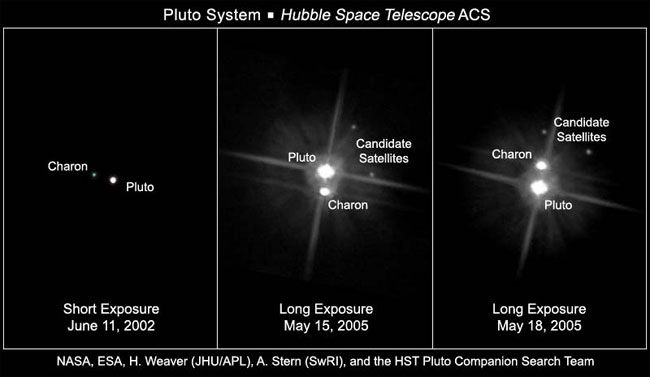
Even before New Horizons rockets off Earth, Pluto has done its best to keep scientists guessing about the far-flung planet and Charon, a companion moon. Last month, NASA announced that the Hubble Space Telescope had observed that Pluto may have not one, but three moons.
New Horizons Buddies
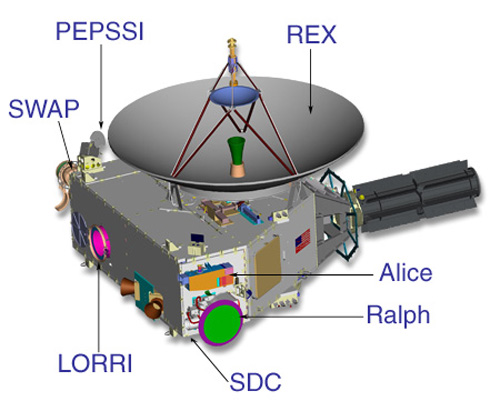
To Pluto, Alice! (HT from New Horizons website).
Ralph's main objectives are to obtain high resolution color maps and surface composition maps of the surfaces of Pluto and Charon. The instrument has two separate channels: the Multispectral Visible Imaging Camera (MVIC) and the Linear Etalon Imaging Spectral Array (LEISA). A single telescope with a 3-inch (6-centimeter) aperture collects and focuses the light used in both channels.
Alice is an ultraviolet imaging spectrometer that will probe the atmospheric composition of Pluto. A "spectrometer" is an instrument that separates light into its constituent wavelengths, like a prism, only better. An "imaging spectrometer" both separates the different wavelengths of light and produces an image of the target at each wavelength.
REX is an acronym for "radio experiment," - it is really just a small printed circuit board, containing sophisticated electronics, integrated into the New Horizons radio telecommunications system. All communication with New Horizons, including the downlink of science data, takes place through the radio package, which makes it critical to mission success.
The instrument that provides the highest spatial resolution on New Horizons is LORRI - short for Long Range Reconnaissance Imager - which consists of a telescope with a 8.2-inch (20.8-centimeter) aperture that focuses visible light onto a charge coupled device (CCD). LORRI has a very simple design; there are no filters or moving parts. Near the time of closest approach, LORRI will take images of Pluto's surface at football-field sized resolution, resolving features approximately 100 yards or 100 meters across.
The Solar Wind Analyzer around Pluto (SWAP) instrument will measure charged particles from the solar wind near Pluto to determine whether Pluto has a magnetosphere and how fast its atmosphere is escaping.
Another plasma-sensing instrument, the Pluto Energetic Particle Spectrometer Investigation (PEPSSI), will search for neutral atoms that escape Pluto's atmosphere and subsequently become charged by their interaction with the solar wind.
The last scientific instrument on New Horizons is an Education and Public Outreach project. The Student Dust Counter (SDC) will count and measure the sizes of dust particles along New Horizons' entire trajectory, which covers regions of interplanetary space never before sampled. Such dust particles are created by comets shedding material and Kuiper Belt Objects colliding with one another. The SDC is managed and was built primarily by students at the University of Colorado in Boulder, with supervision from professional space scientists.
Moon rock samples stolen
An educator's car in Virgina Beach, VA had their car broken into and briefcase stolen containing Moon rocksamples . I say check e-bay.

Sunday, January 15, 2006
Stardust Returns

Stardust has landed in the Utah desert and the cosmic samples are safe. They have been taken to the clean room for inspection. Great job on recovery!
Saturday, January 14, 2006
New Horzion launch ok'd
The launch is ok to go on Tuesday. On the Space Politics page has a good round up on the anti-nuke protests about the launch.
Friday, January 13, 2006
Iraqi Marshes
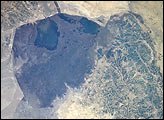
Iraqi Marshes were drained during Saddam’s regime to combat the Marsh Arabs. The “fertile crescent” is the birth place of Abraham, Babylon and the Garden of Eden. With the fall of Saddam the Marshes are being reborn by the Marsh Arabs coming back to the area and efforts in Iraq to refill the marshes. Here is a picture of the marshes in 2001 from NASA.
Hat tip to the Anchoress . I love to read her blog. It inspired me to go find a satellite picture of the area.
Here is the website for the reclamation of the marshes, called Eden Again.
Thursday, January 12, 2006
Two year Aniversary for Vision
NASA Chief Griffins statement:
"Two years ago this week, President Bush committed our nation to the
Vision for Space Exploration. This Vision commits America to a
journey of discovery and exploration with new and exciting plans to
return astronauts to the moon. From there, to voyage to Mars and
beyond, while continuing to engage in groundbreaking space science
and pioneering advances in innovation, creativity and technology.
Together with the partnerships we have in the International Space
Station program, our nation has the tremendous opportunity and solemn
responsibility to lead the way toward the dawn of a new space age."
Stardust Observers

If you are Northern California or the Pacific Northwest you will be able to see the Stardust capsule re-enter the earth's atomosphere on Jan. 15 (Mid-night - 1 am). You can sign up to contribute your pictures here.
Wednesday, January 11, 2006
Calling all Volunteers
I just found this wonderful program with the return of Stardust this weekend. In March volunteers will be able to help out on the project by inspecting the 1.5 million aerogel samples for interstellar dust. Discover a dust grain sample and you'll get to name it.
Volunteer scanners must pay close attention to aerogel images to pick out dust tracks from false signals. and must first pass an initial test using sample pictures, project officials said.
“We will throw in some calibration images that allow us to measure a volunteer’s efficiency,” Westphal said.
Westphal estimates that some 30,000 man-hours will be required to go through each image from Stardust’s aerogel sample return capsule four times.
Tuesday, January 10, 2006
Launch next week of Pluto Probe
The long awaited mission to Pluto will be launched next week, Janurary 17, 2006. The probe is called New Horizons and will explore Pluto-Charon and the Kepler belt. It will arrive at Pluto in 2015, nine years from now.
Interesting facts about Pluto and Charon from this article.
-The surface tempature for Pluto is about about 43 K (-382 degrees F)and Charon is 53 K (-364 degrees F). It is the coldest body in our solar system.
- Pluto can be as close to the sun as 30 astronomical units (AU) and as far away as 50 AU.
Interesting facts about Pluto and Charon from this article.
Scientists continue to discuss whether Pluto is a planet or should be considered a refugee from the Kuiper belt. Whatever its classification, Pluto and its moon Charon are certain to harbor secrets about the early history of planet formation. Charon is roughly half the diameter of the planet itself, and they form a unique pair in our solar system. How they came to be together remains a mystery.
-The surface tempature for Pluto is about about 43 K (-382 degrees F)and Charon is 53 K (-364 degrees F). It is the coldest body in our solar system.
- Pluto can be as close to the sun as 30 astronomical units (AU) and as far away as 50 AU.
Monday, January 09, 2006
Pioneer Anomoly
I heard Bill Nye talk about the Pioneer Anomoly back in July 2005 at the Comet Bash. It apears the Pioneer Probes are speeding up rather than slowing down as they exit the Solar System. JPL engineer John Anderson held back on this information for almost ten years (From a Seattle Times article) Three reasons could be:
Too bad Pioneer 11 in 1995 communication stopped, Pioneer 10 last communication was in 2003. To fully study this Anomoly is to send another probe, but NASA has said no and ESA won't send one untill 2015. Most JPL Pioneer project scientist's won't be around to look at the data.
One possibility is that dark matter is holding the spacecraft back. Some cosmologists believe dark matter exists because only 10 percent of the expected mass of the universe has been found. If 90 percent of the universe's mass and energy is invisible, maybe it could exert gravitational pull on spacecraft.
Another possibility, even more fanciful, is that invisible dimensions are tugging at the Pioneers. This idea has its origin in string theory, a two-decade-old school of thought that suggests we are surrounded by more than the three dimensions we know about. Some versions of string theory suggest there could be as many as 11 dimensions, most of which are curled up and hidden from us.
A third possibility is that gravity has been hiding secrets that three centuries of research have failed to uncover.
Too bad Pioneer 11 in 1995 communication stopped, Pioneer 10 last communication was in 2003. To fully study this Anomoly is to send another probe, but NASA has said no and ESA won't send one untill 2015. Most JPL Pioneer project scientist's won't be around to look at the data.
Stardust is coming back with Comet samples
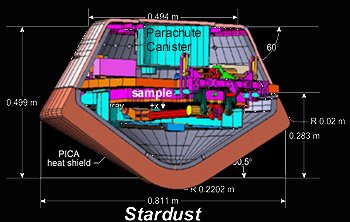
Stardust was launched in 1999 to collect a sample from Wild-2 and it will be returning around January 15th.
In the early morning hours of January 15, 2006, the Stardust mission returns to Earth after a 4.63 billion kilometer (2.88 billion mile) round-trip journey carrying a precious cargo of cometary and interstellar dust particles. Scientists believe Stardust's cargo will help provide answers to fundamental questions about the origins of the solar system.
Update: Here are some facts about the probe,
STARDUST KEY FACTS:
-- The Stardust spacecraft was launched on February 7, 1999, from Cape Canaveral Air Station, Florida, aboard a Delta II rocket.
-- The probe collected dust and carbon-based samples during its encounter with Comet Wild 2 on January 2004, after nearly four years of space travel.
-- Stardust is bringing back samples of interstellar dust, including recently discovered dust streaming into our Solar System.
-- The capsule will re-enter Earth's atmosphere and parachute to the ground in the Utah Test and Training Range, landing on January 15, 2006, at 5:12 a.m. ET.
Source: NASA
The recovery team website and landing site directions is here.
Tuesday, January 03, 2006
New Year and NASA
With StarBaseOC's Blog Aniversary coming in February, I would like to focus on the Moon, Mars and the Vision to renew interest in the exploration of space.
Here is an editorial on NASA's Budget in 2007 NYT.
We have to work hard at lobbying and writting letters to get all of the Vision funded.
Happy New Year!
Here is an editorial on NASA's Budget in 2007 NYT.
But authorization bills do not actually provide money. The real test will come when President Bush submits his budget proposal for fiscal year 2007 in February, and Congressional appropriations committees decide how much money they are willing to put up. If it is significantly less than NASA needs for its assigned tasks, the agency and Congress will need to curtail some of them, lest NASA fall into the old trap of cutting corners and jeopardizing safety. From our perspective, the costly shuttle and the space-station complex look more expendable than pathfinding robotic probes of the solar system and a transition to new manned space vehicles.
We have to work hard at lobbying and writting letters to get all of the Vision funded.
Happy New Year!
Impact on Moon
On Drudge this morining, "Nasa team sees explosion on Moon". A meteoroid crashed into the Moon in the Sea of Rains, Mare Imbrium.
Rob Suggs of Nasa's Marshall Space Flight Center in Huntsville, US, was testing a new 10-in telescope and video camera they assembled to monitor the moon for space strikes.
On 7 November, his first night using the telescope, he observed one.
Renewed interest
"People just do not look at the moon anymore," said Dr Suggs, of Marshall's engineering directorate.
"We tend to think of it as a known quantity. But there is knowledge still to be gained here."
Monday, January 02, 2006
Two Year Aniversary
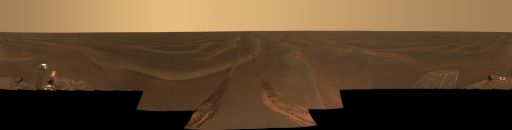
I'm still amazed at those Mars rovers, they are still working on Mars. They have travled a total of 7 miles on Mars' surface so far.
Sunday, January 01, 2006
TS Zeta the 27th Storm
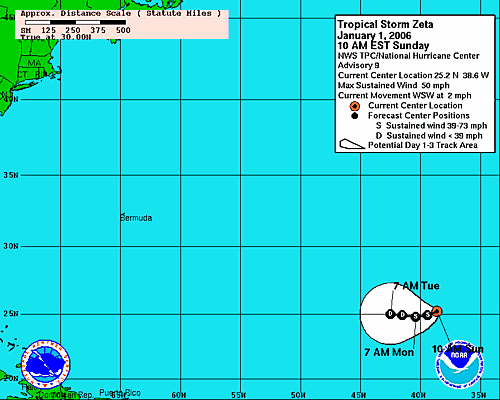
The storm season is still going into the New Year! As Northern California is getting drenched, the Alantic is still churning Storm systems here.
Zeta had top sustained wind of about 50 mph, according to the National Hurricane Center. Forecasters said it was not expected to become a hurricane or threaten land.
Friday, December 30, 2005
China: To the Moon Alice!
China's space program wants to go around the Moon by 2007 in an un-manned capsule. (Their rockets look like Russian clones to me.) They target 2020 for a manned flight. NASA in the Vision plan to do another manned landing by 2018.
Also in today's Orange County Register has an article on rules for space tourists here.
Also in today's Orange County Register has an article on rules for space tourists here.
Tuesday, December 27, 2005
More Rings around Uranus


Friday, December 23, 2005
NASA reauthorization bill
I'm glad that the Senate passed legislation to fund the "Vision for Space Exploration.". Much has been said and done this week on the "Patriot Act" that Space was not on the MSM's radar.
The focus will be to return to the Moon, Shuttle until 2010 and finishing the International Space Station.
The bill will now go to President Bush to sign. I'm glad something positive came out of our lovely legislators this week!
Merry Christmas and Happy New Year to all! Space exploration will defantly be a good in 2006 and the future years. The Moon and Mars will be ours!
The focus will be to return to the Moon, Shuttle until 2010 and finishing the International Space Station.
"Our national policy will determine the nation's role in future space exploration and its contribution to broad research and our national security," Texas Republican Kay Bailey Hutchison, chairman of the Senate Commerce Subcommittee on Science and Space, said in a statement.
The bill will now go to President Bush to sign. I'm glad something positive came out of our lovely legislators this week!
Merry Christmas and Happy New Year to all! Space exploration will defantly be a good in 2006 and the future years. The Moon and Mars will be ours!
Beagle Found
The Mars Global Surveyor found evidence the Beagle 2 did land with the air bags deployed. Pictures of the airbag tracks were found. Beagle might have landed on its side damaging equipment so it could not communicate back to Earth.
Thursday, December 01, 2005
Foam on External tank showed cracks
I've been lax in keeping up on Space news and such. I ran by this article onCNN before thanksgiving on the Shuttle and the crack problems on the external tanks.
"How do these cracks that we've found figure into that? We don't know," said John Chapman, manager of the External Tank Project at NASA's Marshall Space Flight Center. "It would certainly be premature to say the cracks play a factor in that. We don't know that right now. But they might."....
NASA is still conducting tests to determine if the tank incurred cracks during testing and if the tank Discovery actually used had similar cracks.
"We haven't found any eureka, or smoking gun so far," Chapman said.
Thursday, November 17, 2005
Iran's Sina-1 can spy on Israel
About a year ago I found about about Iran's so called scientific space program. Now Sina-1 will be launched next month. It's main purpose is to monitor damage done by disasters such as earthquakes. However, it will pass
"14 times a day from an altitude around 600 miles, with controllers able to point its cameras as they wish, Sina-1 gives Iran a limited space reconnaissance capability over the entire Middle East, including Israel."
Wednesday, November 16, 2005
Scotty's ashes blasted to space delayed
The Falcon X has been grounded due to technical problems. Too bad Scotty couldn't be here to figure it out.
Sunday, November 13, 2005
Wake up Call from Sir Paul
Last night at Paul McCartney's concert at the Anaheim Pond gave a wake up call to the ISS crew here.
Friday, November 11, 2005
Star Trek Phasers a reality?
An interesting article in Stars and Stripes about "a new laser-based, nonlethal weapon designed to temporarily blind aggressors."
BTW Happy veterans day! Support your local veteran and the troops.
BTW Happy veterans day! Support your local veteran and the troops.
Friday, October 28, 2005
Wilma Damages Pluto Probe
The New Horizons spacecraft was in a horizontal position in a hangar at Kennedy Space Center. The door to the hangar is a cloth rolling door and can withstand 145 mph winds. Apparently Wilma blew the door open causing slight damage to the Atlas 5 rocket. It should be ready for launch around January 11, 2006.CNN story here.
Monday, October 24, 2005
KSC closed due to WilMa

The cape is closed today due to Wilma. Here is the Space Ref news release.
NASA's Hurricane page for 2005 has more pictures from GOES here.
Thursday, October 20, 2005
Wilma heads toward KSC

Now we have to watch for Wilma to hit the Cape. HT NASA Watch here. I worry about the space program being cut from the budget because of Katrina and Rita. Now comes WIL-MA!
Last Titan Launch at VAFB
Yesterday was the last launch of the Titan rocket with a secret payload. This was the 368th launch of the Titan in the US and 200th from VAFB. Lockheed Martin's Atlas 5 and Boeing's Delta 4 will replace the Titan. It's the end of an Era.
Thursday, October 13, 2005
Pakistan Earthquake

Here is a picture from space.com on the earthquake in Pakistan. I just wonder if OBL and his buddies got buried there?
Satellite Lost
Here is the picture on the space.com site on the satellite launched from a Russian sub last week here.
Wednesday, October 05, 2005
NASA workers could have damaged the foam on the tank
Workers could have caused the damage to the foam on the external shuttle tank. CNN story here.
Monday, September 26, 2005
JSC received little Rita Damage

Johnson Space center received little damage during Hurricane Rita. All employees have leave until Tuesday.Here is the NASA link to RITA images.
Global Warming debate
I really laugh at some of the press and their "stuck on stupid" responses to the recent hurricanes and the global warming debate. I really think they should take some science courses or enlist some scientist types to report on science news. I googled for William Grey at Colorado State to get his forecasting for the current hurricane season. He has been studying the climate and its cycles for 40 years. I tend to believe the experts than the "celebrities" and leftist greenies that claim hurricanes are the cause of global warming. Dr. Gray said that if we were experiencing global warming then the activity of all Hurricane/Cyclone areas would show increased activity. No such activity is occurring. We are in a cycle of 25 - 50 years of an upswing in storms. Here is an except from his report:
The 1995-2005 Upswing in Atlantic Hurricanes and Global Warming
Many individuals have queried whether the unprecedented landfall of four destructive hurricanes in a seven-week period during August-September 2004 and the landfall of two more major hurricanes in the early part of the 2005 season is related in any way to human-induced climate changes. There is no evidence that this is the case. If global warming were the cause of the increase in United States hurricane landfalls in 2004 and 2005 and the overall increase in Atlantic basin major hurricane activity of the past eleven years (1995-2005), one would expect to see an increase in tropical cyclone activity in the other storm basins as well (i.e., West Pacific, East Pacific, Indian Ocean, etc.). This has not occurred. When tropical cyclones worldwide are summed, there has actually been a slight decrease since 1995. In addition, it has been well-documented that the measured global warming during the 25-year period of 1970-1994 was accompanied by a downturn in Atlantic basin major hurricane activity over what was experienced during the 1930s through the 1960s.
We attribute the heightened Atlantic major hurricane activity between 1995-2005 to be a consequence of the multidecadal fluctuations in the Atlantic Ocean thermohaline circulation (THC) as we have been discussing in our Atlantic basin seasonal hurricane forecasts for several years. Major hurricane activity in the Atlantic has been shown to undergo marked multidecadal fluctuations that are directly related to North Atlantic sea surface temperature anomalies. When the Atlantic Ocean thermohaline circulation is running strong, the central Atlantic equatorial trough (ITCZ) becomes stronger. The stronger the Atlantic equatorial trough becomes, the more favorable are conditions for the development of major hurricanes in the central Atlantic. Since 1995, the THC has been flowing more strongly, and there has been a concomitant increase in major hurricanes in the tropical Atlantic.
Thursday, September 22, 2005
Rita Closes Johnson Space Center
The Johnson Space Center closed yesterday due to Hurricane Rita coming to shore. ISS operations have been transferred to Moscow Space Center. A team of NASA techs are on hand there. NASA's link to RITA here.
Subscribe to:
Posts (Atom)